

All Blacks and Blues wing Caleb Clarke is again using the summer break to upskill himself with a rival oval ball code in Australia – this time with the Sydney Swans AFL club.
“Same grind, different arena,” Clarke posted on his Instagram page recently alongside images of him going through his paces with the team while decked out in its red training kit.
Clarke, a big fan of the South Sydney rugby league club, has previously trained with the Rabbitohs over the off-season for general conditioning.
The 26-year-old’s visit at the Aussie Rules club will likely improve his fitness – players in that code have to survive notorious running tests – but also his aerial game which is a relative strength of his but a general weakness for many of his All Blacks’ teammates last year.
The All Blacks’ inability to consistently claim the ball in the air were factors in all three of their defeats last year to the Springboks, Argentina and England. The latter, a comprehensive 33-19 defeat at Twickenham, ruined their chances of an historic Grand Slam.
Changes to the laws penalising defending players from blocking chasers has made for a more even contest for the ball; an unintended consequence is that there is now a lot more kicking in Test rugby and the All Blacks have not adapted well.
After the England Test, Clarke said: “They’ve taken away the protection. In the past we’ve had the time and the space to get up and take the ball cleanly whereas now it’s a competition.
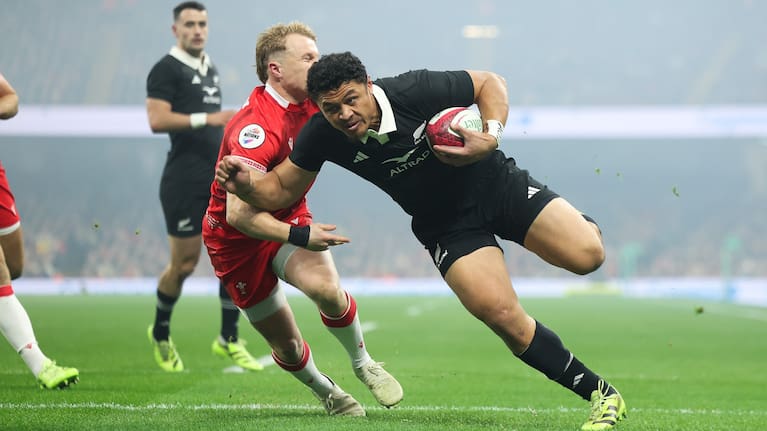
“Looking at the English wingers, they were trying to put out their hand and interrupt the catch. It’s on us to get our hands high and catch the ball cleanly and getting back to those fundamentals.”
There are few better in the world at claiming high kicks than Aussie Rules players – a skill that is largely replicated in the top league and union sides in Australia.
Sydney Swans coach Dean Cox worked with the All Blacks before the Ireland Test in Chicago, but more long-term specialist support in this area for head coach Scott Robertson and his assistants would undoubtedly be beneficial ahead of a gruelling Test year in 2026 which features four Tests against the Boks.
The All Blacks’ review into their year, which was characterised by inconsistency and was notable for the departure of another assistant coach – Jason Holland – will have raised the team’s aerial flaws which were exposed by the Boks in a record defeat in Wellington in September.
“At half-time, we came in and felt like we’d left a few opportunities out there, but in the second-half they won the aerial battle, won the scraps and then we gave away too many penalties around the set-piece,” Robertson said after that Test. “The game got away.
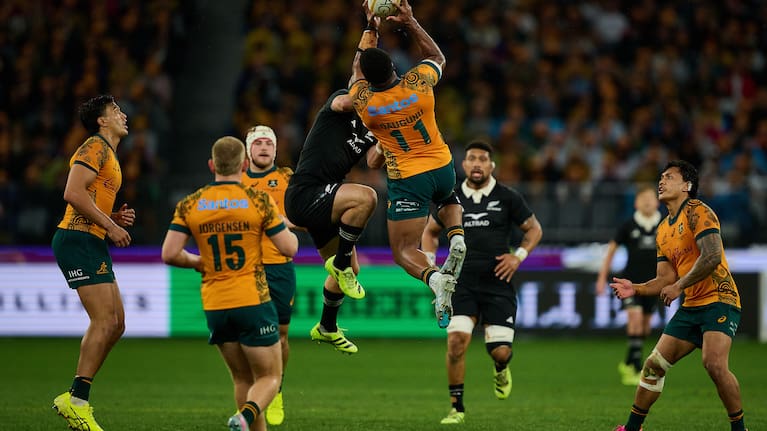
“If it was the preparation, we probably would have seen the signs early. I have to say, South Africa have probably been criticised for their kicking game over the years, but they put so much value and time into it and they get return on it, they’re so good at it. We’ve done a lot of prep on it, but they just owned that area and put so much pressure on us. They know their DNA.”
Potentially complicating matters is that New Zealand Rugby, already searching for a new chief executive after Mark Robinson’s departure, must now also find a new high-performance manager after the resignation of the long-serving Mike Anthony, who is leaving to join the Brighton football club in the English Premier League.
Robertson will require a replacement for Holland, a backs strike coach, at the very least.
A potentially interesting development in France concerns Ronan O’Gara, a former Ireland first-five, who impressed while coaching alongside Robertson at the Crusaders in 2018 and 2019.
O’Gara, the head coach of French club La Rochelle, is under pressure after several underwhelming performances in Europe recently and is set for “crisis talks”, according to local media.