

Two more NHS trusts have declared critical incidents due to intensifying pressures as a result of winter flu and winter bugs like norovirus.
Nottingham University Hospitals (NUH) Trust and Sherwood Forest Hospitals NHS Foundation Trust both said the demand for treatment and beds has forced them to take action over the already busy winter period.
NUH said it is facing “severe and sustained pressure” on its services, with rising demand, winter infections and staff sickness blamed for delays in its emergency departments and wards.
The trust said it is regularly seeing more than 500 patients a day at the Queen’s Medical Centre (QMC) emergency department, which is designed to treat 350 patients a day.
The busiest day of the year so far was 7 January, when 550 patients attended the emergency department, NUH said.
Six NHS trusts have now declared critical incidents. (PA)
Meanwhile, Sherwood Forest Hospitals NHS Foundation Trust said in a statement on Facebook that it had also declared a critical incident because it was seeing “insufficient discharges to meet the demand of patients waiting to be admitted”.
Staff are working under extreme pressure, patients are facing lengthy waits in hospital corridors, and demand for hospital beds has exceeded all the trust’s modelling since Christmas, it added.
It comes after four NHS trusts declared critical incidents on Monday (12 January) following a “surge” in complex A&E admissions.
The full list of NHS hospital trusts with critical incidents
The latest critical incidents come in the same week that four other hospital trusts declared their own critical incidents.
The full list of trusts are:
Royal Surrey NHS Foundation Trust
Epsom and St Helier University Hospitals NHS Trust
Surrey and Sussex Healthcare NHS Trust
East Kent Hospitals University NHS Foundation Trust
Nottingham University Hospitals
Sherwood Forest Hospitals NHS Foundation Trust
What is an NHS critical incident?
An NHS critical incident is declared when hospitals or trusts are no longer able to deliver all their services safely due to extreme pressure.
It signals that the hospital’s resources are stretched to the point where there is a significant impact on patient care, safety or levels of staffing.
A critical incident can often be the result of things like a surge in demand for services – such as during a period of widespread illness – or major accidents, IT failures or severe weather.
Patients are urged to not visit A&E unless absolutely necessary during a critical incident. (PA)
Declaring a critical incident allows NHS trusts to take immediate steps – such as prioritising patients with life-threatening conditions, cancelling non-urgent appointments and operations, restricting visitors to avoid the spreading of illness and moving staff to high-need areas.
During a critical incident, people are urged to use the NHS 111 line instead of visiting A&E and only ringing 999 in life-threatening situations.
Winter viruses ‘bounce back’
Figures from the NHS showed that people in hospital beds with flu in England averaged 2,924 each day during the week ending 4 January – up 9% from 2,676 the previous week.
The figure had previously been on a downward trend, after reaching 3,140 in the week ending 14 December.
But NHS England said that a combination of Christmas and new year gatherings may have caused a “bounce back” in winter viruses such as flu.
The recent cold spell, which saw snow fall across large parts of the country, may also have contributed to an uptick in admissions, with injuries from icy conditions also adding to the pressure inside hospital wards.
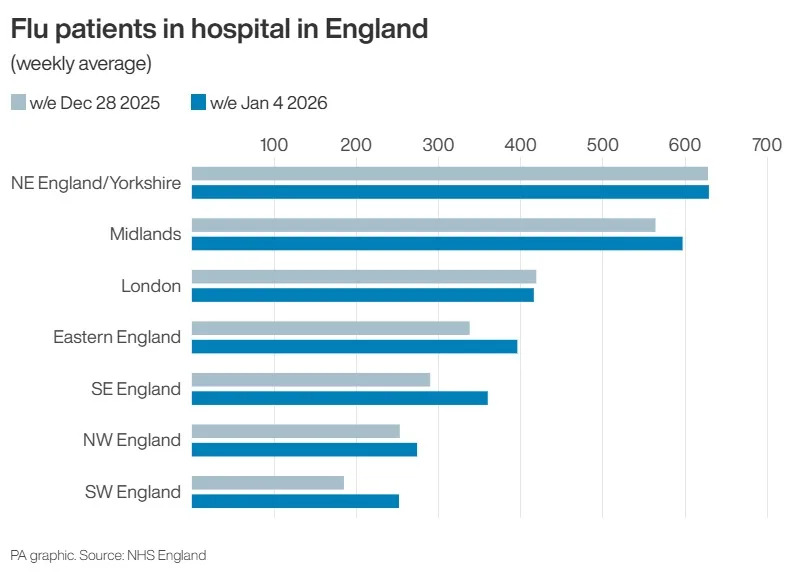
Flu patients in hospital in England, by region. (PA)
NHS national medical director professor Meghana Pandit said: “It’s clear that the worst is far from over for the NHS this winter, with hospitals again experiencing a rise in patients admitted with flu and other respiratory virus cases last week.
“The cold weather also means we are also seeing more vulnerable patients with respiratory problems in A&E and more injuries from slips and falls due to the icy conditions, so it remains an extremely busy time.”
Rory Deighton, acute and community care director at the NHS Confederation, added: “Flu levels are again on the rise and this, coupled with increasing bed occupancy and delayed discharges, shows that there is still a long way to go before this difficult winter is over.
“Other seasonal viruses such as norovirus and COVID are also increasing alongside staff sickness levels.”