
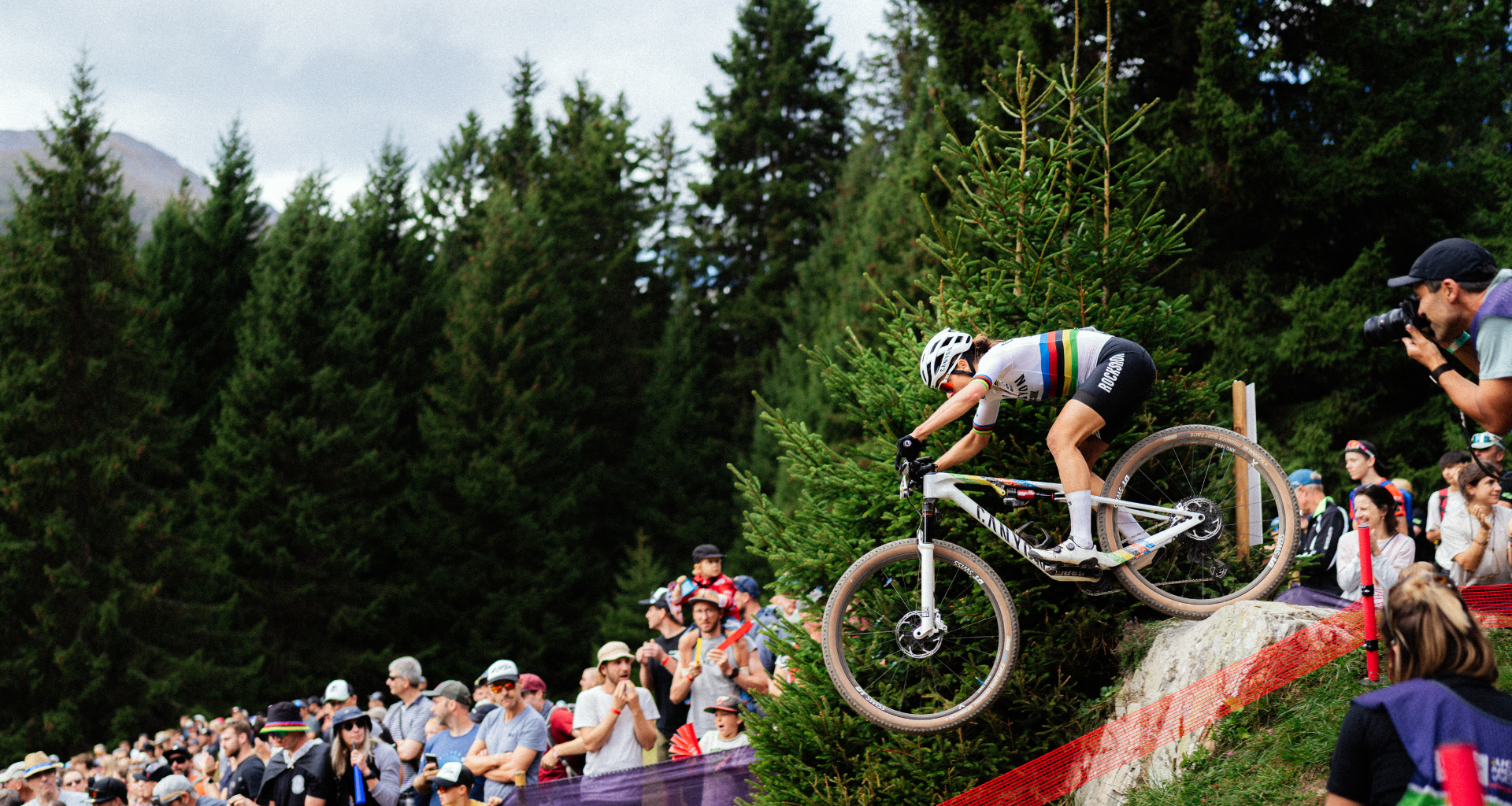

World Cup XC courses are no longer just about testing riders. They’re designed for TV, built under tight constraints, and shaped by forces most fans will never see.

Piper Albrecht, Scott-SRAM
Cross-country mountain biking is such a vivid spectacle on TV; riders hurl through forests, over rocks, and sprint up climbs as if they’ve struck a deal with gravity. But what fans rarely see is the invisible hand, shaping every climb, jump, and camera placement. Behind the trail lies a tangle of rules, politics, and broadcast pressures – all decided before an ounce of dirt is moved.
The 2025 World Cup calendar expanded to 10 rounds across familiar, established tracks. But 2026 brings three new stops – South Korea, La Thuile (Italy), and Soldier Hollow (USA) – each promising a fresh taste of XC racing. To see how these courses come to life, I spoke with Simon Burney, a longtime former team manager and UCI mountain bike coordinator and now head of mountain biking at Warner Bros Discovery (WBD), which owns the series’ worldwide broadcast rights); Paul Beales, WBD’s sport manager for endurance mountain bike racing; and Lenzerheide course builder Benji Otto.
As we’ll learn, modern XC courses aren’t simply created with the aim of testing riders – they are becoming increasingly engineered to produce specific racing narratives for broadcast.
Who really shapes the race?
While WBD and local course builders are responsible for delivering each World Cup, no design work begins without first satisfying the regulations set out by the UCI. These rules exist to protect the core identity of cross-country racing and ensure consistency across the season, but they are not fixed. Instead, they have continually evolved alongside the sport.
As Burney explained, “We only have to go back a few years, and the lap length was between six and eight kilometres.” In the following years, this has come down to between four and six kilometres, settling now on a minimum of 3.5 km.
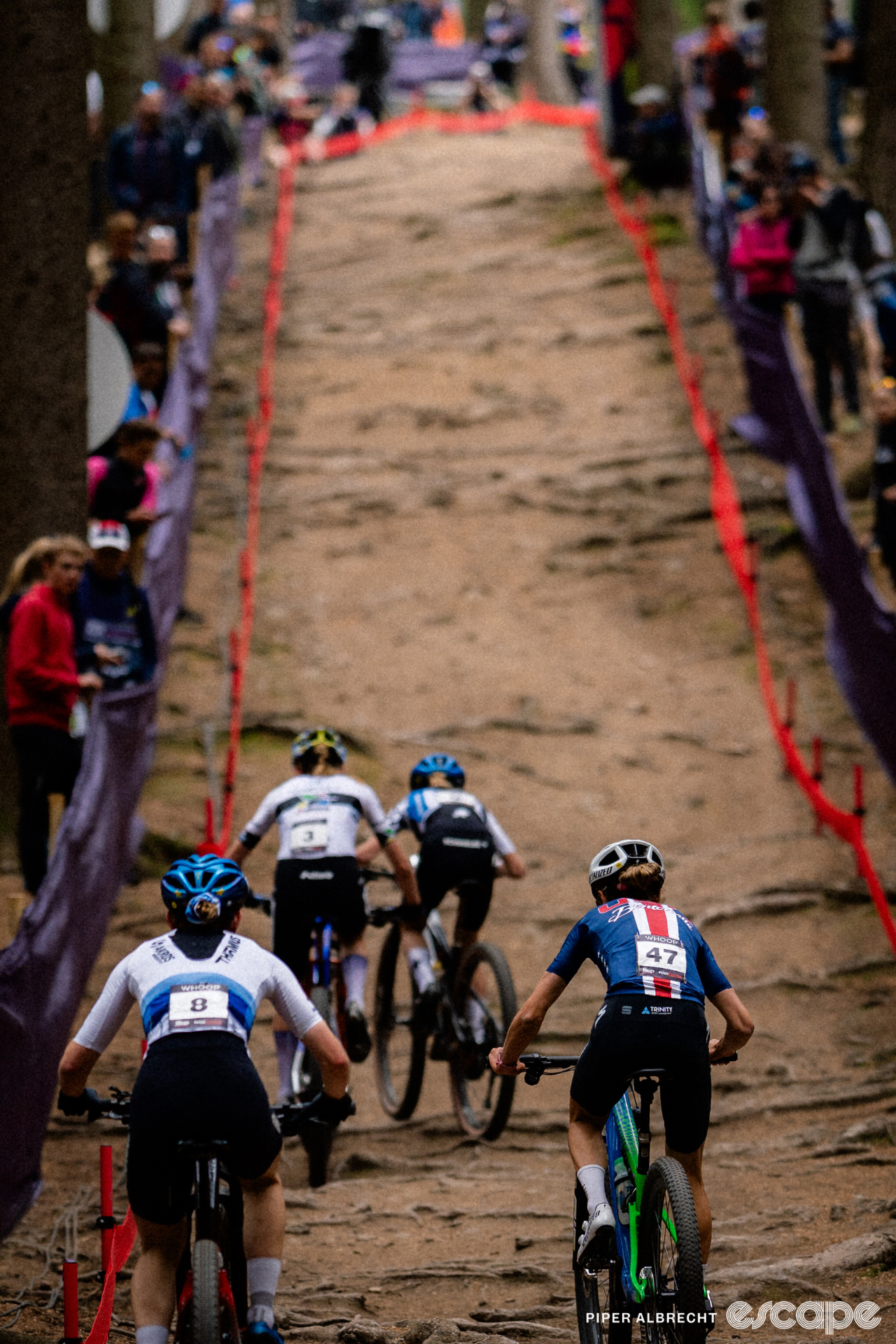 Course designers at Nové Město can tweak the course with accuracy that allows for a lap to grow or shrink in time as needed.
Shorter laps aren’t just an aesthetic choice; they solved a timing problem. Eight-kilometre circuits could balloon past target durations in bad conditions; shorter laps make race timing more predictable. As XC World Cups shifted from two-hour endurance tests to sub-90-minute races, tighter control over total race time drove the change.
At experienced venues like Nové Město, small tweaks can help to drive specific outcomes. “If we need a lap 30 seconds longer to give us another few minutes on a race, the builders understand how to do that,” Burney explained.
This post is for paying subscribers only
Subscribe now
Already have an account? Sign in
Did we do a good job with this story?
👍Yep
👎Nope