
I was provocative this week when I wrote a piece about WorldTour team funding and equipment. I didn’t anticipate how viscerally some of you would react to the suggestion that “the UCI should ban selling pro bikes to customers” – but perhaps that proves the point that pro cycling and ordinary cycling are still deeply wrapped up in one another.
There was a heady mix of outrage, humour and frustration, and amongst the worst of it – one guy called me a nasty name – there was also some thoughtful reflection.
For others, my words were a clumsy but worthwhile attempt to question whether the way pro cycling is funded – and marketed – is still fit for purpose.
You may like
This was never an argument about telling people what they are and aren’t allowed to ride. As one commenter put it bluntly: “Cycling is as expensive as you make it.”
I can’t argue with that, it’s true and always has been. Nobody is forced to buy a £12,000 bike. Shimano 105 and SRAM Rival is, as another reader noted, “a million times better than what we used in the 80’s and in real dollars, cheaper.”
The question I was asking – clumsily for some – was not about consumer freedom, but about whether the current ‘race it on Sunday, sell it on Monday’ model is still a viable one.
Who funds WorldTour cycling?
Some readers pointed out that bike sales don’t fund WorldTour teams, which is true, everything from supermarkets to chemical companies do.
“Your premise is flat out wrong. No pro team is funded primarily by the bike sponsor,” wrote one reader. Another added: “The money comes from insurance companies, supermarket chains, chemical conglomerates, and nation-states trying to convince potential tourists that they won’t be beheaded if they visit on holiday.”
Whilst I won’t comment on the more colourful end of that statement, the comment is absolutely correct in that WorldTour teams are overwhelmingly funded by non-cycling sponsors: Ineos, Lidl, Soudal, Intermarche, etc. Bike manufacturers contribute relatively little to the overall team budgets, especially when compared to rider salaries and staff costs which account for roughly 60% of expenditure.
However, I don’t think that reality undermines my argument; it strengthens it. You can’t get blood out of a stone as they say, and you can’t make more from sponsorship without offering more, commercially.
You may like
Bike brands don’t always fund teams directly, but their entire commercial justification for being there is still rooted in selling the products they bring to the race, through association. Credibility, aspiration, halo effect – call it what you like – but it remains a sales-led model. And that model comes with consequences, like incremental upgrades, accelerating cycles.
“Perhaps the problem is with the margins cycling companies charge on increasingly shorter time frames,” one commenter perceptively wrote. “They seem to charge more for incremental upgrades that are released with greater frequency.”
The system is geared up to make that the norm. The UCI requirement that everything raced must also be sold pushes manufacturers into a relentless cycle of new aero claims, marginal gains, and annual range-refreshes. The tech isn’t the problem. It’s the commercial pressure that comes with it.
As a result, the WorldTour increasingly is a fancy and endless catalogue, rather than a sporting property whose value exists independent of what’s bolted to the bikes. Decouple the product development and product strategy from the racing, and you could free up a ton of resources to help grow the sports appeal, through greater brand value.
People want to buy what they see
“Great way to kill the sport. People want to buy what they see,” one person wrote. “If a person wants to buy Tadej’s bike, why not give him that freedom?”
I love riding pro bikes when I get the chance, and I’d love to own one. But that freedom to go out and buy it has been deliberately cultivated to the exclusion of almost everything else. My argument was not that aspiration is bad. It’s that that aspiration doesn’t have to be purely transactional.
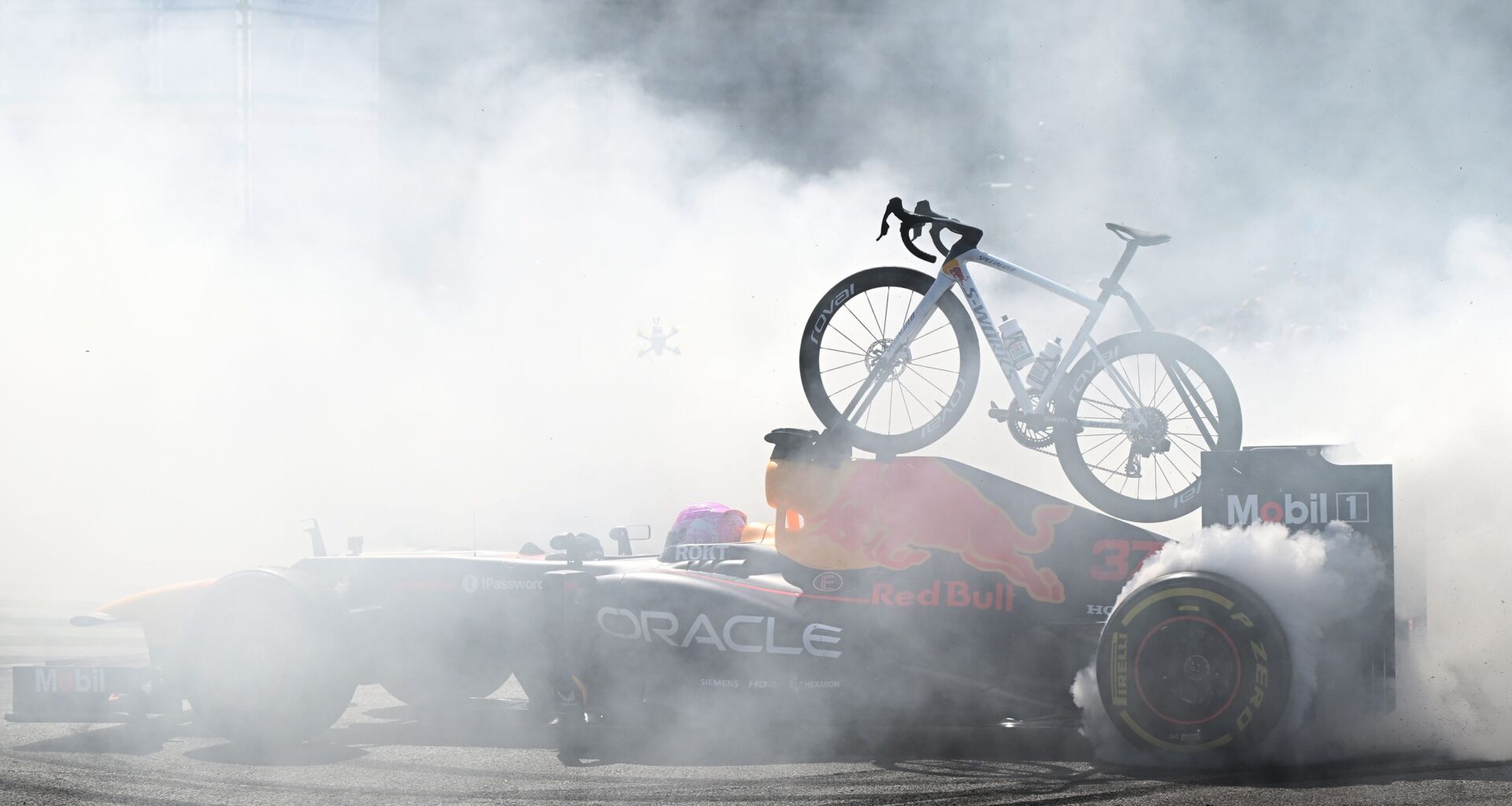
Formula 1 fans didn’t stop loving Ferrari because they couldn’t buy Lewis Hamilton’s car. MotoGP hasn’t collapsed because no one can ride an active-aero factory Ducati. Those sports sell access, narrative, prestige and drama – not the cars and bikes.
Peter Coyle, who’s own thoughts inspired my original post, argued in a follow up post that whilst the core of my thinking was on the right track, the solution I’d offered was somewhat detached. He felt the idea of a tech lock just puts struggling bike brands under more pressure, and would kneecap brands that wouldn’t or couldn’t wear a change that seismic.
His alternative, which to me makes far more sense and again, deserves attention, was one of a homologation model, where brands would still be required to prepare their ideas for sale in products, but the resultant bikes would be sold as strictly limited homologation models.
Further, reimagining or restricting the UCI-competition badge for just those bikes, restoring its prestige, and adding value for customers that covet the very highest tech.
In this approach, people with the cash could still have the chance of buying one, or we as fans would have the chance to see one out on the road, but the limited approach would allow for pricing that might meet some of the development costs.
(Image credit: ANDREAS SOLARO / AFP via Getty Images)“Turning cycling into F1 won’t help anyone but marketing departments”
Improving things for marketing departments was my point – just not in the way many assumed I meant it.
What if manufacturers were incentivised to invest in WorldTour cycling as brand builders, not catalogue managers? What if their value came from storytelling, innovation, fan engagement and long term association – instead of being forced to focus on shifting units tied to a seasonal cycle?
Decoupling race technology from immediate retail availability (through a change in the rules, or manufacturer consensus) wouldn’t reduce consumer choice, it could free it, allowing consumer bikes to be designed for durability, usability and value (and performance of course), while the very highest specification race bikes could be designed unapologetically for one job only.
While WorldTour budgets continue to inflate, sponsor lifecycles are not predictable and remain fragile. This forces most teams to live year to year, entirely dependent on title backers who owe them nothing. As tech progresses and gets ever hungrier for cash, it all feels unsustainable.
I still think my suggestion of this opportunity to shift the focus could expand the appeal of the sport, deliver real growth, and in turn could unlock commercial opportunities that will sustain and grow the sport.
Whatever the answer, it’s not really ever going to be about ‘banning anyone’s bike’, regardless of how good a headline that might be. Judging by the anger, humour, passion and insight in the comments from our readers – we all care deeply enough about the sport to argue about it.
That at least is something pro cycling can still fully rely on.