

In Europe, private brand accounts for 30% of grocery sales.
In the U.S., the number is 19%. The gap is closing, however, and
the coming shift in market share represents $100 billion in sales.
The regional grocers that capture their share of private brand
growth will be the ones that 1)commit to an identity; 2)develop a compelling flagship category or
item; and 3) build the engine to scale. In this
series, we discuss key considerations for each stage of
growth.
Grocers elevate private brand from side project to strategic
pillar when they support the program with dedicated people and
deliberate processes.
Following the launch of the flagship —which we discussed in Part 2 of this
series— the program should have great momentum. To
sustain it, the grocer will need to build systems, and the most
critical components will
bepeopleandprocesses.
On the people side, grocers must define roles and
responsibilities. On the process side, they must establish
timelines and structures. Detailed frameworks in these areas create
the accountability needed to ensure quality, encourage innovation,
and enable speed.
Building systems starts with examining the current assortment
— including the flagship — and evaluating capabilities,
identifying bottlenecks, and testing repeatability.
If grocers scale before they have a strong operational
foundation, product quality wobbles, branding drifts, and
credibility erodes fast.
Grocers who proceed purposefully at this stage, on the other
hand, will reap the benefits of speed when it counts: in category
reviews, new product development, vendor collaboration, and
more.
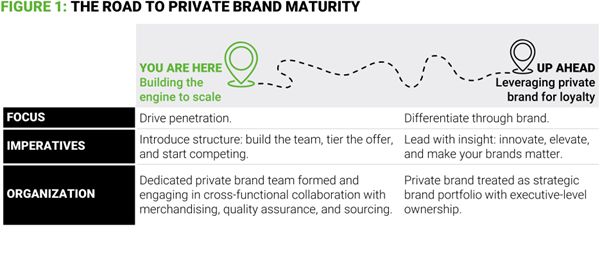
People
A mature private brand program is the innovation engine of the
company.It drives continuous evolution, meets customer needs, and
supports differentiation. It’s a high-stakes endeavor, and it
requires dedicated resources who focus on these areas as top
priorities.
For that reason, many grocers who successfully leverage private
brand establish a Center of Excellence, concentrating talent and
ensuring strategic focus and tactical execution.
Defining the roles
They build in-house capabilities in category and product
development; sourcing and quality assurance; in-store execution;
branding, packaging and marketing; and analytics. Centralizing
these functions — regardless of where they’re placed in
the overall organizational structure — allows for end-to-end
ownership of the process.
It’s not uncommon for grocers to be daunted by the scope of
building a dedicated team for private brand, but this upfront
investment is what equips the program for long-term impact.
The vision is for private brand to be a strategic pillar of the
business, and strategic pillars cannot be outsourced.
Setting expectations
As grocers consider where in the organizational structure
private brand should be placed, they must understand that every
option comes with pros and cons. Setting up private brand for
success will mean increasing its shelf space, ad space, marketing
presence, manpower and more. Category-level budgets will need to be
adjusted to allow private brand to develop into a competitive
option, and the disruption of the status quo will result in
conflict.
To minimize that conflict, leadership needs to be transparent
about the goals for private brand; acknowledge how its
prioritization is expected to impact sales and margin in the short
term and over time; and clarify roles, responsibilities and
decision rights.
Building the team
A private brand program has much in common with a startup, and
the people charged with leading it should embrace that dynamic.
Grocers should look for the following characteristics as they
assign existing personnel and make new hires.
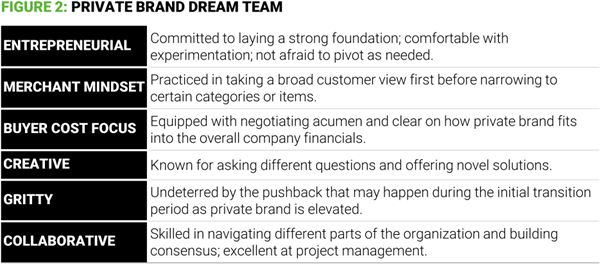
Grocers shouldn’t confine themselves to traditional retail
hiring pools as they build this team; brand specialists or
professionals with CPG experience can be great fits in these roles
and bring different yet highly relevant perspectives.
Integrating the operation
Too often grocers let private brand exist in a silo, which
relegates that team to an advisory role in category management
decisions rather than giving them true agency. For private brand to
reach its potential, it must be thoughtfully woven into the
merchant organization. When that happens, strategic decisions at
the top can permeate into category management processes.
Processes
Grocers with leading private brand programs don’t waste time
reinventing the wheel every time they launch a new product, range
or brand. They adhere to carefully crafted, comprehensive,
end-to-end processes — scrutinized and revamped during the
flagship phase — for category reviews, new product
development, vendor collaboration, go-to-market and other critical
components of the business.
Shorter timelines
The advantage of this approach is the ability to be more
responsive to the needs and desires of customers. Investing time
upfront in creating scalable, repeatable processes is what allows
new products to go from design to debut in as little as nine months
instead of the 20-24 months that is common in the industry.
It’s what enables 3-5 category reviews to happen simultaneously
so that 30-40 categories are being studied and refined every
year.
Fidelity to brand identity
These processes keep packaging, quality control and marketing
standards for private brand consistent for categories across the
store. They shape and guide vendor selection and collaboration.
Establishing brand and product guardrails is never the most
exciting part, but none of the fun product development will be as
successful without it.
Ability to keep up with the customer
The traditional grocery environmentdoesn’t support the speedat which a
compelling private brand program must be able to respond to
shifting consumer trends. Relyingpurely on a calendar tied to
national brand resets means new products aren’t added when
they’re at peak relevance. Timelines are frequently pushed to
give preference to holidays and promotions.
Clarity on accountability
Too often, progress gets stalled when decision-makers delay. The
lack of a centralized project management team means a lack of clear
ownership at each step — and therefore a lack of the
accountability that is needed to keep momentum and move projects
forward.
Strategic pillar
Creating a private brand program that delivers an advantage over
peers in the long term requires some transition and discomfort in
the short term. For grocers intentional about the people and
processes they put in place to underpin the program, however,
private brand will be not only a stronger contributor but a primary
driver of differentiation and growth.
Bringing private brand to the center of the business is no small
feat, but it can have a transformational impact. Historically,
proximity alone could win grocers a certain amount of business, so
it was sufficient to offer an assortment heavily reliant on
national brands and very similar to what was offered by
competitors. Today, grocers must cultivate a unique assortment to
win trips, and private brand will play a leading role in that
evolution. It’s both a remarkable opportunity and a massive
undertaking.
To validate this approach, executives need only look at which
retailers have gained market share and how effectively they have
leveraged private brand to deliver the “whole package” of
value consumers are seeking — quality, innovation and
affordability.
Retailers should expect more shift in share ahead; customers are
revealing what they want, and non-traditional channels are the ones
lining up to give it to them.
Grocers who haven’t yet moved with conviction in this area
can still catch up, but the window is closing fast. It’s time
to act.
Want more?Here’s additional private brand
insight from our team of grocery experts.
How regional grocers capture the $100B opportunity
— Part 2: Develop the flagship
How regional grocers capture the $100B opportunity
— Part 1: Commit to an identity
The $100 billion opportunity for U.S.
grocers
The (enormous) Private Brand Opportunity —
and how manufacturers help grocers realize it
Grocery Shopper Perspectives 2025
The content of this article is intended to provide a general
guide to the subject matter. Specialist advice should be sought
about your specific circumstances.