
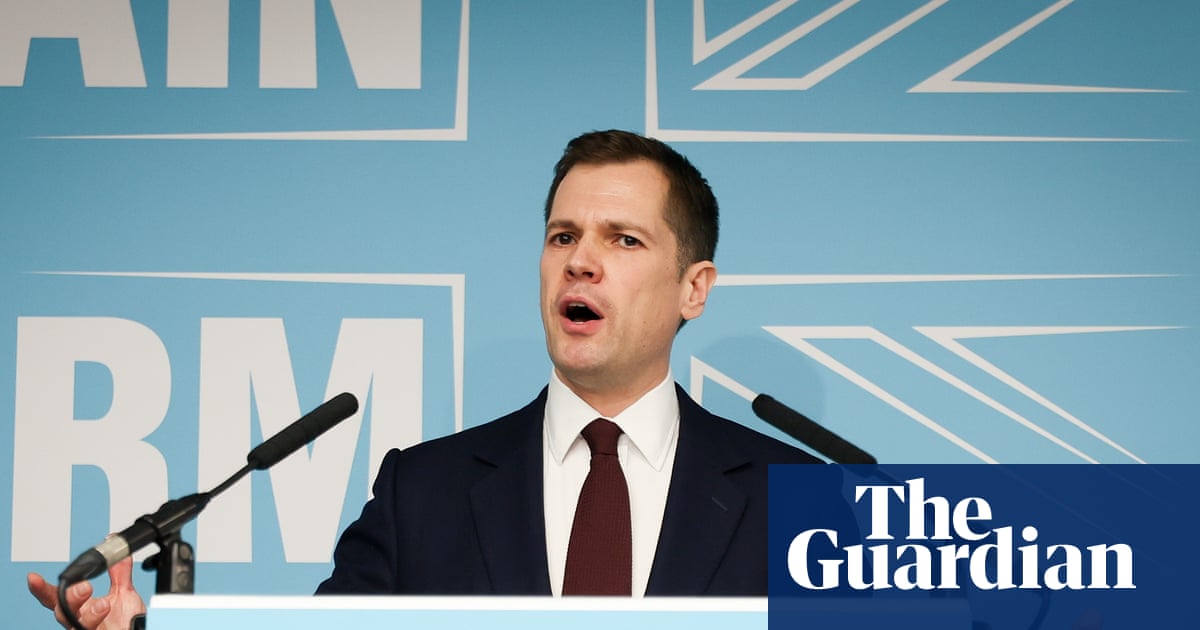
Robert Jenrick has defected to Nigel Farage’s Reform UK after being sacked from the Conservative shadow cabinet, calling his former party “rotten” and urging more MPs to jump ship.
The former justice secretary, who stood for the Tory leadership against Kemi Badenoch, said the Conservative party in Westminster “isn’t sorry, it doesn’t get it, it hasn’t changed, it won’t change, it can’t change” before launching into a broadside against his former colleagues.
“In opposition, it is easy to paper over these cracks, but the divisions and delusions are still there,” he said at a hastily reorganised press conference with Farage in Westminster on Thursday. “I can’t in good conscience stick with a party that has failed so badly.”
The former shadow justice secretary had the Conservative whip removed and his party membership suspended earlier in the day, after Badenoch said she had found “irrefutable evidence” that he was planning to defect. The Tory leader appointed West Suffolk MP Nick Timothy as shadow justice secretary after Jenrick’s sacking.
His sacking appeared to have caught both him and Farage off guard. The Reform UK leader called it the “latest Christmas present I’ve ever had” and said it was still “60-40” if Jenrick would defect until Badenoch forced his hand.
Jenrick arrived on stage – after a lengthy and awkward delay – with a denunciation of his former party and its time in government. “What’s the truth? Both Labour and the Conservatives broke Britain. Both parties are committed to a set of ideas that have failed Britain.”
He said discussions had started with Reform in September, understood to have been facilitated by the former Tory adviser Tim Montgomerie, who joined Farage’s party in December 2024. He also confirmed that he would not call a by-election.
But Jenrick added that there had not been discussions about a defection, but about the state of the country. “Nothing has been offered, I’m proud to join and work with a set of people I have come to know over a very long time … who have built this party from nothing and I’m just here to play my part,” he said.
Jenrick said that some around the shadow cabinet table had said behind closed doors they knew the UK was broken but could not admit it “because it was us who broke it”.
He singled out the shadow chancellor, Mel Stride, and the shadow foreign secretary, Priti Patel, for direct criticism. Stride, he said, was the work and pensions secretary who “oversaw the explosion of the welfare bill and blocked the reforms needed”.
He said that Patel as home secretary had overseen the surge in legal migration.
The former immigration minister admitted he had not intended to leave the Tories on Thursday but said he had resolved to leave soon. “I didn’t know I was going to leave today, but I had resolved to leave the party, and that was, as I said, something I had given a great deal of thought to over a very long time, and the fact that it’s happened a little bit sooner. So what?”
Farage said that after the 7 May local elections there would be no more Tory defections, and Reform would reject more seeking to join. He said Jenrick was “in sackcloth and ashes” about decisions made during his time in the Tory government.
Over the course of the next few weeks, Reform UK would begin to allocate jobs and responsibilities to key people, Farage said. Jenrick is understood to have discussed Reform’s economic policies with Farage, but any appointment as the party’s economic spokesperson would put him on a collision course with the MP Richard Tice, who has long suggested he would be the party’s future chancellor.
Farage said that he knew the party had to have some experienced people if they were to enter government. “We need the experience, I think that’s absolutely vital.”
Jenrick denied he was interested in becoming the leader of Reform UK. “No one joins Reform unless they believe Nigel Farage is the best person to lead this country … that’s why I’ve put aside my personal ambition.”
Westminster sources said Badenoch had been monitoring Jenrick’s activities for some time because of suspicions he was working to undermine the party, and she believed his defection to Reform was imminent. A draft resignation speech was discovered and sent to one of Badenoch’s team, parts of which were released by the Conservative party on Thursday.
Speaking to journalists on a visit to Edinburgh ahead of May’s Holyrood elections, where polls suggest the Scottish party will incur heavy losses at the hands of Reform, Badenoch denied this was “a very bad day”. She said that defections to Reform were evidence that “a lot of people who have gone into politics for the wrong reasons”.
“People who go into politics because they think it’s a gravy train, or because they think it’s a way to get on TV, are finding out that the Conservative party is not the party for them,” she said. “And they’re going to the party that is for people like that.”
“Robert Jenrick is not my problem any more. He’s Nigel Farage’s problem now.”
The Tory leader said more details on the “irrefutable evidence” that prompted her to sack Jenrick on Thursday morning would come “in due course”.
“Every time we have a press conference, we have announcements, we have ideas of how to improve the country,” Badenoch said. “When Reform has press conferences, it’s just: here’s another defection.”
Farage had said earlier in the day that there was no imminent defection planned, though there had been conversations with the former Tory leadership candidate.
Badenoch told Sky News that Jenrick was planning to “torch the Conservative party by putting out comments and allegations that would have been very, very bad”.
Shortly before the news broke on Thursday, Jenrick posted on X: “It’s time for the truth.”