
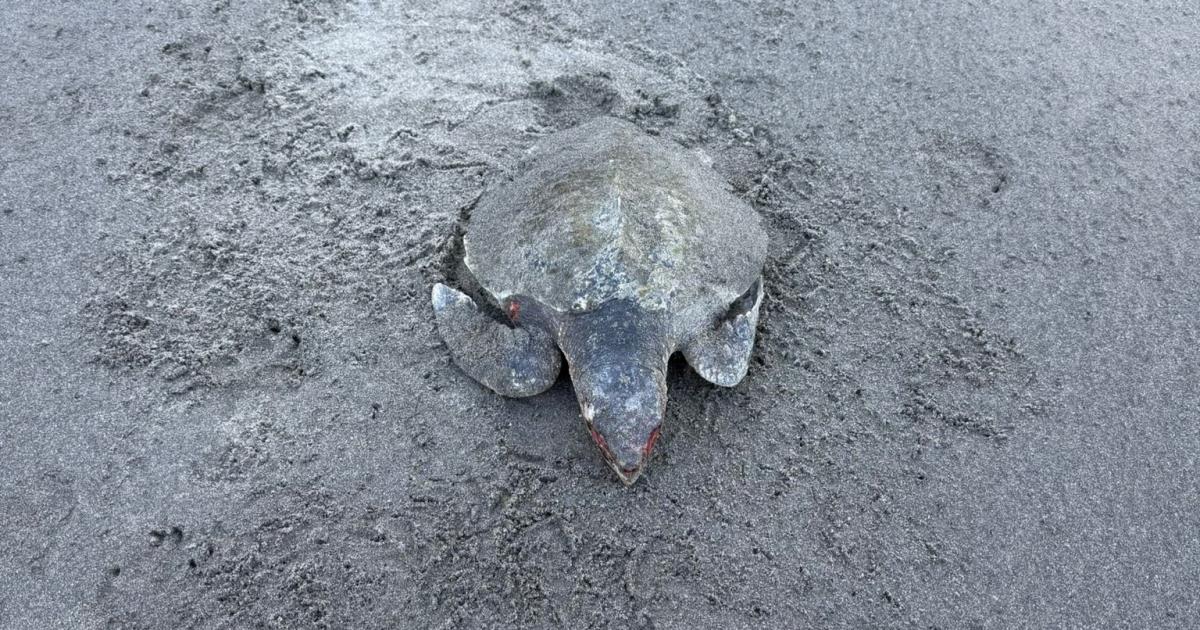
A rare Kemp’s ridley sea turtle was found washed up on Newport Sands on Tuesday, January 13, by local dog walker Marianne Goodson.
The Kemp’s ridley is the world’s most endangered sea turtle after populations plummeted in the 1980s.
They are listed as critically endangered on the International Union for Conservation of Nature’s Red List and as endangered in the US.
An extremely rare Kemp’s ridley turtle has washed up on Newport beach (Image: Marianne Goodson)
Marianne came across the turtle on the parrog end of the beach, past the dunes and far from the sea.
Unfortunately, the animal was dead and its eyes were not intact.
Marianne photographed the turtle and contacted a friend who is a marine biologist.
“Because it was a turtle I knew I had to do something,” she said.
Her friend thought the turtle might have been a hawksbill and put her in touch with Matt Westfield, strandings coordinator for the UK Cetacean Strandings Investigation Programme in Wales.
Matt confirmed that it was in fact an extremely rare Kemp’s ridley turtle.
Matt went to the beach to try and locate the animal the next day but unfortunately by then it had gone.
According to conservation group See Turtle, the Kemp’s ridley is the smallest of the seven sea turtle species.
It was on the brink of extinction in the 1960s and 200 nesting individuals existing in the 1980s. There population is now building but remains low, at an estimated 7,000 to 9,000 individuals today.
Kemp’s ridleys are most commonly found in the Gulf of Mexico and the US Atlantic seaboard, from Florida to New England.
A few sightings have also occurred before in the UK. In October last year a live Kemp’s ridley washed up on a beach in Scotland and in 2021 another survivor washed up in north Wales.
The Marine Conservation Society reports that there was a total of 69 sightings of Kemp’s ridley turtles reported in UK and Irish waters between 1748 and 2020.
It is thought that these sightings are becoming more common as climate change expands the turtle’s migration range.
In the winter Kemp’s ridley turtles nest on the beaches on the Gulf of Mexico.
However, they are sometimes swept off course by tropical storms and when entering colder waters can go into cold-water shock, where their metabolism slows, making them weak and unable to swim.
“You don’t expect to see a turtle washed up on the beach in Pembrokeshire,” said Marianne.
“It’s a shame it didn’t survive and a shame that they didn’t find it because they probably would have been able to do some further investigation.
“When I realised how rare they are it seemed more of a shame.”