
Captured by NASA satellite on January 10, 2026, the bloom appeared as swirls of green and blue, an unmistakable sign of a thriving marine ecosystem in motion. Located roughly 800 kilometers east of New Zealand’s South Island, the Chatham Islands are typically isolated and sparsely populated. But every austral summer, the surrounding ocean transforms.
The Chatham Rise, a broad submarine plateau that extends eastward from New Zealand, plays a central role in fueling these blooms. According to NASA Earth Observatory, the area sits at the intersection of cold Antarctic currents and warmer subtropical waters. This convergence zone, coupled with long daylight hours, creates optimal conditions for phytoplankton growth and circulation.
Satellite Reveals Swirling Bloom
The bloom was documented by NASA using data from the VIIRS instrument aboard the NOAA-20 satellite. As reported by NASA Earth Observatory, the image taken on January 10 shows a large, ring-shaped formation surrounding the islands, delicate wisps and spirals shaped by surface currents and eddies.
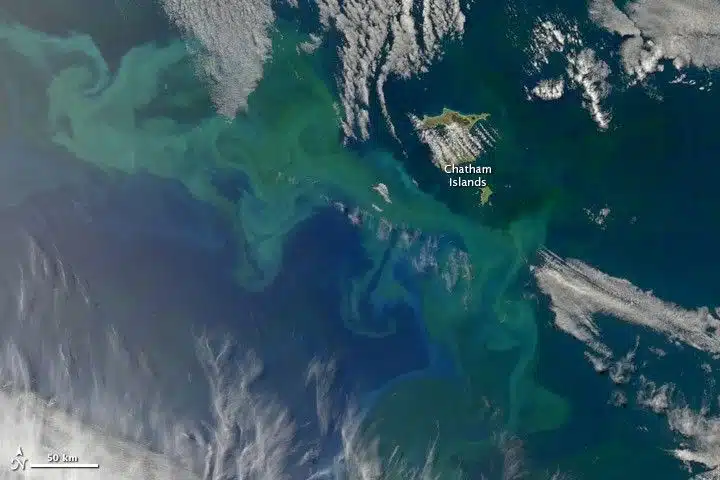 Phytoplankton bloom swirls around the Chatham Islands. Credit: NASA
These organisms, though microscopic, become visible when they bloom in large quantities, as their chlorophyll reflects sunlight in a way that satellites can detect. This natural event is part of a regular seasonal pattern in the region, but the intensity and clarity of this year’s bloom stood out. The satellite data came through the Joint Polar Satellite System (JPSS) and NASA EOSDIS LANCE.
High Productivity Beneath The Surface
The bloom’s location on the Chatham Rise is no coincidence. The topography of this underwater feature enhances nutrient upwelling by trapping cold, rich waters. This supports the explosive growth of phytoplankton, which sit at the base of the marine food web.
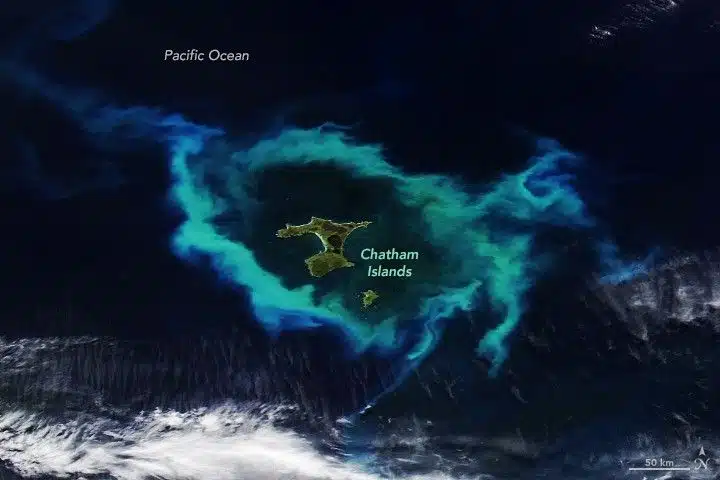 Swirls of phytoplankton light up the waters around the Chatham Islands. Credit: NASA
According to research published by Murphy et al. in the New Zealand Journal of Marine and Freshwater Research, satellite imagery has shown consistent phytoplankton activity around New Zealand’s waters. The Chatham Rise, in particular, is a known hotspot. The result is a biologically rich area that sustains fisheries targeting species like pāua, rock lobster, and blue cod. These species depend on the steady availability of phytoplankton, directly or indirectly, as a food source.
Why Do Marine Mammals Strand in Groups?
The abundance of marine life extends beyond fish. The waters around the Chatham Islands support at least five species of seals and 25 species of whales and dolphins. As reported in the statement, the same conditions that foster high productivity also draw marine mammals to the area in large numbers.
Yet the region is also known for a darker phenomenon: mass strandings. These events, sometimes involving hundreds of animals, occur with unusual frequency around the Chatham Islands. While the causes remain unclear, researchers are exploring possible links between strandings and the area’s oceanographic features.