
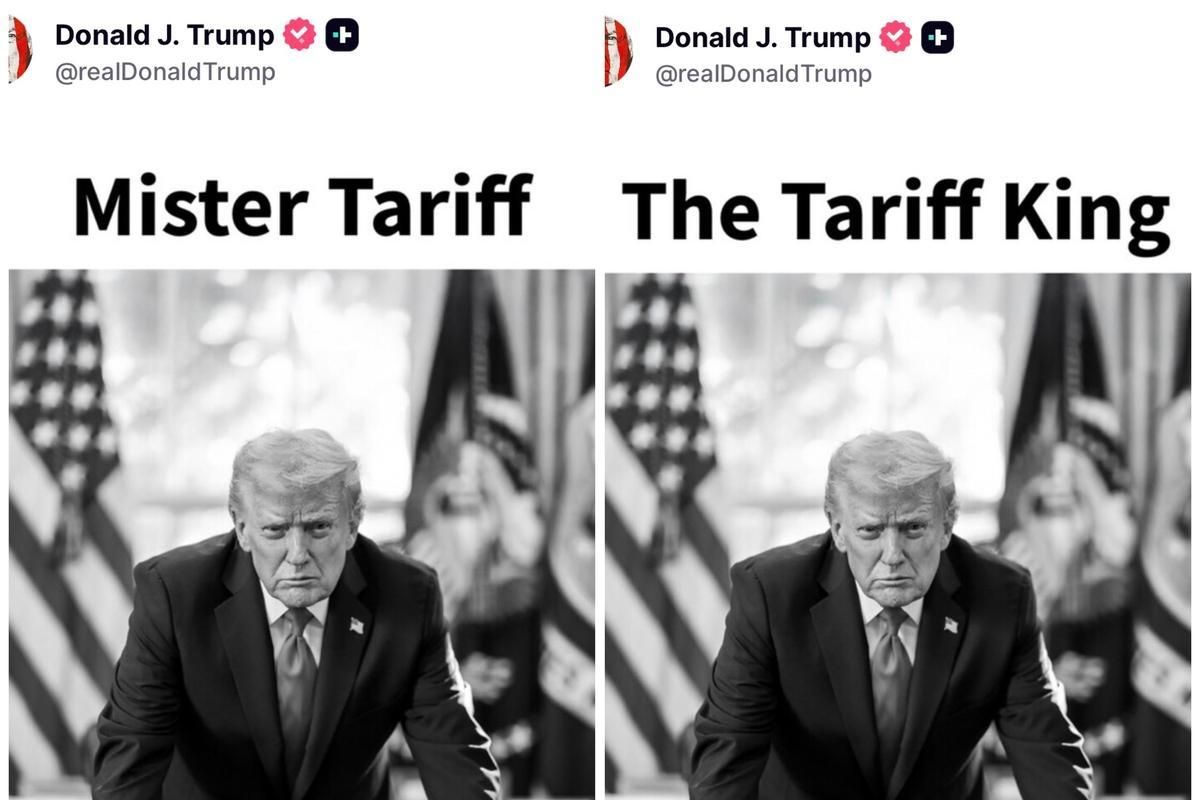
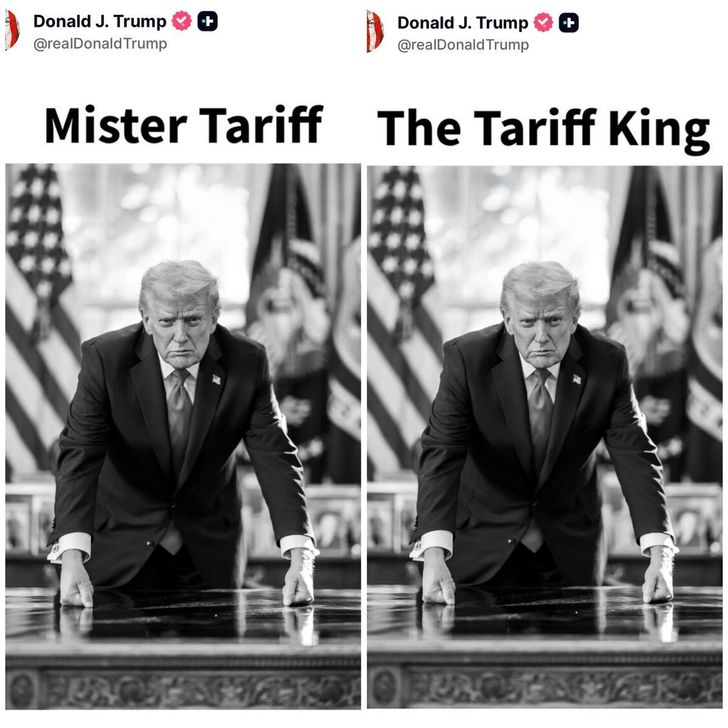
U.S. President Donald Trump calls himself “Mister Tariff” and “The Tariff King” in social media posts, Friday (local time). Captured from Trump’s Truth Social account
The government has been scrambling to calm concerns that Korean chipmakers could face unfavorable treatment under the U.S. semiconductor tariffs, as their Taiwanese rivals have already won exemptions in return for massive investments in the United States.
Citing Washington’s pledge of “no less favorable” treatment for Korea’s chip exports, Seoul’s presidential office vowed Sunday to ensure Samsung Electronics and SK hynix are not disadvantaged against Taiwan Semiconductor Manufacturing Co. (TSMC) in the U.S. market.
“The government plans to communicate with companies and talk with the U.S., while thoroughly analyzing the agreement between the U.S. and Taiwan,” Cheong Wa Dae told reporters.
“The government will talk with the U.S. to minimize impacts on Korean companies, in accordance with the principle of ‘no less favorable’ treatment stated in the Korea-U.S. joint fact sheet.”
When Seoul and Washington signed the fact sheet last November to lower U.S. tariffs on Korean goods from 25 percent to 15 percent in exchange for Korea’s $350 billion investment in the U.S., Seoul was assured it would not be treated less favorably than other nations on chip tariffs, though the semiconductor tariff rate was left undecided.
“For any Section 232 tariffs imposed on semiconductors (including semiconductor manufacturing equipment), the United States intends to provide terms for such Section 232 tariffs on Korea that are no less favorable than terms that may be offered in a future agreement covering a volume of semiconductor trade at least as large as Korea’s, as determined by the United States,” the fact sheet reads.
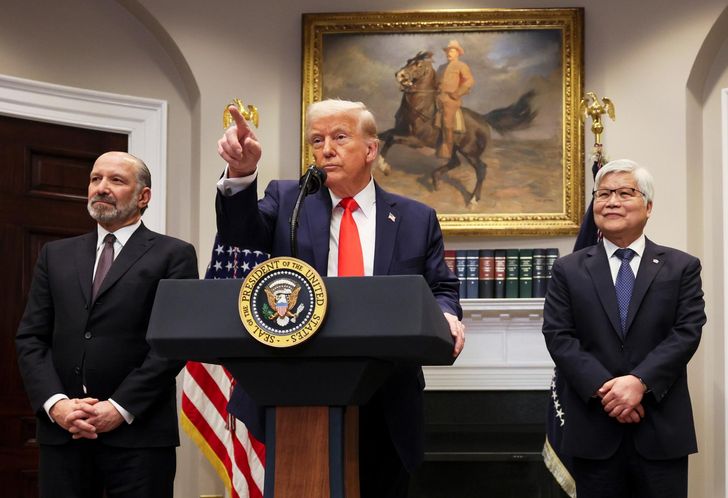
U.S. President Donald Trump speaks as C.C. Wei, right, chairman and CEO of Taiwan Semiconductor Manufacturing Co., and U.S. Commerce Secretary Howard Lutnick listen in the Roosevelt Room of the White House in Washington, March 3, 2025. AP-Yonhap
However, it has become uncertain whether the U.S. will maintain Korea’s most-favored-nation status on chip exports, especially after an official from the Donald Trump government signaled that his administration wants “separate agreements for separate countries” on semiconductor tariffs.
Even if the U.S. treats Korea the same as Taiwan, it is difficult for Korean chipmakers to make additional large-scale investments in the U.S., unlike their Taiwanese competitors that plan to invest at least $250 billion in U.S. production capacity. The Taiwanese government has also pledged $250 billion in credit support for its firms.
Samsung is investing $37 billion in a wafer fabrication plant under construction in Texas, while SK is spending $3.87 billion on an advanced chip packaging facility in Indiana. Both companies are also building a massive semiconductor cluster in Korea.
Additionally, $150 billion of the $350 billion that Seoul committed to investing in the U.S. is designated for shipbuilding cooperation. Deputy Prime Minister and Finance Minister Koo Yun-cheol also said Friday that the weak won has made it difficult to begin the U.S. investments during the first half of this year.
Despite these challenges, Samsung and SK face growing pressure from Washington to join TSMC in promising massive U.S. investments. The Trump administration has threatened steep tariffs on memory chips, not only on advanced ones already subject to the 25 percent duty.
On Friday (local time), one day after Taiwan secured its U.S. tariff exemption in exchange for TSMC’s factory construction in Arizona, U.S. Commerce Secretary Howard Lutnick told reporters that tariffs could reach up to 100 percent unless chipmakers expand manufacturing in the U.S.
“Everyone who wants to build memory has two choices: They can pay a 100 percent tariff, or they can build in America,” Lutnick said at the groundbreaking ceremony for Micron Technology’s new plant in Syracuse, New York.
Although Lutnick did not single out any specific countries or companies, his comments were widely seen as a call for more U.S. investment from Samsung and SK, which lead the global memory market.
When Washington enacted a new 25 percent tariff Wednesday (local time) on Nvidia’s H200 artificial intelligence accelerators and other advanced chips, Seoul initially expected limited impact, since Korean exports to the U.S. are focused on memory products.
“The first-stage measure announced is focused on advanced chips from Nvidia and AMD, and excludes memory chips, which are key export products of local companies,” Trade Minister Yeo Han-koo told reporters Saturday at Incheon International Airport after a weeklong visit to Washington.