
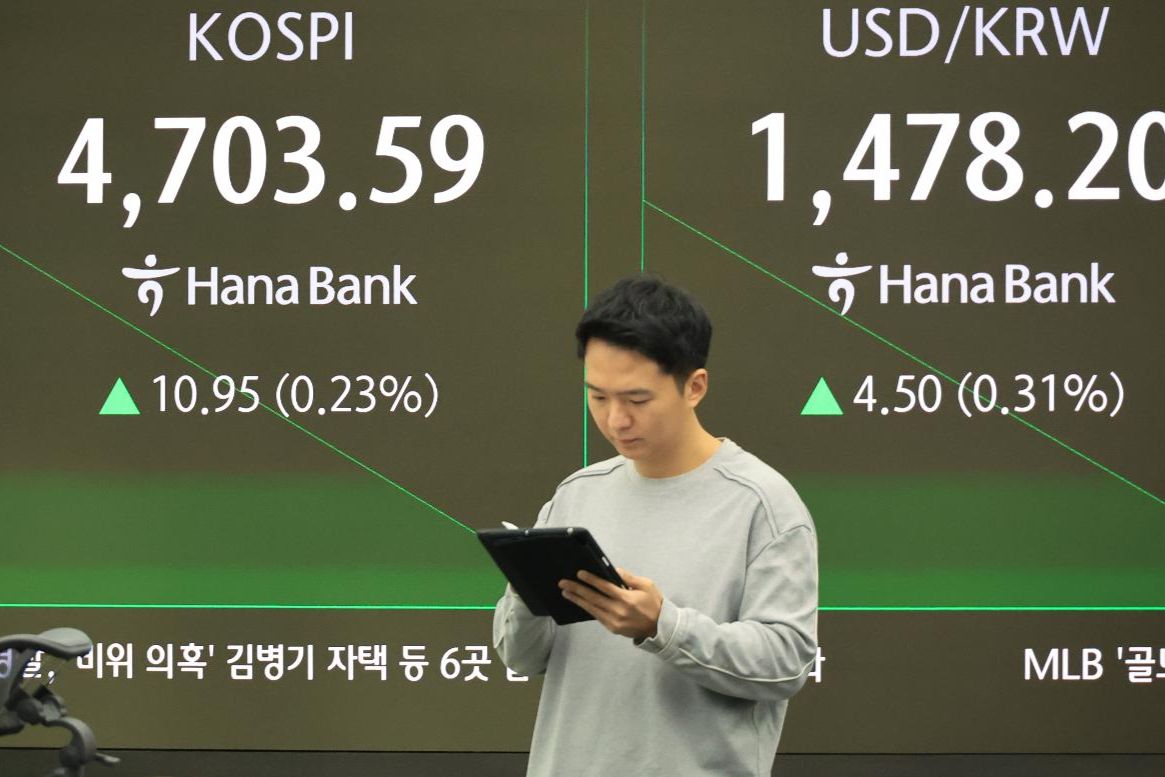
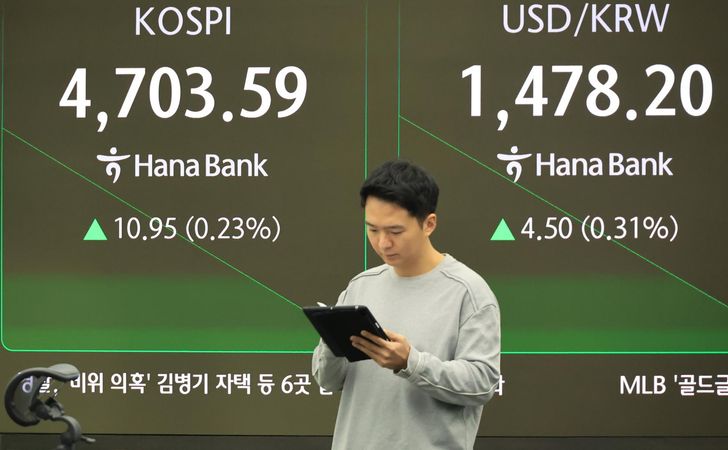
An electronic trading board shows the Korean currency at 1,478.20 won against the U.S. dollar at a Hana Bank in Seoul, Wednesday. Yonhap
Financial authorities are strengthening coordinated efforts with banks, insurers and brokerages to prevent the Korean currency from weakening to 1,500 won relative to the U.S. dollar, part of a shift away from monitoring to supervisory intervention of both retail and corporate dollar demands, market watchers said Sunday.
Financial service providers are instructed to curb dollar-focused marketing and incentivize dollar-to-won conversion, reflecting the belief that private-sector dollar hoarding is a significant issue driving the won’s weakness.
Whether this pressure will slow the won’s depreciation will become clearer in the weeks ahead. Skepticism lingers that financial institutions are able to reorient their business strategies, especially when factoring in currency stability considerations at the expense of near-term margins.
According to financial market sources, the Financial Supervisory Service (FSS) and Bank of Korea (BOK) have had several meetings with financial institutions recently to discuss the won’s sustained depreciation.
The currency weakening is driven in part, they say, by expectations for further dollar gains, leading more households and firms to hold the global reserve currency through investing in deposits and insurance products.
Also at play are aggressive marketing campaigns riding on strong dollar demand, reinforcing pressure on the won.
The FSS plans to convene deputy CEOs in charge of foreign exchange (FX) operations at major commercial banks on Monday.
Regulators are expected to provide guidance against marketing that promotes dollar deposits. They will also push banks to strengthen benefits for customers who convert foreign currency into won.
This reflects the government’s stance that continued dollar hoarding is amplifying the won’s weakness.
Earlier this month, a senior official of the Ministry of Economy and Finance summoned FX marketing heads at major banks, warning that excessive exchange rate discounts on dollar deposits and conversions could further weaken the local currency.
In response, banks have begun adjusting their products.
Shinhan Bank and KB Kookmin Bank are complying with the government’s push to increase dollar supply in the domestic market and discouraging dollar hoarding.
The focus is not on stopping FX transactions, but on strengthening incentives toward converting dollars into won rather than holding them.
Insurers are also scaling back aggressive sales of dollar-denominated products.
The FSS has summoned senior executives at major life insurers to review the rapid growth in dollar-linked insurance, ensuring that they uphold compliance rules for suitability and risk-disclosure responsibilities.
Regulators have issued consumer alerts against treating insurance as a currency-betting tool.
“Currency fluctuations could lead to losses. We are examining whether insurers have adequately complied with suitability and other rules. Depending on the outcome of insurers’ internal reviews, on-site inspections may follow.”
The Korean won ended at 1,473.6 won on Friday, losing 3.9 won from the previous session.