
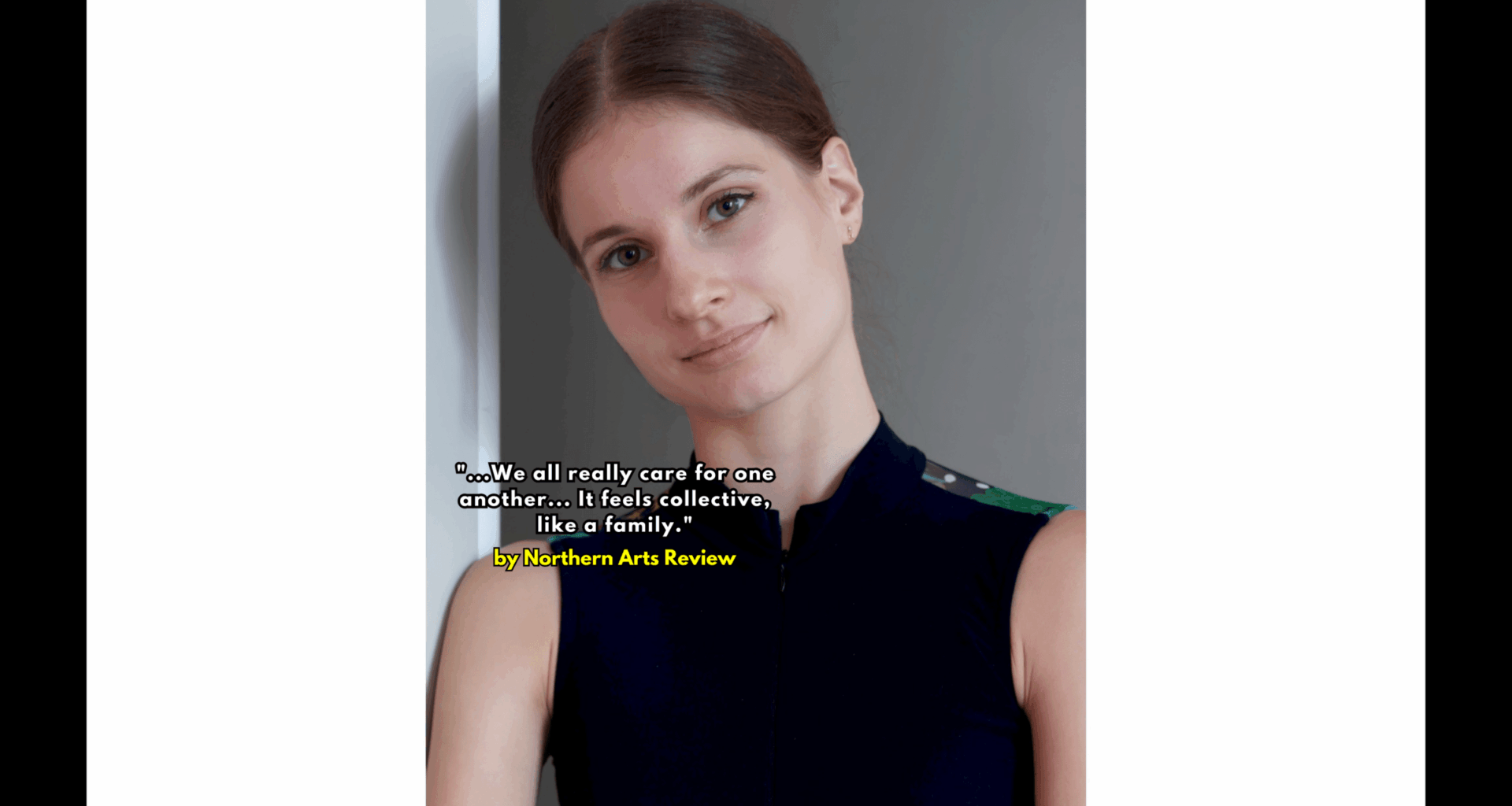
“…We all really care for one another… It feels collective, like a family.”
By Sean Sable
Pauline Faget is currently a principal soloist with Varna State Ballet. She joined the company in 2018 and the company are currently on tour in the UK with Cinderella, Swan Lake and The Nutcracker.
Pauline was born in 1997 in Agen, France. She studied at the École Nationale Supérieure de Danse de Marseille and later at the Centre Chorégraphique Christian Conte et Martine Chaumet. Her repertoire includes Odette/Odile, Swan, Polish and Hungarian Dance in Swan Lake; Marie and French Dance in Nutcracker; Princess Aurora in Sleeping Beauty; Myrtha in Giselle; a duet in Coppélia; Medora Pas de Deux in Le Corsaire; Mercedes in Don Quixote; Catarina’s Friend in Catarina, or La Fille du Bandit; and The Dying Swan, among other roles.
Sean Sable was able to grab a few minutes of this busy performer’s time and ask her about taking on such demanding roles and the pressure involved in touring.
You’re performing both The Nutcracker and Swan Lake on this tour. They are two roles that demand very different things from a principal. How do you transition between them, mentally and physically?
For me, preparation is everything. I practise both roles all year, so they are always there in my body. On days when I don’t dance in the morning, I like to set myself calmly. I write in a notebook, organise my thoughts, and really take things one day at a time. After performances, I watch recordings, note what I can improve, and go to sleep with those corrections in mind. Then the next day, I reset. I have breakfast, chat with friends and sometimes visit with friends before going back to work.
What really helps me switch roles is the ritual around performance. Makeup is a big part of it. Clara should feel young and open, while Odette or Odile needs something darker, more sculpted. I change my eyeliner, eyeshadow and earrings. Its these small details that help my mind shift. There’s also the timing of each ballet. In Swan Lake, I don’t enter immediately, so I can listen to the music and watch the stage come alive. That space lets the character settle in naturally.
You spoke about using backstage time and even other dancers’ energy to prepare. How does that environment affect your performance?
Backstage energy matters so much. In The Nutcracker, there are many young dancers, and they create a whole world for themselves before going onstage. They invent family roles for the Christmas party, make jokes, change names, these sort of things. It’s very playful, very childlike. That energy actually helps, because Clara needs that sense of excitement and innocence.
There are a lot of young people in the company, often eighteen or in their early twenties, and they have so much energy. We’re told that Christmas onstage must feel exciting every second, and some dancers are completely all in. They almost run onto the stage. It can be chaotic, but it’s also infectious.
Even in Swan Lake, where I have more quiet time before my entrance, watching the story begin helps me arrive emotionally. Hearing the music, seeing the other dancers fully inside the world, reminds you that you’re part of something big. That shared atmosphere prepares you mentally in a way no rehearsal ever could.
You’re a principal in a relatively young company. Does that bring extra pressure?
Yes, it does, but it’s a very particular kind of pressure. I came into this company as a corps de ballet dancer and moved step by step through the ranks, so I know exactly what they’re going through. I remember how intense it is to dance every single day, sometimes without rest, while principals may perform one show out of three or four.
Because of that, I feel a responsibility to set an example, not just technically, but in my behaviour and attitude. At the same time, I’m also incredibly supported. The other principal women help constantly, whether it’s fixing hair, checking costumes, or being there during quick changes. We all really care for one another.
Before shows, people come to wish me luck, and after, they congratulate me. Everyone—from principals to the corps de ballet. And I do the same for them. It feels collective, like a family. It’s part of what makes the pressure manageable and even meaningful.
Your training began in the French tradition, but Varna Ballet often works in a more Soviet or Russian style. What has that adjustment been like?
It’s interesting because I trained in a very French method until around sixteen and then moved into a more Russian-trained environment. It’s essential that dancers learn quickly how to adapt. You have to understand what a ballet master or choreographer wants and execute it immediately.
Still, some things are challenging. For example, I naturally place my arms lower at the barre, which is more French, while here they prefer them higher. That’s difficult because it affects every movement, and the moment you stop thinking about it, your body returns to habit.
But there are also little things they don’t ask me to change if it works. And as a principal, choreography is often shaped specifically for you. If something suits my proportions—my long arms, for example—they adjust the details so it looks good on my body.
Partnering seems central to your work. What do audiences often misunderstand about it?
Partnering is extremely complex, especially for the men. For me, it can be emotionally hard to stop dancing with someone I’ve built trust with, but the technical challenges are even greater for the men. Every woman has a different height, centre of gravity, leg shape, arm length. The placement of a hand moves from dancer to dancer, and that changes the mechanics of every lift and turn.
Men must adapt constantly, while we remain in the same body. They have to know our choreography perfectly. Not just their own steps, but exactly where we will be, how fast we move, how high we jump. It’s their specific task. The women get the pointy shoes; the men get the partnering.
Touring can be physically punishing. Does touring in the UK pose any special challenges? What sustains you through ambitious tours like this one?
Touring is always demanding, but that’s exceptionally true on longer tours. Your body goes through phases. First you must adjust to the intensity, then you settle into it, and later you hit moments of real fatigue. Recovery becomes essential: warm showers, massage, conserving energy before and after shows.
And touring in England is quite different from touring in other places. For example, in Mexico City, we had the altitude which makes breathing difficult. But in England, you have the cold. The older theatres are beautiful, but with high ceilings and very little insulation, backstage can be very cold. Muscles cool quickly, and cramps are common, especially when you’ve been offstage for a long time and then have to return fully warmed and ready.
What really inspires me, though, is the audience. Sometimes during the interval, or later that evening, I’ll look at social media and see people sharing their experience. Things like photos from the theatre, comments about coming as a family, or saying it was their Christmas gift to each other. Seeing that reminds me why we do this. Every audience is different and each one deserves the same commitment. Remembering that really helps you work hard when you’re tired.
Can you tell me something unusual about being a ballet dancer that people might not already know?
Between the principals, we have an unspoken agreement that one of us will always stay in the theatre, even if we’re not scheduled to perform. It’s not something imposed by management. It’s just something we do for each other. If someone feels ill or gets injured, there’s always a possibility that another principal might need to step in.
I’ve experienced this before, particularly when I was in the corps de ballet. Once, a dancer twisted her ankle very badly during Swan Lake, and suddenly we realised someone needed to go on. I wasn’t prepared. At all. My hair was down, and I had on no makeup. But everyone moved quickly. People brought shoes and costumes, even helping with makeup. I had ten minutes to remember choreography I hadn’t danced in years, but it worked because the whole company supports each other. Partners know the choreography. Other dancers give cues. You work it out together. Those moments show how strong the company really is.
Sean Sable is a Yorkshire based freelance writer and editor specialising in Young Adult and Horror fiction, frequently at the same time. When she isn’t buried under a pile of books and manuscripts, she is looking for her keys and having extensive one-sided conversations, in Swedish, with her deaf cat. You can find her online at: www.seansable.co.uk
Post Views: 0