
Breadcrumb Trail Links
Published Jan 19, 2026 • 3 minute read
 0122 BI Senior Scene.BI.jpg jpg, BI, apsmcArticle content
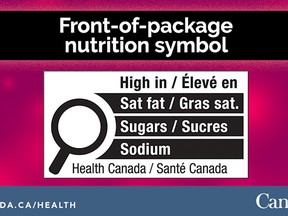
Health Canada wants to increase consumers’ awareness of the front-of-package nutrition symbol, so I am going to share some information on this new initiative which came into effect January 1, 2026. It is anticipated that this simple visual cue will support everyone’s ability to make informed food choices when shopping for food for themselves and their families.
Advertisement 2
This advertisement has not loaded yet, but your article continues below.
Article content
The front-of-package symbol is black and white with a magnifying glass to capture your attention. You will see the words “High in” at the top of the symbol along with sat fat, sugars or sodium. You will see the words “Health Canada” at the bottom of the symbol to point out that the government requires it.
Article content
Recommended Videos
Article content
The federal government’s new front-of-package labelling system will make it simple to spot products high in sodium, sugar or saturated fat, without struggling to understand and interpret the usual nutrition labels. Ideally it will help Canadians make healthier choices with confidence, even when you are racing through the aisles at your local grocery store.
Most packaged foods feature a nutrition facts table and a list of ingredients in the tiniest font possible. The nutrition facts table shows the nutrients in each serving and their corresponding percentage of daily values. The percent daily value is a quick reference to tell you if the food contains a lot or a little of certain nutrients. The ingredient list shows what ingredients the food contains.
Advertisement 3
This advertisement has not loaded yet, but your article continues below.
Article content
Many foods and beverages feature prominent labels showing what are called nutrient content claims — touting benefits such as “high in calcium” or “source of iron” — or health claims, such as “a healthy diet low in saturated and trans fats may reduce the risk of heart disease.” However, a product that qualifies for this kind of claim may also be high in sugar or salt, which can increase your risk of chronic disease, including heart disease and stroke. New front-of-package labelling will change this somewhat confusing scenario, providing up-front information that enables you to make healthier choices faster.
Some foods will not need to display a front-of-package symbol. Here are some reasons:
· That food item is not high in saturated fat, sugars or sodium, meaning it is typically less than 15 percent of the daily value.
Advertisement 4
This advertisement has not loaded yet, but your article continues below.
Article content
· That food item has health protection benefits. This includes foods such as vegetables and fruits.
· Nutrition information is not required on that food, such as whole cuts of raw meat with no added ingredients.
· The symbol could appear redundant, such as on packages of sugar and salt.
The focus on the three sneaky “S’s” is because regularly consuming foods high in sugar, sodium and saturated fat can lead to increased health risks, such as obesity, high blood pressure, heart disease and stroke.
Canadian diets are dominated by ultra-processed foods, and Canada’s Food Guide recommends limiting these foods and drinks because they are not part of a healthy eating pattern. Also, research has shown that almost 50 percent of the calories consumed by Canadians have come from ultra-processed foods in recent years.
Advertisement 5
This advertisement has not loaded yet, but your article continues below.
Article content
It is anticipated the new label will help everyone make healthier choices, and that is good for the health of our whole population. It also makes nutrition information easier to find for people who may struggle with the detailed nutrition facts table on the back, like those with low literacy, poor eyesight or limited English or French language skills. Front of package labelling will also
encourage manufacturers to develop healthier products and reformulate existing foods, resulting in a healthier food supply.
Information in this column is compiled by Shell-Lee Wert, CCSH, 470 Dundas Street East, Unit 63, Belleville, K8N 1G1. Please visit our website at https://ccsh.ca or email me at shell-leew@ccsh.ca, or call 613-969-0130 or 613-396-6591 for information and assistance. Community Care is a proud United Way member agency. Funding in part from Ontario Health East.
Article content
Share this article in your social network