
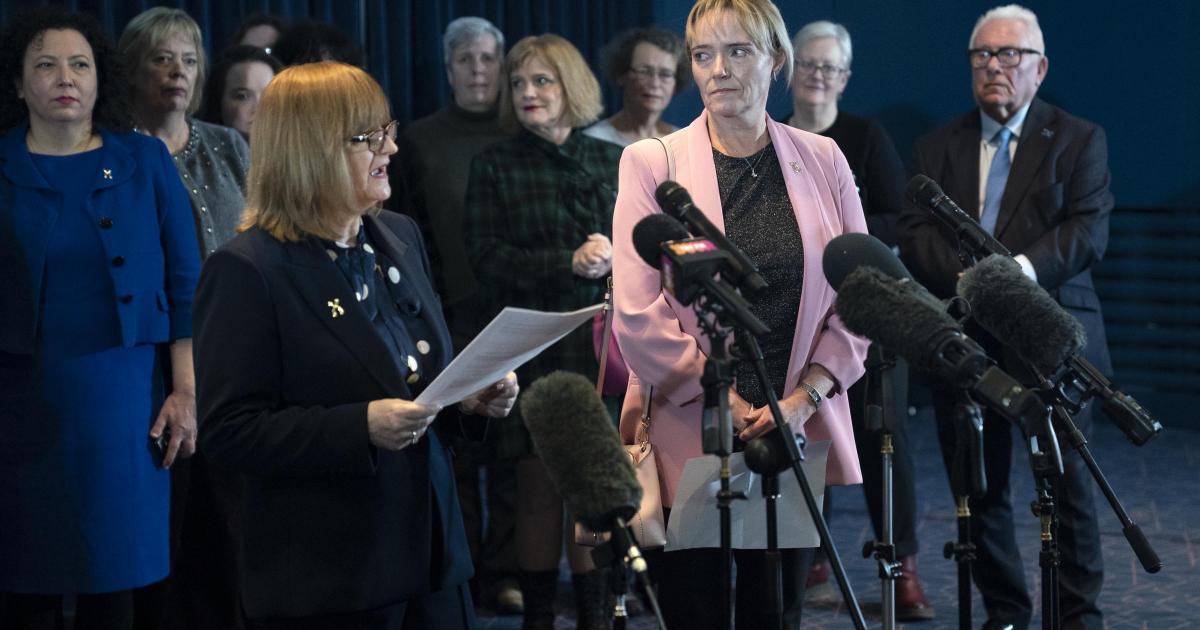
Ms Peggie’s lawyers confirmed on Monday that they have now lodged a Notice of Appeal challenging not only the tribunal’s original December 8 judgment, but also the two subsequent “certificates of correction” issued on December 11 and December 23.
The ruling found that NHS Fife harassed A&E nurse Sandie Peggie on four occasions after she complained about sharing a female changing room with transgender colleague Dr Beth Upton at Victoria Hospital in Kirkcaldy on Christmas Eve 2023.
However, most of Ms Peggie’s other claims – including victimisation and discrimination under the Equality Act 2010 – were dismissed. All claims against Dr Upton were also rejected.
The judgment began to unravel within days of publication after it emerged that several quotations attributed to previous legal cases did not exist.
This prompted speculation that generative artificial intelligence may have been used to draft parts of the ruling.
In his complaint, retired lawyer and former part-time tribunal chair Ewan Kennedy, argued that the corrections issued went far beyond what was permitted under section 67 of the Employment Tribunal Rules 2024, which allows only for clerical mistakes and accidental slips to be amended.
He said it was “a very serious matter” for corrections to venture into “substantial matters”, including substituting a word with its opposite.
Mr Kennedy said: “Suggestions have been made in the Press that the falsehoods may have resulted from careless use of some form of artificial intelligence, but that can be no possible excuse.
“Any solicitor who did something similar in professional practice could expect immediate disqualification for life.”
Responding to Mr Kennedy, Sandra Muir, speaking on behalf of Judge Susan Walker, the President of Employment Tribunals, said that errors in the judgment and the “inclusion of misquotations from other judgments” were “regrettable”.
She said she was “aware of the widespread public speculation that Judge Kemp has improperly used generative AI in the writing of this judgment”.
Ms Muir added: “Having made enquiries, I am satisfied that Judge Kemp did not use generative AI in drafting the judgment.
“It is clear from my enquiries that the source of the erroneous quotes from Forstater and Ashers was an exchange of correspondence between Judge Kemp and a judicial colleague.”
Ms Muir added that Judge Kemp accepted he was “ultimately responsible” for the content of the judgment and had taken steps to correct the errors “promptly” when they were identified.
Tory MSP Murdo Fraser said: “Given the amount of taxpayers’ cash that has been squandered on this case, this latest revelation is deeply alarming.
“It is astonishing that a judge used this information without bothering to corroborate it.
“Serious questions remain as to why so many mistakes have been made in such a high-profile judgment and it is hardly surprising Sandie Peggie’s team are preparing an appeal based on this fresh development.”
Nurse Jennifer Melle (right) with Fife nurse Sandie Peggie, as they take part in a show of solidarity on College Green outside the Houses of Parliament (Image: Yui Mok/PA)
Ms Peggie was in Westminster on Monday supporting Jennifer Melle, a nurse facing possible dismissal after speaking out about being disciplined for using a patient’s incorrect pronouns and allegedly breaching confidentiality following racial abuse by a transgender patient.
In a statement, her legal team said the appeal covers the original ruling itself, a first correction that rewrote a key passage on how protected characteristics are balanced, and a second round of amendments which altered the wording of several substantive paragraphs.
The latest certificate of correction, issued on December 23, contained 11 further amendments. Judge Kemp said they were to fix additional “clerical mistake(s), error(s) or omission(s)” in the ruling.
One change substitutes the word “male” with “female” in a passage defining a trans man as a person “assigned female sex at birth who has the protected characteristic of gender reassignment”.
Several amendments correct inaccurate quotations from cases cited by the judge, including replacing the word “man” with “claimant” to reflect the original wording.
Another correction relates to the Supreme Court ruling in For Women Scotland v The Scottish Ministers, which clarified that the definition of “woman” under equalities law is based on biological sex.
The original Peggie judgment omitted the word “trans” from a quotation.
It had stated: “Such women may in practice choose to use female-only facilities in a way which does not in fact compromise the privacy and dignity of other women users.”
The amended version now reads: “Such trans women may in practice choose to use female-only facilities in a way which does not in fact compromise the privacy and dignity of other women users.”
Judge Kemp has also corrected the name of gender-critical group Not All Gays Ireland, which had been incorrectly quoted as “Not For Gays”, prompting a formal complaint from the organisation.
Earlier corrections, made on December 11, fixed references to a 2021 case by gender-critical campaigner Maya Forstater, the chief executive of Sex Matters, against the Centre for Global Development Europe.
The judgment originally stated: “There are different protected characteristics under the act but there is nothing stated specifically within the act itself, or the court’s decision, that one protected characteristic takes precedence over any other.
“In Forstater v CDG Europe and others UKEAT/0105/20 the Employment Appeal Tribunal had emphasised that: ‘It is important to bear in mind that the [Equality Act 2010] does not create a hierarchy of protected characteristics’.”
But after Ms Forstater and her legal team warned the quote did not exist, it was amended.
The Judicial Office said they could not comment on an individual case.