
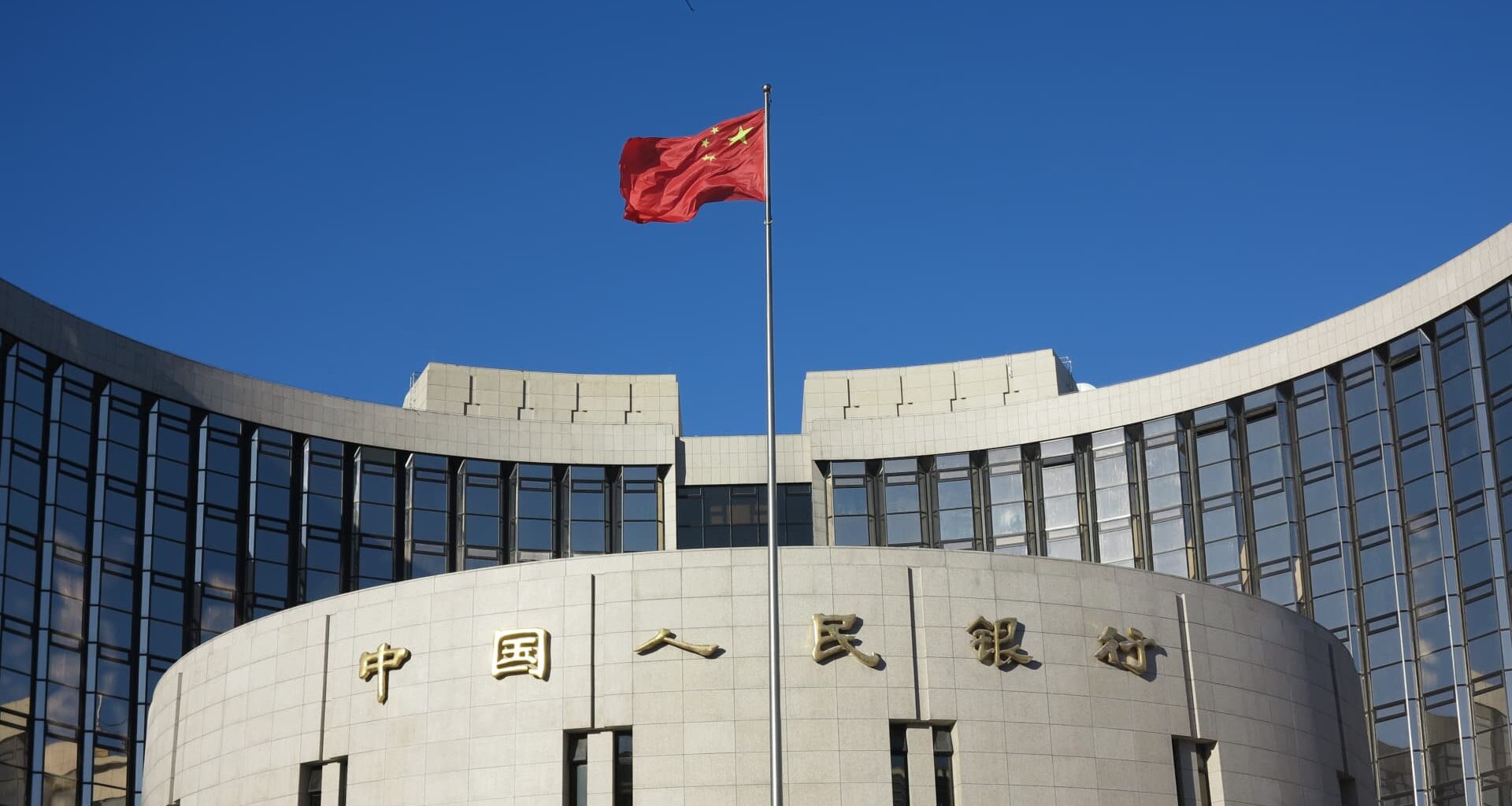
BEIJING, CHINA – JANUARY 06: The People’s Bank of China (PBOC) building is seen on January 6, 2025 in Beijing, China.
Visual China Group | Getty Images
China’s central bank kept its loan prime rates unchanged on Tuesday as the authorities focused on targeted support for specific sectors to bolster a slowing economy instead of broad policy easing.
The People’s Bank of China held its 1-year and 5-year loan prime rates at 3% and 3.5%, respectively, keeping them unchanged for an eighth straight month.
The 1-year rate influences most new and outstanding loans, while the 5-year benchmark affects mortgages.
The decision came as the world’s second largest economy lost its momentum in the final quarter of 2025, growing 4.5% year on year, the slowest pace since the reopening from stringent Covid curbs in late 2022.
In nominal terms, China’s GDP growth edged up to 3.8% year on year in the fourth quarter as deflation showed signs of easing, said Erica Tay, director of macro research at Maybank.
The GDP deflator — a metric that highlights changes in the prices of goods and services — narrowed to minus 0.9% in the fourth quarter amid tentative signs of recovery in industrial profits and tax revenues, Tay estimated, although that marked the 11th quarter of deflation in the economy.
“Beijing has become increasingly concerned about one of the worst domestic demand slowdowns in this century,” a team of economists at Nomura said in a note Monday.
Retail sales growth fell to a 3-year low of 0.9% in December, as household confidence continued to be battered by a years-long housing slump, a bleak job market and entrenched deflation.
Last week, the central bank lowered the interest rates on its structural monetary policy tools by 0.25 percentage point, reducing the 1-year rate for various relending facilities to 1.25% from 1.5%, effective Monday.
The PBOC also plans to set up a dedicated relending program for private firms and increase quotas for tech innovation loans, support for small and medium-sized private companies.
New bank loans shrank to a 7-year low of 16.27 trillion yuan ($2.33 trillion) in 2025, according to official data compiled by financial service provider Wind Information, underscoring sluggish borrowing demand and piling pressure on the government to provide more stimulus.
Deputy Governor Zou Lan told reporters last week that was “still room” to reduce both the reserve requirement ratio and policy rates this year, while acknowledging that conditions have improved for further monetary easing.
Banks’ net interest margins, or NIMs, have showed signs of stabilizing, Zou said, after years of contraction weighed on lenders’ profitability. The NIM has remained at 1.42% for a second straight quarter through September, but was 11 basis points lower compared to a year earlier.
The yuan’s recent appreciation has also helped create space for policy rate cuts, Zou noted. Chinese offshore yuan has gained over 1% against the dollar in the past month, breaching the key threshold of 7 per dollar last month for the first time since May 2023.
The offshore yuan was little changed on Monday, trading at 6.9571 against the greenback, according to LSEG, while the onshore yuan was 6.9612 per dollar. China’s 10-year government bond yield dipped modestly to 1.834%.
Policymakers have attributed the recent appreciation in yuan to a weakening dollar and easing geopolitical tensions between the U.S. and China, rather than a shift in monetary policy. The PBOC remains committed to prevent “overshooting” and keeping the yuan in a “reasonable and balanced equilibrium,” Zou said.
Economists at Goldman Sachs expected the PBOC to cut the reserve requirement ratio by 50 basis points and the policy rate by 10 basis points in the first quarter.
China’s manufacturing and exports have held up well as businesses navigated growing trade barriers around the world, with industrial production rising 5.9% for the entire year of 2025 and exports climbing 5.5%, taking its trade surplus to record of early $1.2 trillion.
Fixed-asset investment in urban areas declined 3.8% last year, the first annual decline in decades, dragged by the deepening slump in property investment and Beijing’s campaign to curb local debt risks and rein in excess capacity in some industries.

Weekly analysis and insights from Asia’s largest economy in your inbox
Subscribe now