
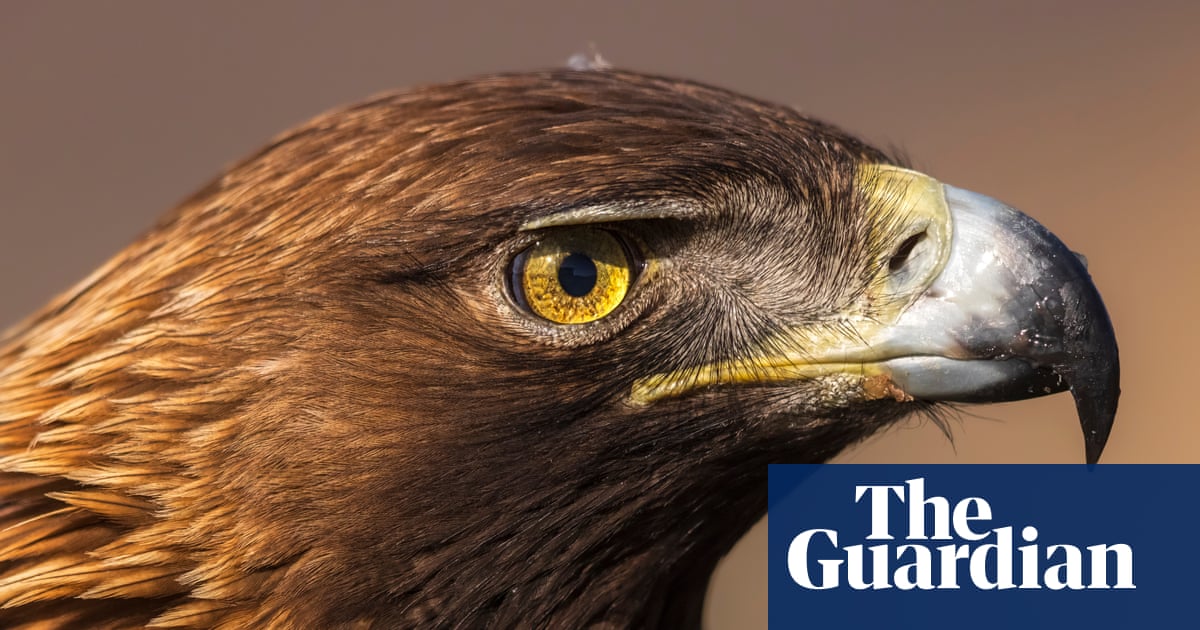
Many people look up to admire the silhouette of raptors, some of the planet’s largest birds, soaring through seemingly empty skies. But increasingly, research shows us that this fascination runs both ways. From high above, these birds are watching us too.
Thanks to the development of tiny GPS tracking devices attached to their bodies, researchers are getting millions of data points on the day-to-day lives of these apex predators of the skies, giving us greater insight into where they hunt and rest, and how they die.
The data shows human activity has hidden consequences across entire landscapes, and is more significant than previously thought.
One phenomenon the data has revealed is the “weekend and holiday effect” on days where more people tend to go to wilderness areas – such as the beach, or forest for hiking. Researchers found eagles expand their range on public holidays, an indication that they travel further to find food.
Dr Pascual López-López records the measurements of a female golden eagle, while technician Cristina Navarro Pérez safely restrains it in Castellón, Spain. It took 18 attempts between 2024 and 2025 to capture the bird
“We thought before that eagles would just ignore people in the forest,” says Dr Pascual López-López from the University of Valencia, but GPS tracking reveals the opposite. Birds will abandon breeding if there is too much human disturbance, and it makes it difficult for them to hunt prey (as prey species are often scared too) so they have to travel further to find food.
Researchers say better regulation is needed in protected areas to ensure that people are not climbing or hiking during the breeding season. “It’s not a matter of prohibition, but of regulation,” says López-López.
Our growing knowledge of raptor movements also reveals when they suddenly stop – indicating that they have been killed. From 2015, GPS technology revealed an alarming pattern of human-linked deaths among the endangered Bonelli’s eagles in the Valencia region of Spain. Collision and electrocution with overhead power lines was a leading cause of death. “We weren’t aware of the magnitude of the problem prior to this research,” says López-López.
The golden eagle is one of the most iconic birds of prey on the Iberian peninsulaA Bonelli’s eagle (Aquila fasciata) chick is measured and prepared to be fitted with a GPS tag
The story unfolding with this single species in one region of Spain is being repeated nationally, and potentially around the world. It is not just eagles that are affected: storks, bustards and flamingos are also killed when they collide with power lines or use them to rest in lieu of trees. In Spain, at least 33,000 raptors die each year from electrocution on power lines, which now crisscross much of the planet.
The GPS tracking study also shows that despite legal protections, Bonelli’s eagles are still being shot and poisoned by hunters, farmers and people who keep racing pigeons.
As early as the 1800s, naturalists observed how eagle and hawk populations declined as their habitats were cleared and cities expanded. Deforestation is causing population declines in the largest number of species globally, as most raptors are forest-dependent – if they lose their habitats it is harder to survive. But it is not all negative. Barn owls, for example, thrive in agricultural landscapes, while peregrine falcon populations are rising in urban areas.
López-López releases a golden eagle in Castellón. Its GPS transmitter provides unique data that will help shape future strategies for the species’ conservation
Now, a new form of human development is emerging as a threat – the huge growth in renewable energy.
Research published in December found that renewable energy expansion can undermine species reintroductions, with 9,000 griffon vultures dying from turbines in Spain in the past two decades (the country installed its first windfarm in 2005). “They change landscapes,” says López-López. “I’m in favour of renewable energy, and the energy transition is necessary. But the problem is the cost of these developments – we need better planning to think about which areas we should be doing them in.”
Globally, 18% of species facing threat of extinction are negatively affected by utilities and service lines (mainly electrocution), while 11% are negatively affected by wind facilities, research shows. Lead researcher, Christopher O’Bryan from the System Earth Science Research Institute at Maastricht University, says: “This is a complex problem and there is not necessarily going to be a silver-bullet solution. We have to accept trade-offs.”
A common buzzard (Buteo buteo) on an electricity pylon near Valencia. As humans push further into wild habitats, power lines pose an increasing threat to birds
But GPS tracking helps us understand what those compromises can be. For example, a 10-year research project tracking red kites found that a 25-metre (82-ft) increase in rotor diameter resulted in a five-fold increase in mortality. The researchers could give exact recommendations on how the blades should be built to reduce excess mortality. “It’s about finding win-wins,” says O’Bryan.
Elsewhere, short-toed eagles, Montagu’s harriers, booted eagles, bearded vultures, griffon vultures and Egyptian vultures are all being GPS tagged, and scientists are finding that “the causes of mortality are the same”, says López-López. Electrocution is a leading problem. “Even a modest reduction in adult mortality could prevent regional extinction.”
In some regions, conservationists are working with power companies to retrofit pylons. In Doñana national park, Spain, electrocutions of the Spanish imperial eagle have been reduced by 97% thanks to retrofitting pylons.
In the US, Duncan Eccleston, a researcher from EDM International which provides wildlife consulting services to electric utilities, estimates that approximately 15% of pylons in golden eagle habitat in the US would be considered “high risk” to eagles, with up to eight times greater likelihood of electrocution than the remaining pylons. “If we focus on fixing 15% of poles in golden eagle habitat, we’re really taking control of a vast proportion of the problem,” he says.
Bruna, a female Bonelli’s eagle that died from electrocution on power lines. Her death was discovered via her GPS transmitter, which enabled researchers to identify the pylon, leading to it being modified to help prevent other birds from dying
Electricity companies are motivated to solve this problem, because these interactions are not good for utilities, says Eccleston. “If you have an electrocution, there is a good chance they are knocking the power out.”
Many companies are now only building avian-friendly pylons, says Eccleston. “There is a lot of work right now to renew this system, and this is worldwide. There is an opportunity to do things differently and do things better.”
Find more age of extinction coverage here, and follow the biodiversity reporters Phoebe Weston and Patrick Greenfield in the Guardian app for more nature coverage