
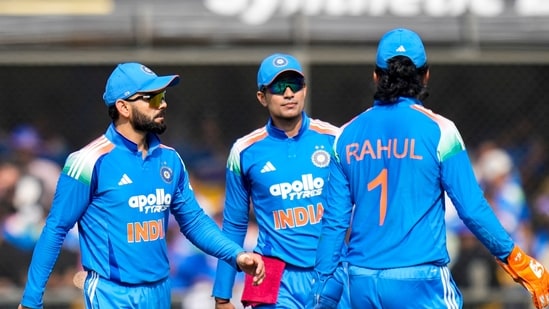
The 2019 World Cup semi-final. The 2021 World Test Championship final. The 2024 home Test series defeat and now the 2026 home ODI loss. New Zealand keeps doing India dirty time and time again. No one gave them a chance to walk away victorious when they touched base in India. The series began as everyone expected – with an Indian victory. But that was that as far as happy memories were concerned for Gautam Gambhir and Shubman Gill, as things quickly went downhill from there.
 India lost the three-match series against New Zealand. (PTI)
Defeats in the second and third ODIs handed India their first-ever home series loss to New Zealand. The image of head coach Gautam Gambhir after the agonising 41-run defeat in Indore summed it up best, his expression capturing genuine concern over the state of affairs with a World Cup just a year and a half away.
India might have won the series opener in Vadodara, but the outcome could have been very different had KL Rahul not steadied the ship after a mini-collapse late in the innings. The subsequent series defeat to the Kiwis once again underlines how the team management is getting its planning wrong, with little evidence of lessons being learnt from past failures.
The obsession with batting depth continues to come at the expense of bowling, which has visibly suffered. India struggled throughout the series to take wickets in the middle overs as Daryl Mitchell ran riot, piling up 352 runs across three matches, including two centuries and a fifty. It also feels like the clock has been turned back to 2016: while the viral Instagram trend may be in full swing, India appear to have taken it too literally, with the batting once again looking overly dependent on Virat Kohli.
Why did India lose?
Only Kohli emerged with real credit from the three matches against New Zealand, returning scores of 93, 23 and 124 to finish with an aggregate of 240 runs. There was hope in the series decider for as long as he occupied the crease, but his dismissal proved the final nail in the coffin as New Zealand sealed a famous win and silenced the Indore crowd. At 37, Kohli scoring runs in ODIs is routine, and nothing less is expected of the star batter. The pressing question, however, is what the rest of the batting order is contributing?
Shubman Gill, the current ODI captain, has long been viewed as the Prince-in-waiting, destined to inherit the crown from Kohli. But compare the two batters at 26, and the contrast is stark. When Kohli is in rhythm, he rarely throws his wicket away against the run of play. Gill, however, did the exact opposite in the opening two ODIs, gifting his wicket soon after reaching fifty. On both days, India had chances to put the game to bed, but lapses in concentration from Gill allowed New Zealand to claw their way back. In the series decider, he was undone by an incoming delivery from Kyle Jamieson, once again exposing a long-standing weakness.
Rohit Sharma entered the New Zealand series in a rich vein of form after producing a masterclass against Australia and South Africa. However, pacers Kyle Jamieson and Zakary Foulkes kept him in a stranglehold inside the Powerplay, forcing him into false shots. His dismissals owed more to poor timing, perhaps a sign of things to come, as the Hitman is not ageing in reverse and his match exposure remains limited, given he now plays only one format.
KL Rahul, long criticised for failing to finish games under pressure, fell into that trap once again in the series decider, playing a loose shot early in his innings. That said, there is no need for harsher judgment just yet, considering he had earlier rescued India in the Rajkot ODI after a top-order collapse. Shreyas Iyer, meanwhile, scored 49 in the opening match but failed to build on it in the next two games. The right-hander may need time to find his rhythm, as he is coming off a lengthy injury layoff.
Toothless bowling
In the absence of Jasprit Bumrah, Kuldeep Yadav is the lone genuine wicket-taker in India’s ODI XI, and with the left-arm spinner enduring a series to forget against New Zealand, it was no surprise that the hosts struggled to rein the visitors in. Mitchell arrived well prepared, repeatedly taking on Kuldeep in all three matches the moment he was introduced into the attack.
Head coach Gautam Gambhir also has plenty to answer for. Why was Arshdeep Singh left on the bench for the first two games? The T20 World Cup cannot be the explanation. If that was the logic, then what justified Kuldeep playing all three matches? Ever since Gambhir took charge, wicket-taking has seemingly become an afterthought, and the team is now paying the price.
The inclusion of Arshdeep Singh shifted the balance in the series decider, as he struck in the very first over by removing Henry Nicholls. That early breakthrough was significant, especially after the Kiwi openers had put on a century stand in the series opener, with Mohammed Siraj and Harshit Rana unable to make inroads with the new ball.
Rana showed promise with both bat and ball throughout the series and can certainly be groomed for the future. However, questions must also be directed at the BCCI chairman of selectors, Ajit Agarkar. Why is Mohammed Shami still sitting at home? When Jasprit Bumrah is unavailable, shouldn’t a proven match-winner be recalled? Shami has been putting in the hard yards in domestic cricket for Bengal, and the selectors may soon have to act before the opportunity slips away.
A final word on Nitish Reddy. The management may offer several explanations for persisting with him as a pet project, but replicating what Hardik Pandya brings to the side is no easy task. Reddy is talented and scored a fifty in Indore. But his bowling is nowhere close to Pandya’s. He bowled eight overs in the decider without ever looking likely to pick up a wicket or even tie down an end as Mitchell and Phillips went on the offensive. India’s fascination with all-rounders needs rethinking if the side is to regain its mojo. Either Reddy is played as a specialist batter, or the team must look elsewhere for a genuine all-round option.
The bilateral series loss may not trigger widespread soul-searching, but Gambhir himself said after the ODI defeat to Australia that individual milestones mean little when a series is lost. His predecessors, Ravi Shastri and Rahul Dravid, also shuffled personnel, yet bilateral losses were few and far between. Under Gambhir, that list is growing, and it is time he reflects on his own missteps before it is too late.