
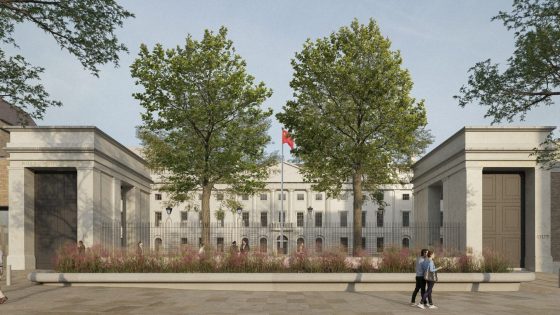
The 2.3ha scheme, proposed to be built opposite Tower Bridge and the Tower of London UNESCO world heritage site, consists of accommodation, offices and a cultural centre for the Chinese Embassy. It combines new buildings alongside a range of repurposed existing buildings on the former Royal Mint site.
Housing and communities secretary Steve Reed approved the scheme today (20 January), agreeing with the planning inspector’s conclusions following the planning inquiry last February.
His decision follows three missed, self-imposed deadlines for making a ruling and amid a mounting political and media backlash in the UK and US over concerns that the building posed a national security risk.
Of particular concern has been the proposed network of 208 underground rooms, which The Telegraph reported last week sat next to fibre optic cables carrying sensitive financial and internet data across the City of London. The newspaper said it had obtained unredacted plans showing a room within the subterranean complex near the cables, which, it wrote, ‘Beijing [had] sought to keep from public scrutiny’.
This revelation caused six Labour MPs to call on the prime minster to reject the proposal. A senior White House official also weighed in on the situation, raising fears that the new embassy could be used to ‘exploit the critical infrastructure of our closest allies’. Technically, however, the decision has remained with the housing secretary.
Meanwhile, shadow home office minister, Alicia Kearns, called the lack of security concern ‘disappointing’ during a parliamentary Q&A, and claimed the embassy would give China a ‘launch pad for economic warfare against our nation’.
Reed had previously been expected to make a ruling on the embassy last month. But this was pushed back to allow time to consider particular security implications raised by government ministries.
Previously, Reed’s predecessor, Angela Rayner, had been due to issue a verdict by 9 September, but postponed her decision in order to receive further information from China.
In August, she asked the Chinese embassy to supply further information over the blanked-out sections of submitted planning documents, which had been ‘redacted for security reasons’, according to the BBC. These included drawings seen by the AJ for the cultural exchange building and Embassy House elements of the application.
Last year, then-home secretary Yvette Cooper and then-foreign secretary David Lammy signalled cautious support for the proposals if China amended the scheme to include a ‘hard perimeter’ around the embassy to solve concerns over public safety. But at the planning inquiry, China signalled that it would not amend its plans.
In November, the Guardian reported that MI5 did not have any security concerns about the project, while the Metropolitan Police withdrew an earlier objection.
Rayner originally called in the plans in October 2024, three months after China resubmitted an identical scheme to that previously rejected in the wake of Labour’s July election victory.
Before that, Beijing had appeared to walk away from the project and did not appeal to the planning inspectorate before a deadline. It claimed Tower Hamlets Council’s rejection of the scheme in December 2022 was ‘without merit and [had] no basis in planning policy’.
Tower Hamlets said its committee had rejected China’s application ‘due to concerns over the impact on resident and tourist safety, heritage, police resources and highway safety given the congested nature of the area’.
Other reasons for the rejection included potential harm to surrounding heritage assets such as the Tower of London, and the impact of the development on residents of the neighbouring Royal Mint Estate. However, the council’s planning officers had described the scheme as ‘well-designed’, and recommended its approval.
Opposition was also mounted by protesters and local politicians because of China’s repression of the predominantly Muslim Uyghur people, and David Chipperfield was criticised for accepting the commission (Is the new Chinese embassy Chipperfield’s most controversial job?).
Prime minister Keir Starmer has a planned diplomatic trip to China, according to reports. The issue of approving the embassy had previously been raised in Starmer’s first meeting with his Chinese counterpart, Xi Jinping.
What secretary of state said in his ruling
‘[He] agrees that the reuse of this brownfield site carries substantial weight’
‘[He] has reviewed the 24 plans which do not show use information for all rooms. He has also reviewed room use information provided in some cases on cross-sectional drawings. In the circumstances of this case, given the material which is before him, and the nature of the proposed embassy use, the secretary of state does not consider that there is real as opposed to theoretical ambiguity as to what planning permission is sought for, or that it is impossible properly to understand the scope of the uses proposed.’
‘[He] agrees with the Metropolitan Police Service’s position that ‘the location of the Royal Mint site means that large-scale protests … are able to be policed safely, balancing the rights of protestors with the local community and road users … and notes that protests are common across London, and the Metropolitan Police Service is highly experienced.’
‘There is no suggestion that the operational development permitted by any grant of planning permission would interfere with the cables, nor that a lawful embassy use of the site would give rise to any such interference. He notes that no bodies with responsibility for national security, including the Home Office and Foreign and Commonwealth and Development Office, have raised concerns or objected to the proposal on the basis of the proximity of the cables or other underground infrastructure. He considers that the lack of objection from these bodies on this issue carries significant weight.’
What the planning inspector said
‘In design terms, this is an exemplary scheme. This is in terms of architectural design and heritage, which promotes sustainable adaptive reuse while making considerable positive enhancements correcting the failures of a poor quality, damaging, 1980s scheme.’
‘The proposal would conserve and enhance nationally significant designated heritage assets and enhance their settings. It would enhance the character and appearance of the conservation area. The Tower of London World Heritage Site would also be enhanced. The setting of other assets, including Tower Bridge, would be preserved.’
‘The proposed development is of international importance and would enhance London’s standing as an international city. The proposals would support diplomatic and trading relations with the People’s Republic of China.’