
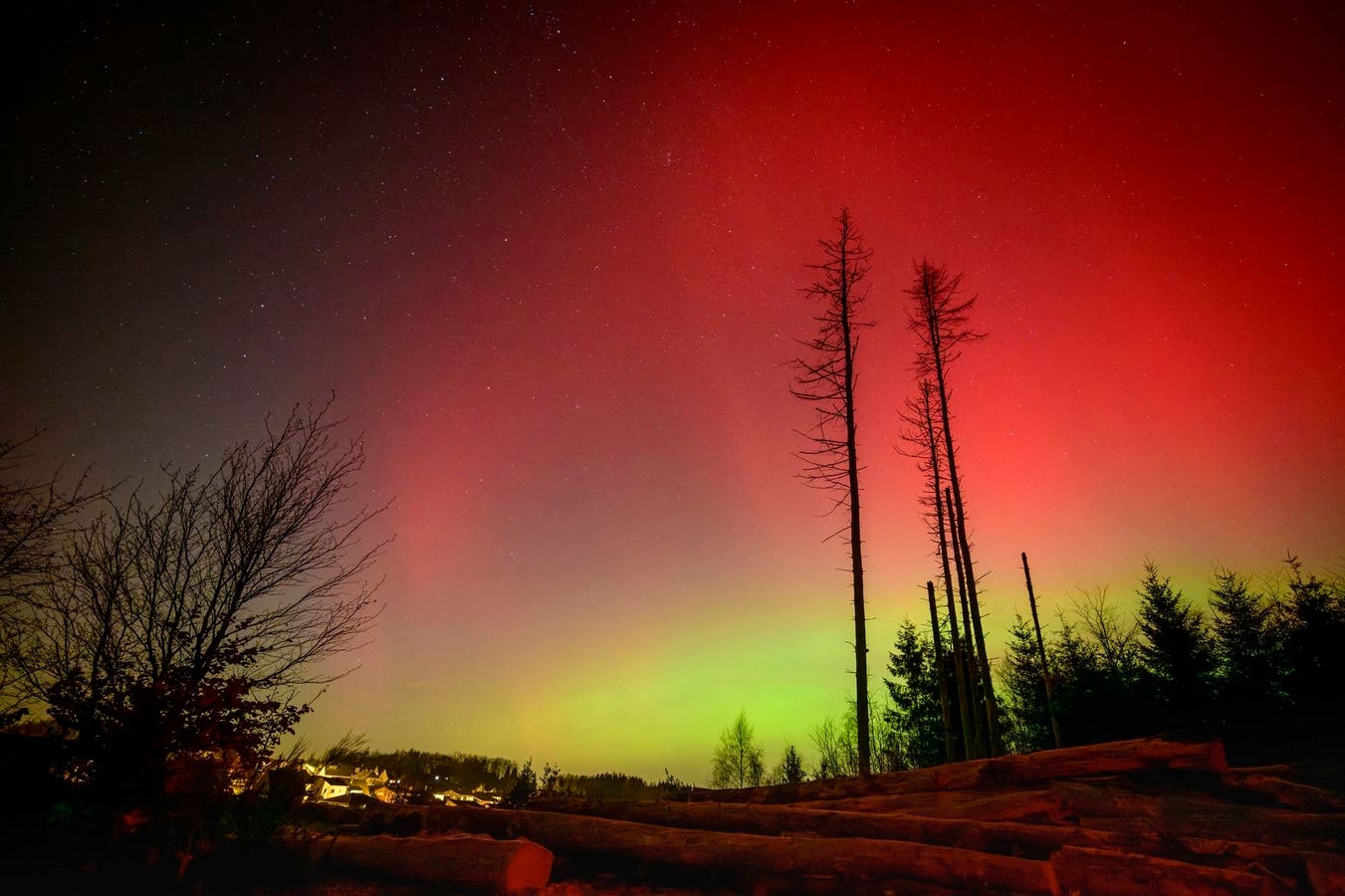
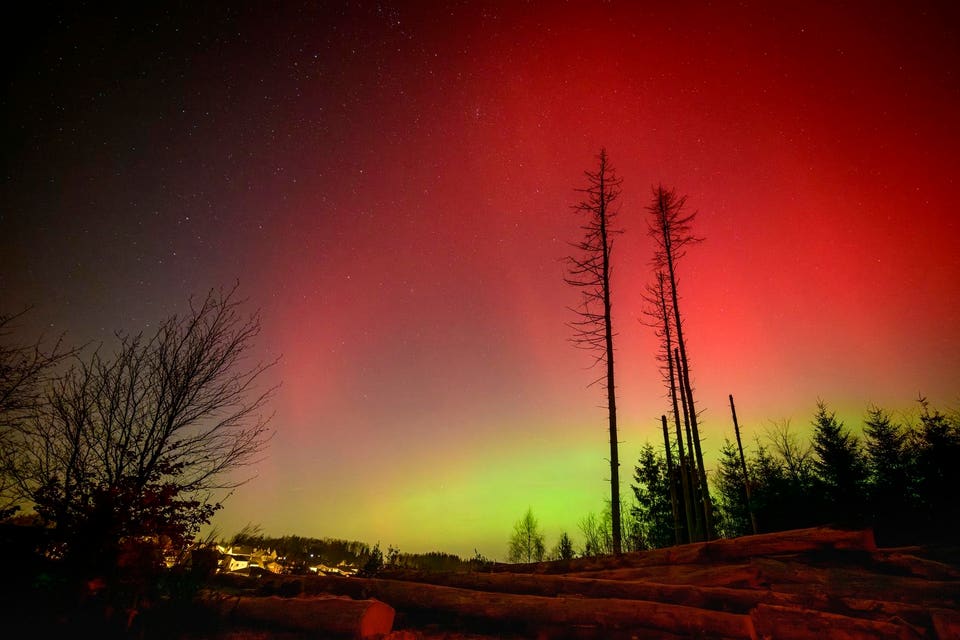
Northern Lights above Breckerfeld, North Rhine-Westphalia, western Germanny, on Jan. 19, 2026. A NOAA forecast suggest that Northern Lights may be visible in northern U.S. states on Jan. 20, 2026. (Photo by SASCHA SCHUERMANN / AFP via Getty Images)
AFP via Getty Images
The Northern Lights could be visible across parts of 10 northern U.S. states overnight Tuesday, Jan. 20, through Wednesday, Jan 21, 2026, according to a forecast by the National Oceanic and Atmospheric Administration’s Space Weather Prediction Center. Here’s how to photograph the Northern Lights with a phone.
Although it won’t be anywhere near as powerful as last night’s spectacular display across China and Europe during a G4-level geomagnetic storm, the forecast is for a lesser G1 event as Earth’s magnetic field responds to the after-effects of a as a “full halo CME” — a coronal mass ejection. The CME, a cloud of charged particles ejected from the sun, left the sun on Sunday, Jan. 18, in the wake of a massive X1.9-class solar flare.
According to Spaceweather.com, the G4 event is subsiding, but minor G1 to strong G3 geomagnetic storms may occur on Jan. 20, with “high-latitude sky watchers” advised to remain alert for auroras. “The geomagnetic activity is expected to reach Minor to Severe (G1 to G4)
levels on 20 Jan, as the combined influences of +CH HSS and the Halo CME
passage persists,” said NOAA, citing a coronal hole and a fast-moving stream of solar wind, as well as the CME. .
With a 3%-lit waxing crescent moon setting soon after dark on Tuesday, the night sky ‚ if clear — will create perfect conditions for long exposure photography to reveal any auroras, which could become visible beneath the Arctic Circle and into mid-latitude U.S. states.
ForbesUpgraded ‘Severe’ Northern Lights Alert For 24 States Monday After Solar FlareBy Jamie CarterNorthern Lights Forecast: What To Expect On Tuesday
NOAA’s latest forecast calls for a G1-rated geomagnetic storm beginning as it gets dark in North America on Monday — but possibly strengthening to G3. However, the exact timing of space weather is very difficult to predict because it depends on the speed of the solar wind.
Always monitor NOAA’s 30-minute aurora forecast and SpaceWeatherLive.com, as well as apps such as Aurora Now, My Aurora Forecast, SpaceWeatherLive or Glendale Aurora, which provide live solar wind data.
NOAA’s aurora viewline forecast for Tuesday, Jan. 20, 2026.
NOAANorthern Lights Forecast: Where And When To Look
According to NOAA’s aurora view line, the Northern Lights are most likely in higher-latitude regions. U.S. states that may see aurora include Alaska and (northerly parts of) Washington, Idaho, Montana, Wyoming, North Dakota, South Dakota, Minnesota, Wisconsin, Michigan, New York and Maine.
If a G3 geomagnetic storm results, that could mean more states seeing aurora, including Oregon, Nebraska, Iowa, Illinois, Indiana, Ohio, Pennsylvania, Massachusetts, Vermont and New Hampshire. However, states farther north will always have the best odds.
How To Observe The Northern Lights
Since this may be a photographic aurora (see below), for the best views, locate a dark place using the Dark Sky Place Finder and a light pollution map. The darker the northern sky, the more vibrant the display — even during moderate geomagnetic storms. A clear northern sky will be required.
Even during moderate storms, auroras can appear as faint, gray or milky arcs to the naked eye, while appearing vivid in photographs. Modern smartphones are capable aurora cameras when conditions cooperate. Enable Night Mode or Pro Mode, use the main camera lens, and stabilize the phone with a tripod or solid surface.
What Causes The Northern Lights
The Northern and Southern Lights (aurora borealis and aurora australis) result from an interplay between the solar wind — a stream of charged particles constantly flowing from the sun — and Earth’s magnetic field. Auroras occur when charged particles from the solar wind accelerate down Earth’s magnetic field lines and collide with oxygen and nitrogen atoms high in the atmosphere. These collisions excite the gases, which then release energy as shimmering light.
Though the sun appears to have reached its solar maximum in late 2024, strong solar activity continues and is expected into 2026. The declining phase of solar maximum is notable for having extreme solar events, so more landmark aurora events are likely in the coming months.
Wishing you clear skies and wide eyes.