
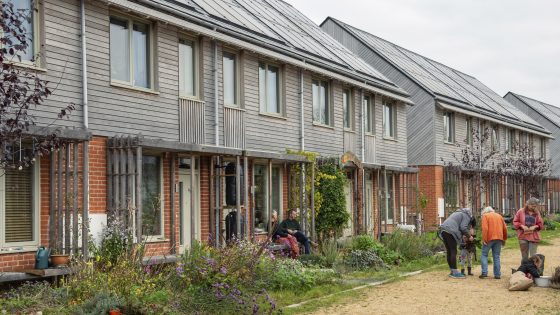
The initiative sets out a £5 billion fund to give low-income households free energy upgrades. The government has also offered zero and low-interest loans to install solar panels, aiming to triple the number of UK homes with the panels by 2030.
In social housing developments, the plan could see entire streets upgraded at the same time.
New homes will also be required to have solar panels fitted as standard following the introduction of the Future Homes Standard early this year.
The programme includes greater protections for renters, which will support landlords in making energy upgrades in a ‘fair way’ over several years, in an effort to raise half a million families out of fuel poverty by 2030.
All households will have access to a £7,500 universal grant for the installation of heat pumps, as well as a first-of-its-kind offer for ‘air-to-air heat pumps’, which also cool homes during the summer months.
Energy efficiency schemes will now be delivered under the new Warm Homes Agency, which will bring together Ofgem experts and schemes that are currently split across government departments.
Prime minister Keir Starmer said: ‘A warm home shouldn’t be a privilege, it should be a basic guarantee for every family in Britain.
‘Today’s plan marks a turning point. It will help to slash energy costs and lift up to a million people out of fuel poverty.
‘This is a government bearing down on the cost-of-living crisis. By driving bills down for good and upgrading millions of homes, we’re giving people the security and the fair shot they need to get on in life.’
The government has called its initiative the ‘biggest public investment in home upgrades in British history’ saying it will meet the ‘record demand’ for domestic clean energy systems.
Energy secretary Ed Miliband said: ‘It is a scandal that millions of people in our country do not have the security of a home that is warm, affordable and safe.
‘With this investment, we embark on a national project to turn the tide – waging war on fuel poverty and taking another step forward in tackling the affordability crisis for families throughout Britain.’
National Retrofit Hub co-director Sara Edmonds said the organisation welcomed the plan as ‘an opportunity to expand the definition of success in retrofit, focusing on the real impact retrofit has on people’s lives’.
She added: ‘Meeting fuel poverty and carbon targets is vital, and evidence shows people value warm, healthy, affordable homes with greater comfort and less damp and mould.’
Home upgrades available under the new scheme will include solar panels (photovoltaic and thermal), heat pumps (ground source and air source, including air to air), home and heat batteries, smart controls, insulation (wall, floor, and roof) and draught proofing.
Further comment
Marion Baeli, partner – sustainability + transformation, 10 Design
‘The Warm Homes Plan marks a quiet but decisive shift towards a whole building approach, which I have been advocating for a long time, recognising that insulation, heating, ventilation and energy systems must work together for homes to be warm, affordable and resilient.
‘Crucially, it moves retrofit beyond isolated household measures and treats it as infrastructure. By prioritising street and area based delivery, it recognises that neighbourhood scale retrofit enables shared solutions, lower costs, better quality and faster progress – especially in social housing, where dense urban areas and mixed tenure streets make piecemeal approaches ineffective.
‘The Plan also embraces step by step retrofit. Instead of pushing households into all or nothing upgrades, it supports sequencing improvements: starting with fabric and controls, then moving to clean heat, generation and storage. This reduces disruption, spreads cost and avoids locking homes into short term fixes that hinder long term decarbonisation.
‘Quality is no longer treated as secondary. The Plan acknowledges the failures of past delivery models and the need for stronger coordination and assurance as the sector scales. There is growing recognition that poor design, weak oversight and fragmented responsibility are as damaging as underfunding.
‘The challenge now is whether delivery can match the ambition: shifting from fragmented interventions to genuinely integrated, well designed upgrades that treat homes as systems, and communities as the unit of change. Needless to say, addressing such a challenge will require a substantial, well trained retrofit workforce, and organisations such as the Retrofit Academy will be central to providing the skills and training needed.’
Dan Watt, director (building services, engineering and sustainability) at Civic
‘The Warm Homes Plan matters not just because of the scale of investment, but because of what it signals about how we value our homes and the people who live in them. At its best, improving the performance of our homes is about more than carbon targets; it’s about comfort, health and dignity. For too long, energy efficiency has been discussed in technical terms. This announcement begins to bridge the gap between national and environmental ambition and what people actually feel day to day – warmer homes, lower bills and places that are easier to live in. What we must do is ensure that people who can access these grants are aware of how to do so; and the real impact it can make.
‘But there’s also a wider opportunity here. Retrofitting at scale is one of the most effective ways to cut emissions while adapting our housing stock to a changing climate. This is where a system thinking approach becomes vital: programmes like the Warm Homes Plan are most powerful when they’re joined up with planning policy, building regulations, public health and climate adaptation strategies. Issues such as energy efficiency, overheating risk, fuel poverty and resilience are deeply interconnected, and addressing them in isolation limits their impact.
‘If we take this opportunity to join the dots – aligning retrofit investment with better design, smarter regulation and long term climate thinking – initiatives like this can genuinely move the needle. Not just towards lower emissions, but towards homes that are healthier, more resilient and fit for the future.’
Félicie Krikler director, and head of residential at Barr Gazetas
‘With its ambitious commitment to upgrade millions of homes and lift one million families out of fuel poverty, the Warm Homes Plan places retrofit firmly at the forefront of the construction agenda. It makes clear that retrofitting is essential for efficiently upgrading the UK’s housing stock and tackling the energy crisis while keeping long term sustainability in mind.
‘That said, ambition alone won’t guarantee outcomes. We’ve seen that our construction sector workforce continues to decline 1.6% year on year, so the pipeline of projects that the government has promised will require a huge push from both private and public sectors. We also need to consider different housing typologies and user needs across the country. No matter what framework is in place, we need to implement localised retrofit strategies and a commitment to upskilling if we want to see this delivery.’
Neb Augustinov, national retrofit lead, Ridge
‘The Warm Homes Plan is a genuinely ambitious step forward, bringing together years of piecemeal schemes into a single national push to upgrade the UK’s housing stock. Done well, it has the potential to do more than cut energy bills, improving everyday life at home through warmer rooms, lower costs and homes that feel healthier and more comfortable to live in.
‘If the focus stays on performance in real, lived-in homes, the Warm Homes Plan can drive lasting improvements at scale, rather than short-term fixes. That’s why the emphasis on low carbon technologies like solar panels and heat pumps needs to be considered as part of a whole-house approach. From our experience advising local authorities and landlords on how best to install these technologies, we know that installing heat pumps in homes with poor insulation can leave residents facing higher bills rather than lower ones, particularly across older parts of the housing stock.
‘To succeed, the plan will need the right solutions applied in the right way, in the right homes. Alongside new systems, early attention to insulation, windows, ventilation and moisture control is essential. Without that, well-intentioned upgrades risk storing up problems rather than solving them.’