
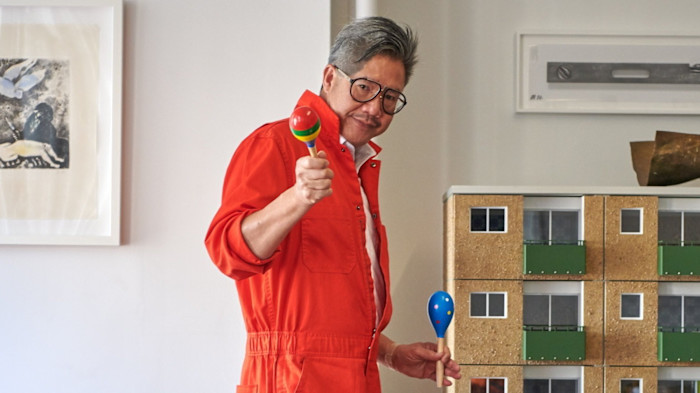
“I’m a next chapter kind of person,” says Kulapat Yantrasast, when we meet in Bangkok. The Thai architect is here for the opening of his first significant project in his home country — a reworking of a 1980s warehouse into a private museum of contemporary art called Dib Bangkok — and he is dressed in a black corduroy jumpsuit and a furry-topped baseball cap. On his breast is a sparkling diamanté brooch spelling out the word “Kulaparty”; on his feet are Crocs decorated with silver studs.
Architects have often self-branded — Le Corbusier’s heavy-rimmed glasses, Richard Rogers’ bright green collarless shirts — but few as exuberantly as Yantrasast, who says he hasn’t “seen a suit jacket for 20 years”. If his is a look that demands you meet him on his own terms, then many are happy to do so.
At 58, Yantrasast is reaching peak visibility, with an array of projects that makes his next chapter look like a busy one. Among them is the new Byzantine and Eastern Christian Art department and Roman antiquities trail at the Louvre — 60,000 sq ft of museological real estate that represents the French institution’s biggest overhaul since 2012. A new Contemporary Art Center in Makati City, Metro Manila — its 70,000 sq ft contained in a delicate flowerlike wooden construction — will be completed in 2027. There is also the ILMI Science Discovery and Innovation Center in Riyadh, its glittering glass globe likely to become a symbol of Saudi Arabia’s conspicuous progression and increasingly glitzy skylines.
The day before our Bangkok meeting he had also made a quick stop in Delhi, where he recently landed the job of designing the new Yuge Yugeen Bharat Museum (which will replace the National Museum of India). In a dramatic reuse of the North and South Blocks of Lutyens’ and Baker’s 1930s Secretariat Buildings — once the architectural definition of British rule — it will contain 950 new galleries across more than 1mn sq ft. “I understand the context of Asia,” says Yantrasast, who won the commission after a competition that featured four other practices, including Zaha Hadid Associates and IM Pei.
 Speed Art Museum in Louisville, Kentucky, whose expansion was designed by Yantrasast
  Grand Rapids Art Museum, Michigan, another Why project
Since setting up his company, Why Architecture, in 2004, he has completed several major cultural projects in the US — often reworkings of or additions to existing buildings. Yantrasast defines his approach as “acupuncture architecture”. “Our work is very intervention-based,” he says. “I like to think that what we do decides the life, rather than the form. If you are going to do a building, an interior, the point, first and foremost, is the lived experience that it provides. One thing I learnt from doing museums in America is the importance of the visitor experience.”
Why Architecture is split between New York and Los Angeles, and the team is a mixture of architects, landscape designers and researchers. “We work in a state of slight chaos,” says Brian Butterfield, the lead architect on Dib Bangkok, “but it seems to yield the right results.” In May, an incisive $70mn reworking of the Rockefeller Wing of the Arts of Africa, the ancient Americas and Oceania at the Metropolitan Museum of Art in New York was particularly well received.
Why Architecture (with Beyer Blinder Belle Architects) reinstated the transparency of the original 1980s design of the Kevin Roche and John Dinkeloo glazed extension, allowing views across Central Park, and treated 1,800 objects to a display that unravelled multiple and complex histories, rather than presenting continents as monolithic slabs. “The most privileged part of my job is getting to meet the scholars,” he says. “And these curators pour their hearts out to you, because they want you to help them tell their stories.”
 The reworked Rockefeller Wing at the Met, New York © Bruce Schwarz
Yantrasast grew up in Thailand, but went to Tokyo to study for his degree, master’s and PhD. “In Thailand, contemporary architecture in the 1980s was either about putting a traditional roof on a modern-looking building, or following the glass-office block style that could have been in Houston. I wanted to discover a better language for the people, the climate, the context, and I realised I mustn’t turn to the west for that. So I went to Japan.”
Later, in the mid-1990s in Bangkok, he met Tadao Ando, the celebrated king of concrete, whose minimalism and rigour imbue his buildings with an almost spiritual quality. “There was a bit of snobbery around him when I was in Tokyo, that he was more a stylist than an intellectual,” says Yantrasast. “But it was love at first sight.” They went on to work together for eight years.
In 2004, Yantrasast peeled himself away from Ando — “I travelled all over the world with and for him, and it was amazing, but it wasn’t my party,” he says — and found his way to Los Angeles. “I was attracted by people like Frank Gehry and the Eameses, and all the immigrants from Germany in the 1940s who had gone to LA.”
 Marciano Art Foundation, Los Angeles
There Yantrasast became the go-to architect for both concrete and glass houses, and art foundations such as the Marciano, a Masonic temple repurposed as an altar of contemporary art. “That is the nature of Los Angeles, a lot of private money,” he says. “I’d like to have done more public parks by now.”
The Bangkok project came to him in 2018. The man behind it, Petch Osathanugrah — a flamboyant Bangkok billionaire businessman, pop star and art collector — had been envisioning a museum for several decades. “He’d been talking to everyone — SANAA, OMA, all the glamorous ones,” says Yantrasast. “I don’t see myself as sexy, I’m a problem-solver. But then we became friends.” The family had acquired the warehouse and Yantrasast set about making it a place to exhibit their exceptional collection of western and Thai art from 1960 to now.
“We agreed that Bangkok has enough colour, that what it needed was something relatively serious and resolved, more austere, more Zen,” says Yantrasast. “The building was an I-shape — just a long concrete structure — and we made it into a U-shape to create a courtyard. I’m very much a courtyard person.” He also added a cone-shaped structure clad in silvery mosaic tiles that hovers over a pool of dark water, and a sawtooth roof line.
 Chapel and skylights at Dib Bangkok © Dib Bangkok/W Workspace
Inside, the spaces are long and lean, the fully glazed ground floor filled with light, the two upper floors with high ceilings. It is lightly finished with polished concrete floors and long picture windows. “I don’t like being in a building and not knowing where you are,” says Yantrasast.
The inaugural exhibition, overseen by the museum’s Japanese director Miwako Tezuka, knits together the strands of the collection, beginning with an interactive piece by the Australian Marco Fusinato, which invites visitors to hit a reverberating wall with a baseball bat, but quickly moving to Arte Povera works by Jannis Kounellis. There is a stunning Anselm Kiefer — a huge room-sized work of towering bronze blooms — and sculptures by Montien Boonma, Thailand’s pre-eminent artist who died in 2000 aged just 47.
Osathanugrah died unexpectedly a few years ago, so the inauguration of Dib (pronounced “dip” and meaning raw or authentic) and the running of the myriad family businesses has fallen to his 32-year-old son Chang. “We want Dib to serve as a place to slow down, away from the hustle and bustle and chaos of urban living,” says Chang. “And Kulapat understood that, and that we want this to highlight Bangkok as a cultural beacon.”
 Yantrasast, right, and art photographer Andreas Gursky at the Dib site during construction
As the opening party unfolded on the Saturday night, Chang — the heir to this empire and also to his father’s combination of artistic and business ambition — took to the stage with his band and played a range of songs, from Talking Heads’ “Psycho Killer” to Lou Reed’s “Walk on the Wild Side”. Yantrasast, now in a bright orange Adidas issue jumpsuit and chunky beige Crocs, saw his courtyard come to life and smiled.
Find out about our latest stories first — follow FT Weekend on Instagram, Bluesky and X, and sign up to receive the FT Weekend newsletter every Saturday morning