
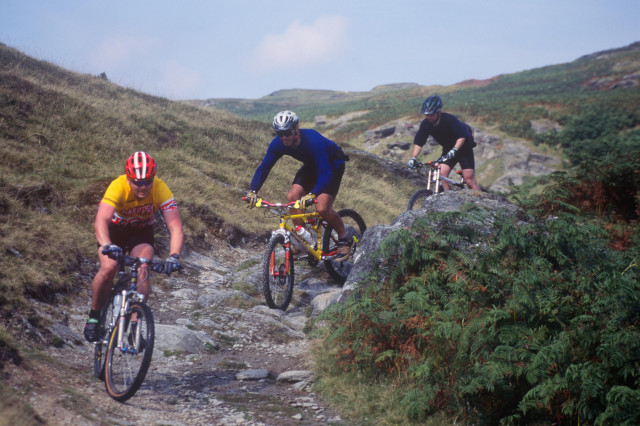
[Images by Steve Thomas]
I’ve little doubt that younger eyes roll when those of us old enough to, now, know better mumble on, all purple-hazed and dayglo eyed, about the 1990s and the golden era of mountain biking. Why do so many look back with a fading yet bold memory reels of the sport in the ’90s? Should it really be known as the ‘golden era’ of our sport?
Well, in an analogue nutshell, probably it does indeed deserve that distinction. Why? Because it was an era that saw an almost new and rebellious genre of cycling go from the dusty fringes of acceptance to becoming fully certified by the governing bodies of cycling (the feds), and earning full Olympic status too, thus becoming “famous” fast in cycling terms. Our great sport effectively grew up in a fast and furious way, and became fully legit in every possible way.
From the fully rigid garden gate-like contraptions of the 1980s through to carbon fibre full suspension bikes with disc brakes, from strapped in to clipped in, from multiple disciplines and unruly races to dedicated and fully regulated and televised World Cups and World titles. Our riding went from guess-and-go map reading to following dedicated routes and trail centres. The 90s were where it all evolved – and, at least for a good part of the 90s, the sport was indeed raging, only now it was with the one-eyebrow raised backing of the machine rather than against it, as it was in the 80s.
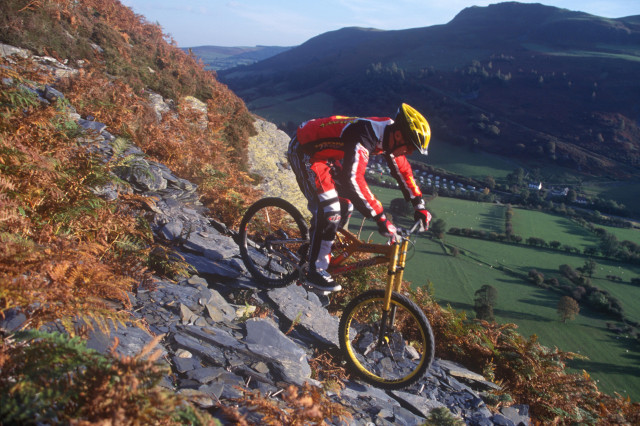
Glancing back to a time of four UK TV channels (Sky was coming soon), VHS and cassette tapes and paper magazines, it’s hard to recount the finer details and dates of the 1990s timeline of mountain biking. Many of us who were around will no doubt have specific details and happenings etched into our distant and dusty memories, yet these are surprisingly hard to pull together accurately, and even though I have communicated with many of the major figures from the era, few of us can remember these hard timeline facts and dates. I guess, we were all just way too busy ratting around on rigid bikes, having the times of our lives to be concerned about such things and future-proofing them.
So do forgive me if I miss-date or skimp on some finer details, as we only have a certain amount of resources and space, and this is not about the stats; it’s more a tale of a great and evolutionary era for British mountain biking.
When racing got really serious
As 1990 came around, things were starting to get serious in mountain biking. Although in the UK we’d had some form of national title races already, be they “open to all comers” races or series-based, there was a lot of crossover between the various non “officially regulated” series and the emerging BMBF (British Mountain Bike Federation – now BC) events.
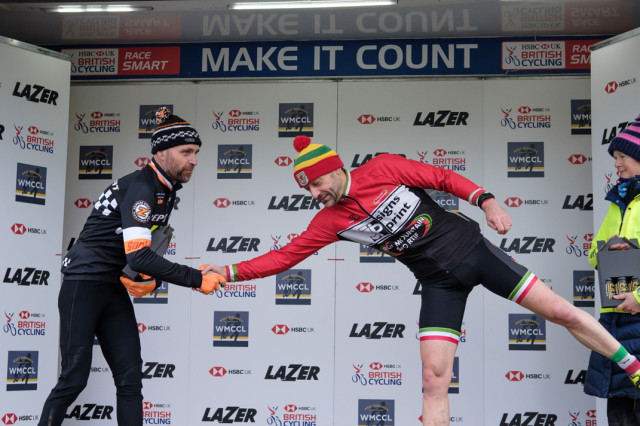
TG3.jpg, by Steve Thomas
By this time, the British Peugeot-sponsored racers Tim Gould and David Baker were already fast becoming global stars of mountain biking. Their results and wins in the US NORBA series, in the new Grundig series and medals earned in unofficial world championships, already made them, arguably, bigger in America than in the UK at that time, as the sport was still a few steps behind in evolution and stature – till then.
When late summer 1990 came around, mountain biking was granted its first-ever UCI World Championship, a race held at altitude in Durango, Colorado. A sizeable British contingent went west for the historic occasion, and Tim Gould was to finish third in the cross-country race, although he did also win the unsanctioned hill climb race too. Mountain biking had finally, officially arrived.
The sport was absolutely on fire during the early 1990s in the UK, with the National Series and National Championships firmly finding their places, plus a whole list of other epic races and formats of the sport also thriving, not to mention the UK hosting superb World Cup rounds too, and even an MTB Tour of Britain a few years later. Naturally, as the sport became more popular, it got more rules, regs and specific formats.
By this time, various outside brands, such as Carlsberg, Grundig, Pepsi, Volvic, Nissan and more started paying sponsorship attention to the sport in the UK (and elsewhere), and the same reverberated within the bike industry. With the big bike brands and the evolving specialist UK MTB brands, this fuelled a real racing boom, not only on home turf – there were a growing number of Brits riding high in the World Cup too.
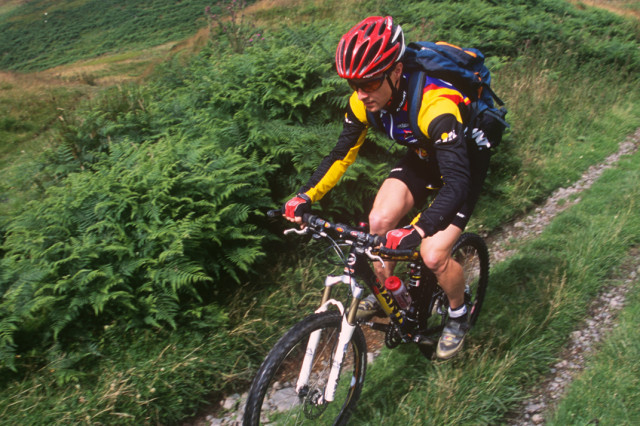
Barrie Clarke in action, by Steve Thomas
On the cross-country scene, both Gould and Baker were winning World Cups, and despite working full time in with it, Barrie Clarke was also taking World Cup podiums for Raleigh in his spare time, as he recounts, “I remember the first ever (official) World Cup in Elba. I think I came 4th while David (Baker) was 5th, and Ned (Overend) won. It wasn’t that easy to get to Elba in the first place, and I was back at work on Tuesday. I remember waiting for the ferry, and we were almost collapsed on the floor; it was just how it was. We raced hard and gave it everything, and I enjoyed it, and going to the places we went – we raced on good morale.”
While many young Brits were also scoring top results on the world scene, both Caroline Alexander and Gary Foord also took World Cup victories in the 90s, as Gary remembers from 1994: “Mammoth is something I will never forget. When I look back, I realise I could and should have won more big races, but a huge part of what I was doing was just for the fun of it. I realised I had sponsorship responsibilities, but I loved the training, travel and regular strong results, so the ultimate ruthlessness of having to win wasn’t totally at the front of my mind.”
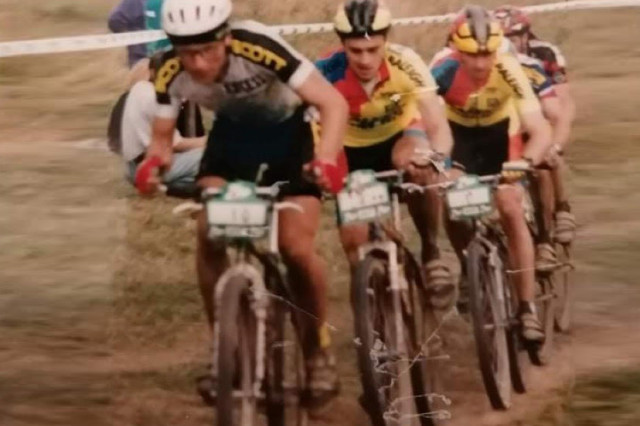
Gary Food competing at the UCI MTB World Cup.jpg, by Steve Thomas
In 1996, cross-country racing became XCO when it was granted immediate (no-trial) Olympic status, and in the years leading up to that, the sport boomed beyond recognition, which also led to the rest of the world taking the sport seriously. This included a whole bunch of eerily fast French and other Euro racers, a couple of whom sadly tinged the previously clean repute of the sport at the time.
During the early 90s, downhill also pretty much separated from cross country racing and became a dedicated discipline in its own right, as Steve Peat remembers, “Back in the early 90’s we all rode everything; on a Saturday it was trials and downhill, and on the Sunday it was cross country. I used to ride the same Kona hardtail for everything, and was competitive in cross country at the national level too. I finished second in the Expert XC category National Champs as well as in downhill.” In 1998, Steve would win his first World Cup round in the USA.
While downhill also got its own and first World Cup series in 1993, Jason McRoy was very much leading the charge for Brits abroad, swiftly making a name for himself and carving out a path for the swathe of Brits who would follow on. JMC was tragically killed in a motorbike accident in the summer of 1995.
In 1996, in Kaprun, it would be Rob Warner who would take the first-ever World Cup downhill elite round win for the Brits, and by the end of the decade, we would have the likes of Tracy Moseley heading for the gravity big time too, and the Brit co-dominance of downhill racing was just about to begin.
Bouncing into the 1990s
Unlike with road and other types of bikes, when it came to mountain bikes and making them, when the 90s came around, it was still a theory and design book yet to be written – an open book. We were to see more bright-eyed and open-minded innovation than cycling had seen in the previous few decades, all driven by the lack of constraints and tradition. This made the era a fantastic, wild west-like and fun one to ride through.
At those 1990 World Championships, there were only a handful of riders using these newly trialled suspension forks, and clipless pedals were also new to the game, while disc brakes were something only being tinkered with in sheds by those of a mechanical and motorcycle leaning.
During the first half of the 90s, this all started to change, and British brands were very much a part of this evolution. Although many of the early British classic MTB brands were already starting to emerge, during the early and mid 90s Pace introduced its iconic RC35 and then the RC30 suspension fork, which was a game changer for many of us, while Hope Tech added its first hydraulic disc brakes to its range shortly afterwards. USE, Middleburn, and X-Lite all emerged as high-end component brands at the time, with Orange and Saracen also thriving – to name but a few.
By the end of the 1990s, the bikes we rode were almost unrecognisable compared to those of only a few years earlier. Although they are now considered as antique by many, at the time they were revolutionary, and transformed how and what British mountain bikers could and did ride.
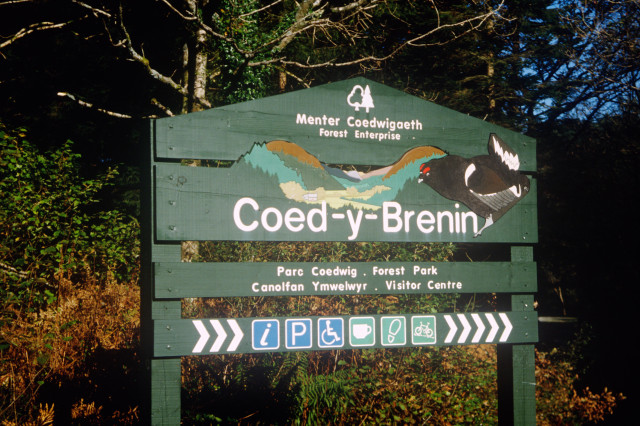
Talking of what we did ride on in terms of terrain at the different ends of the decade, that also evolved at a good and innovative speed, largely thanks to the emergence of trail centres. The first true UK dedicated, full-on, trail centre was Coed y Brenin, which officially launched in the mid 90s, under the carving hand and bold vision of Dafydd Davis, which we detailed here a while back.
So, that’s loosely why we call the 1990s the golden era of mountain biking. Apologies for those I missed. The sport has surely moved on and changed since those days, as has life. Mind you, every time I rattle my aluminium gravel bike downhill, it jars me and my wrists right back to 1992.
You might also like: