
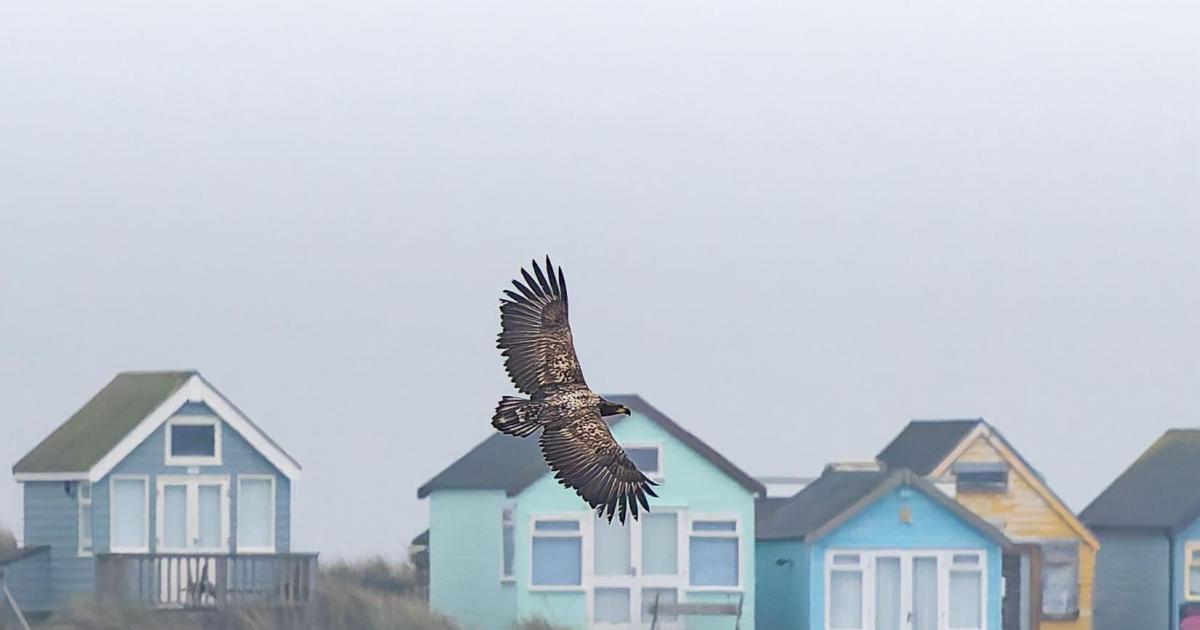
Richard Moore captured a photograph of the large bird of prey at the harbour on the morning of January 18.
The sighting comes as white-tailed eagles are becoming an increasingly familiar, though still rare, presence along the south coast.
The species, also known as the sea eagle, was driven to extinction in England more than 200 years ago due to persecution.
In recent years, Forestry England has been leading the White-tailed Eagle Reintroduction Project, in partnership with the Roy Dennis Wildlife Foundation, to restore the birds to the country.
Young eagles have been released on the Isle of Wight since 2019, with the birds monitored using satellite tags as they explore wider areas, including Dorset and Hampshire coastlines.
White tailed eagle (Image: Richard Moore)
In 2025, Forestry England announced a record number of white-tailed eagle chicks hatched in the wild in England, marking a major milestone for the project.
Steve Egerton-Read, White-Tailed Eagle Project Officer for Forestry England, said: “We have been patiently monitoring these nests for many months and hoping they would be successful. It is always such an exciting time but also incredibly nerve wracking!
“This was especially the case for the pair of eagles in Dorset who were first time parents. It was an incredible moment when we caught our first glimpse of that tiny fluffy chick in the nest, but equally, it’s an anxious time as the parents get to grips with what they need to do.
He added: “Ultimately, it has been so rewarding to see this pair of eagles, often spotted in and around Dorset, care for the chick all the way through to it fledging the nest.”
White-tailed eagles are Britain’s largest birds of prey with a wingspan of up to 2.5 metres and were once widespread across England.
Human persecution caused their extinction, with the last pair breeding in southern England in 1780.
In 2019, Forestry England and the Roy Dennis Wildlife Foundation began reintroducing these iconic birds to the English landscape.
To date, 45 young white-tailed eagles have been released. This includes eight birds released this summer from the team’s base on the Isle of Wight.