
Hegseth’s war service and views on Nato alliespublished at 19:28 GMT 23 January
19:28 GMT 23 January
 Bernd Debusmann Jr
Reporting from the White House
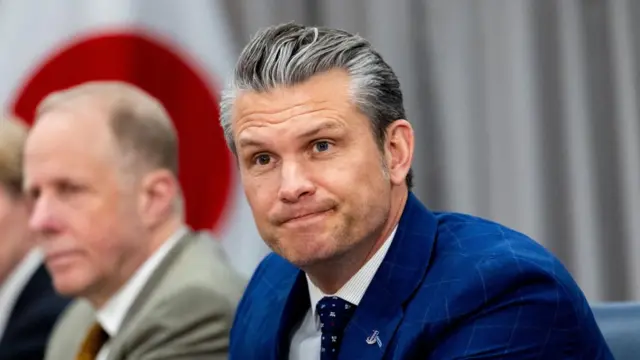 Image source, EPA
Only a small handful of the top tier members of the US
government have served in the military – and a much, much smaller number served
in the “Global War on Terror” in either Iraq or Afghanistan.
In Donald Trump’s cabinet, only one member fought in
Afghanistan: defence secretary Pete Hegseth.
Hegseth, now 45, commissioned as an infantry officer soon
after graduating from Princeton University’s Reserved Office Training Corps
(ROTC) programme in 2003, two years into the Afghan war.
After two other overseas deployments – guarding detainees at
Guantanamo Bay and with the 101st Airborne Division to Iraq – Hegseth deployed
to Afghanistan in 2011 and 2012.
In Afghanistan, he was primarily involved in teaching
lessons in counterinsurgency at an academy in Kabul.
It is unclear how much direct interaction he had with allied
Nato troops while there.
Kabul, however, was the headquarters for the Nato-run
International Security and Assistance Force in Afghanistan (ISAF) until 2014, and troops
from a wide variety of countries were present in the city between its fall in
2001 until the Taliban returned to power in 2021 after taking control of towns and cities across the country.
But, in the past, Hegseth has been quite dismissive about
Nato’s contribution to the war, last year joking that ISAF stood for “I
saw Americans fighting”.
“Ultimately, it was a lot of flags… [But it] was not a lot
of on-the-ground capability,” Hegseth told lawmakers on Capitol Hill last year.
“You’re not a real coalition, you’re not a real alliance,
unless you have real defence capability, and real armies that can bring those
to bear.”