
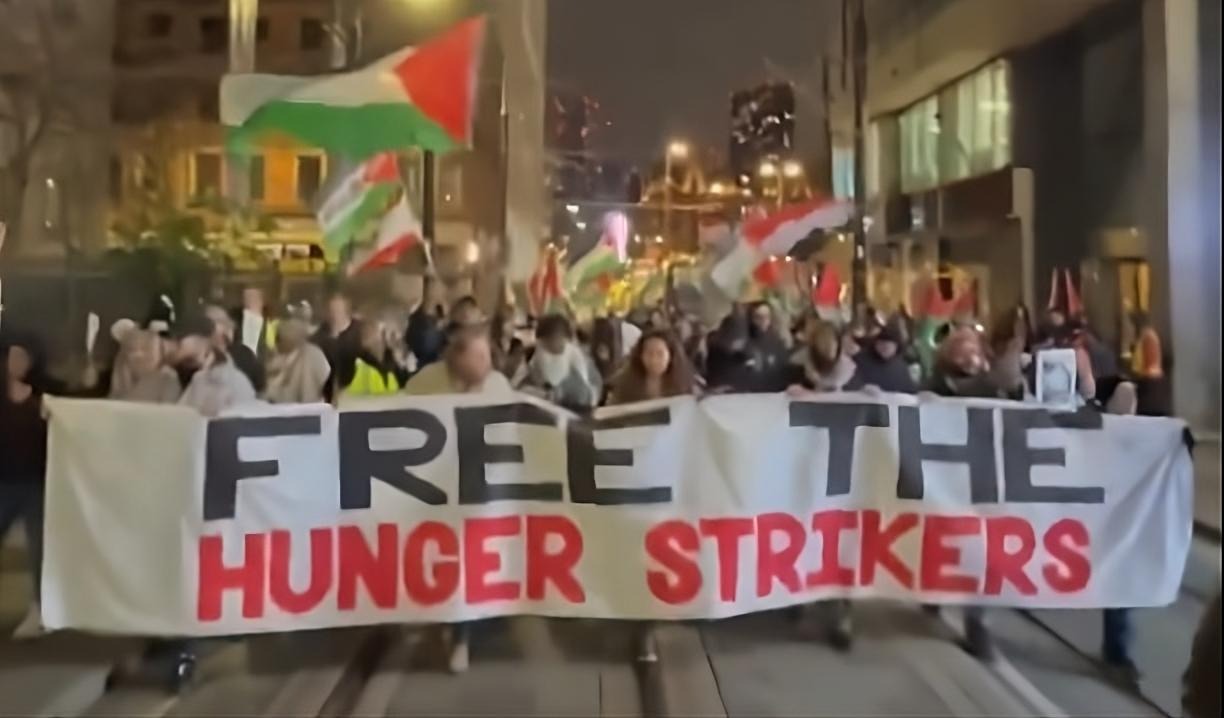
For several months now, the UK has witnessed an escalating wave of judicial and prison repression against pro-Palestinian activists. Twenty-four of them, most of whom are linked to the collective Palestine Action, are being held without conviction following actions targeting Elbit Systems UK, the main Israeli arms supplier operating on British soil. Confronted with indefinite detention and systematic repression, several prisoners began a hunger strike in November.
The end of a hunger strike with grave consequences
It was with relief that we learned on Wednesday that three of the hunger strikers whose lives were most at risk — Heba Muraisi, Kamran Ahmed and Lewie Chiaramello — have ended their action, as doctors and relatives had warned of an imminent risk of death.
The announcement came on the 73rd day of Heba Muraisi’s hunger strike, a moment laden with historical and symbolic significance, identical to that reached by Irish republican activist Kieran Doherty, who was the sole survivor among the ten men who died during the 1981 hunger strike in British prisons. According to Prisoners for Palestine, all of the hunger strikers have now entered a phase of re-feeding, in line with medical advice — a process that itself carries risks and can prove fatal if not managed correctly. Nonetheless, all of the strikers will face serious and lasting consequences following an action of such duration.
The suspension of the hunger strike has also taken place under specific political circumstances, as reported by the group : ‘The decision to end the hunger strikes came when it was revealed that Elbit Systems UK had been denied a crucial £2 billion military contract with the Ministry of Defence — a key demand of the hunger strikers.’
Among the prisoners’ central demands was the closure of Elbit Systems’ UK sites. The hunger strikers had been arrested under anti-terrorism legislation for actions denouncing the Israeli company’s role in the genocide in Gaza. While no such closure has taken place, the strikers succeeded in forcing the suspension of a contract between Elbit Systems UK and the British Ministry of Defence.
Citing an internal source within the Ministry of Defence, The Times reported that the contract was ultimately awarded to a rival consortium led by Raytheon UK. According to Francesca Nadin of Prisoners for Palestine : ‘We will never know for certain, but it is quite clear to me that the totality of the campaigns — whether the hunger strike, Defend Our Juries, or the legal challenge — all had an impact, because public discussion has now shifted completely.’
From hunger strike to collective organisation
Above all, the hunger strike acted as a powerful catalyst for mobilisation. Across the UK, solidarity actions intensified, with regular demonstrations outside Parliament, courts, the prisons concerned and Labour Party offices. Moreover, the campaign helped to publicly expose the British military-industrial complex and its structural ties to the genocidal Israeli state. This is the true political gain of the hunger strike carried out by the Filton 24.
Prisoners for Palestine further emphasised : ‘In the past few weeks alone, 500 people have signed up to take direct action against the genocidal military-industrial complex — more than the total number of people who took action with Palestine Action over the entirety of its five-year campaign.’
This momentum quickly spread beyond Britain’s borders. Hunger strikers joined the movement in Italy and the United States, while solidarity rallies and demonstrations took place in Paris, Tel Aviv, Prague and many other cities. Major international figures expressed their support, including Georges Ibrahim Abdallah — the Lebanese revolutionary militant released in July 2025 after 41 years of imprisonment in France — as well as former Irish republican prisoners, among them Tommy McKearney. Earlier this week, Sally Rooney, Angela Davis and Judith Butler were among dozens of writers and academics who signed a public appeal demanding justice for the hunger strikers.
Among the demands that were partially met was the transfer of Heba Muraisi to HMP Bronzefield, closer to her family, after having been held several hundred kilometres away. A partial easing of prison censorship was also observed. The group stated that, ‘during the hunger strike, some prisoners began receiving entire bundles of mail that had previously been withheld, and in one case, prison staff issued an apology for a letter delayed by six months. Books on Gaza and feminism were also delivered after months of waiting.’
A struggle that must continue
Despite these advances, central political demands remain unmet. None of the prisoners have been released on bail, despite the absence of any conviction and the fact that some have already spent over a year in pre-trial detention without trial. The proscription of Palestine Action has not been lifted, and the criminalisation of support for Palestine continues. Above all, British imperialism has rapidly replaced Elbit with Raytheon UK. A British subsidiary of the RTX group (formerly Raytheon Technologies), Raytheon is among the world’s largest arms manufacturers and constitutes one of the central pillars of US imperialist power projection.
The company has supplied weapons systems used in some of the most appalling wars of recent decades — Iraq, Afghanistan, Yemen, Syria and Ukraine. It also maintains close ties with the Israeli military apparatus, notably through joint missile defence projects such as the Arrow system, as well as industrial collaborations with Israeli arms companies. If Elbit operates as a regional executor of Israeli colonial violence, Raytheon functions as its global architect, integrating Israeli technologies tested on Palestinian populations into worldwide systems of militarism.
In this context, the sacrifice made by the hunger strikers now calls for mass mobilisation — the only force capable of transforming the accumulated solidarity into a lasting political balance of power against the UK Labour government’s complicity with Israel, the repression of Palestine solidarity, and Starmer’s militarist agenda. In this regard, the mobilisations initiated by dockworkers in Genoa, Italy, last September — who blocked arms shipments bound for Israel — offer a concrete example of how organised collective action within imperialist countries can directly disrupt the material circuits that make genocide possible.
As only one hunger striker remains, having resumed his fast on 10 January, Prisoners for Palestine states : ‘We are now concentrating our efforts and attention on Umer Khalid, the last hunger striker still in action, who continues to use his body as a weapon against the state.’