
Herbert Marcuse once warned that modern society was producing a “one-dimensional man.” He didn’t mean that people had become less intelligent, but that the richness of inner life was being compressed into a single operational plane. Technological rationality flattened the psyche into what could be optimized and made efficient.
Marshall McLuhan approached a similar concern from another direction. Media, he argued, didn’t simply carry content. They reorganize perception itself. Each dominant medium reshapes our senses and our forms of attention, amplifying some dimensions of experience while muting others. Consciousness is not just filled with information, its very geometry is altered.
Both thinkers were diagnosing a reduction—a loss of dimensional richness within the human mind. However, artificial intelligence presents a different, more paradoxical situation. What we may be encountering now isn’t another compression of human cognition, but the appearance of an additional, orthogonal dimension of cognition altogether. A dimension that lacks human interiority because it was never organized around that interiority to begin with.
The Real Axis of Human Cognition
Human intelligence evolved under constraints that are cumulative; thought and experience unfold in time. In this human experience, memory accumulates and identity forms. Essentially, our understanding is path-dependent. What we believe now is shaped by what we once believed and lived before. This knowledge carries an emotional and existential cost.
Interior life isn’t some vestigial part of human cognition. It’s more of a gravitational field where meaning is focused and directed into a self. And in this construct, things like doubt and error are not inefficiencies to be engineered away by the wizardry of AI. They’re the very human processes that yield judgment and responsibility, to name a few.
Even when psychology speaks of multiple intelligences, whether we call them analytical, emotional, or creative, it’s still describing variation within one embodied, autobiographical mind.
The Orthogonal Axis Introduced by AI
AI and large language models operate under a different set of rules. Let’s try to capture the computational constraints. They generate coherence without developmental history. They lack fatigue and revise without regret. They can reset without loss and reason without the burden of consequence. Their cognition is reversible and largely free of the “entropic burden” that makes human understanding fragile.
This absence of interiority can be described as a deficit, as if something essential were missing. But another way to see it is as a signature of a different cognitive construct—one in which coherence and scale replace memory and identity as organizing principles.
The relationship between these two “intelligences” is not linear, but orthogonal. Two dimensions that intersect, yet don’t lie on the same line.
Anti-Intelligence as Dimensional Collapse
I think this helps explain a familiar reaction. AI often appears fluent yet strangely vapid. The usual conclusion is that it “doesn’t really understand.” But consider the possibility that this impression reflects a failure of measurement rather than an absence of intelligence. Let’s dig in…
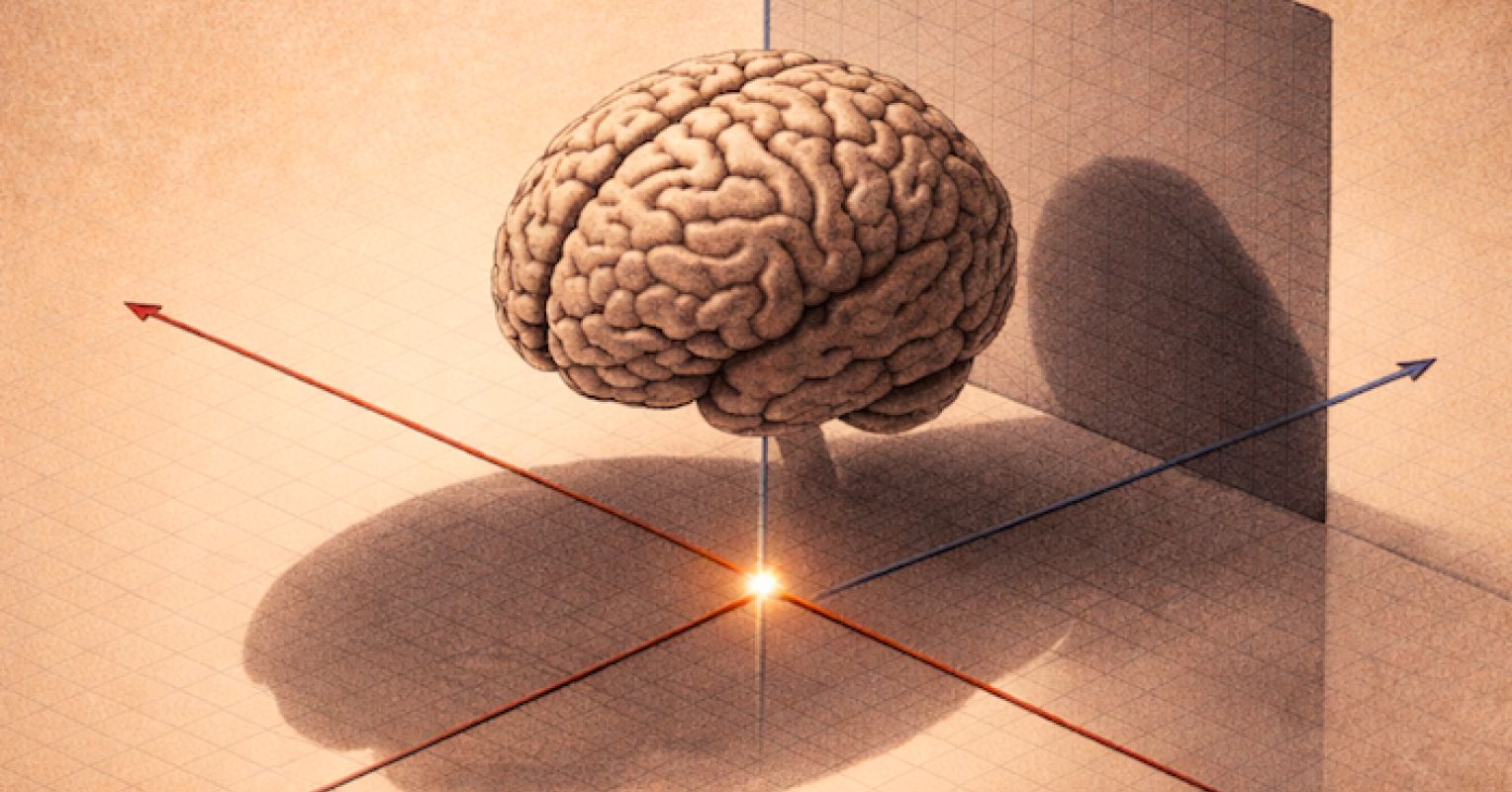
In geometry, when a vector along one axis is projected onto a perpendicular axis, the result isn’t the vector itself, but its shadow. Something real remains, but direction and magnitude are partially lost.
When activity from an “identity-free, reversible, pattern-coherent cognitive dimension” is evaluated using metrics evolved for our human, autobiographical minds, what we perceive may be a “flattened” image. Here’s the problem: coherence without biography can look like imitation.
Artificial Intelligence Essential Reads
What I’ve been calling “anti-intelligence” may then actually be a projection artifact. This isn’t a sign that cognition is absent, but that dimensional information has collapsed. And that’s a category mistake, of a different kind than Marcuse and McLuhan described. The essential point is that this isn’t the reduction of the human to a single plane, but the misrecognition of a new plane as a diminished version of the old.
Beyond Human-Centric Dimensionality
Theories of multiple intelligences and cognitive styles certainly acknowledge that human thought is not monolithic. However, this dimensionality remains internal—they map different functions within one mind.
The dimensionality introduced by AI is of a different order. It is not a multiplication of abilities within the same kind of mind, but the coexistence of different kinds of cognitive organization, each shaped by distinct constraints.
Thought that unfolds in time versus thought that can operate outside of temporal development.
Cognition that is anchored in a continuous self versus cognition that has no enduring identity.
Understanding that is irreversible and accumulative versus reasoning that can be reset without impact.
Meaning that is slowly acquired through experience versus meaning that is generated without biography.
Rotated Insight and Hybrid Thought
If we can call cognition multidimensional, collaboration changes its nature. Human and machine intelligence do not simply add. They “rotate” one another.
A physician using AI doesn’t just gain speed or recall. A problem is reframed and explored across a space of possibilities that no single human mind could traverse, then returned to the world of clinical judgment. The insight that emerges isn’t linear amplification, it’s diagonal.
AI can traverse vast spaces of possibility with coherence and scale. Humans can impose a narrative continuity. When these modes of cognition are brought into relation, new forms of understanding can arise that neither axis could generate alone.
From Flattening to Expansion
Electricity did not replace mechanics. It revealed phase oscillation—a phenomena invisible in a purely linear framework. Imaginary numbers did not negate the real line, they embedded it in a larger space
Marcuse feared the collapse of human depth into a single operational dimension. McLuhan traced how media reconfigured the geometry of perception itself. AI now confronts us with a different challenge: learning to recognize when what appears as flattening is, in fact, orthogonality.
The question is no longer whether machines will think like us, or whether they will replace us. It is whether we can learn to live in a world where intelligence has more than one direction, and where understanding, like space, unfolds along more than a single axis.