
Photo: Courtesy of Sundance Institute
“Brains are pretty delicate things.” Someone says this early on in Josephine, and Beth de Araújo’s film expands on it by entering the mind of an eight-year-old girl who has witnessed a horrific crime. During an early morning soccer practice with her father in Golden Gate Park, Josephine (Mason Reeves) sees a stranger rape a jogger by some public bathrooms. The story is topical, to be sure, and it could easily make for cheap sentiment, but the director remains focused on Jo’s inner life, trying to portray the newly dangerous and confusing world from her perspective.
That requires fairly bold stylization, but the film never feels overtly aestheticized, because the formal approach fits the character’s psychology. As played by the rather wonderful Reeves, Jo is a hesitant, impressionable child. Her father, Damien (Channing Tatum), is big on physical fitness and powering through things: “Scared don’t live here,” he tells her after trying to get her to run under a closing garage door, part of their morning workout. Jo, however, is too frightened to do so. After she witnesses the ghastly incident in question and the rapist (Philip Ettinger) is apprehended (with some help from Damien himself, who chases after him with the cops), Jo begins to see the perpetrator everywhere in her life — hanging out quietly, sitting at the family dinner table, playing with her pet mouse, coloring her books. It’s a disturbing conceit that could easily become a heavy-handed one, but de Araújo handles it with surprisingly grim elegance, filming in long takes that float around rooms and occasionally pass by this ghostly figure out of Jo’s trauma, still in the telltale green polo shirt he was wearing when he committed the crime.
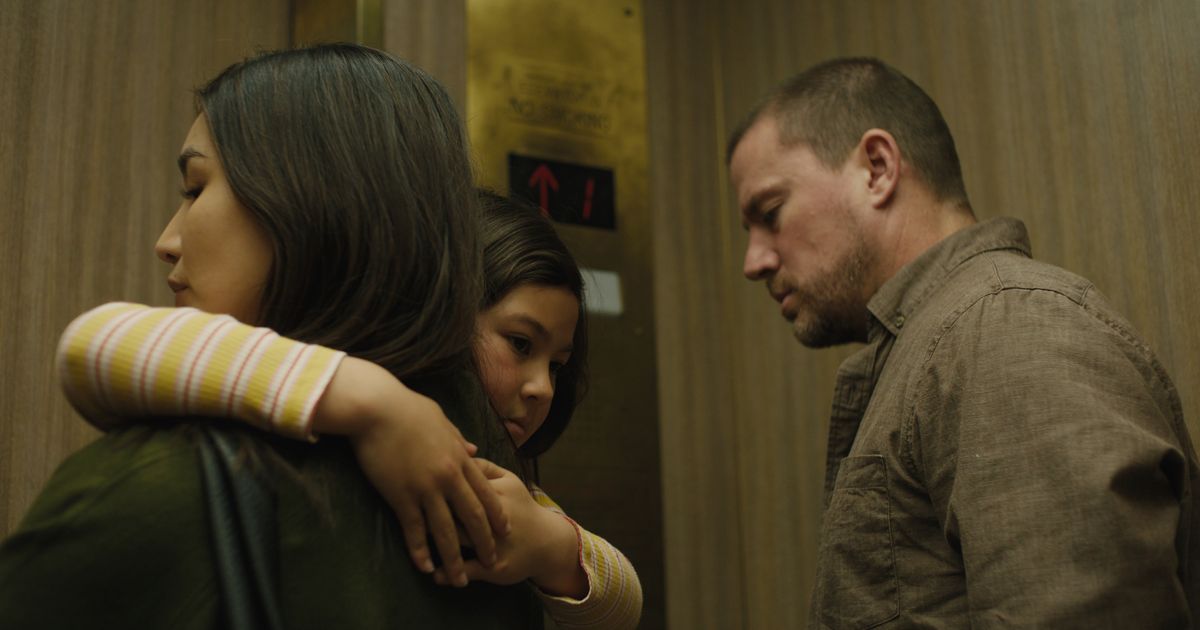
It eventually becomes clear that Jo is the one person who can identify the man in court, and so, this stylized portrait of her mental state merges with the narrative question of whether this fragile child is competent enough for her testimony to carry any weight, as she’s tested by counselors, psychologists, lawyers. Her parents themselves can’t argue on the best way to protect her. Her mother, Claire (Gemma Chan), is a dancer, in tune with her own delicate emotions and worried about her child having any involvement in this. Damien, who admits he’s only good with “physical stuff,” is adamant that Jo do her duty and put this monster away for good. That he himself was abused as a child feeds into both his stoicism and his stridence, and Tatum brings just the right amount of burly confusion to the part. He’s eager to do the right thing, but the right thing in his mind often involves aggression, rage, and emotional withdrawal.
De Araújo shoots much of the film in lovely, drifting long takes that are expansive in scope but limited in perspective. Though the camera rarely adopts a direct point of view, it really does feel like we’re in this child’s mind, looking out with fear at a world where nothing is clear and anything is possible. It all comes to a climax with a bravura sequence in which the handheld camera follows Josephine into court and ping-pongs with increased agitation as she’s questioned by dueling attorneys. The director uses style to enhance the drama, but she also refuses to sensationalize. At times I was reminded of Pascal Plante’s Red Rooms, the grisly 2024 psychological thriller about a young woman obsessed with the trial of a demonic serial killer. Josephine isn’t nearly that intense, but both films foreground a visual vernacular that cuts through mundane courtroom minutia to evoke their characters’ increasingly turbulent psychological states.
Before she introduced the film at its Sundance premiere, de Araújo noted that her young star Reeves would only enter the auditorium and take her seat halfway through the screening because much of what happens in the first half of the movie would not be appropriate for a child of her age to see. These words caused a stir, because they were a reminder of how fragile young minds are when it comes to these kinds of images. They were also memorable because Reeves gives a mesmerizing performance, letting all her character’s inchoate turmoil burst through in tough little spurts; obviously, the filmmakers had to draw this performance out of her without ever really showing her what she’s supposed to be witnessing. But maybe de Araújo’s words also served as a reminder of how fragile our own minds remain — that these kinds of images continue to work on our own delicate brains as well, though maybe in less overt fashion. Josephine might not tell a particularly original story, but it tells it in a way that makes us see the world anew.
Sign up for The Critics
A weekly dispatch on the cultural discourse, for subscribers only.
Vox Media, LLC Terms and Privacy Notice