
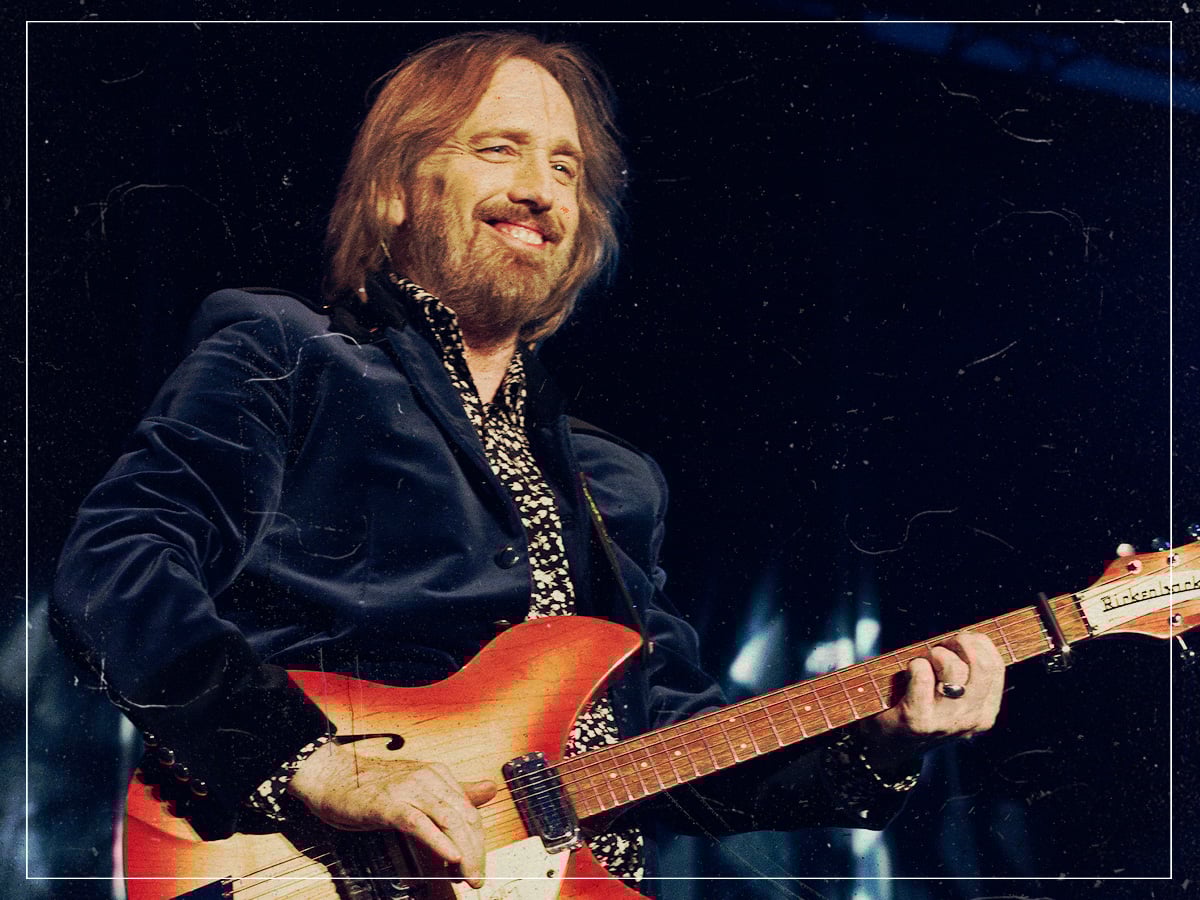
(Credits: Far Out / Ирина Лепнёва)
Sun 25 January 2026 18:53, UK
A musical education can be achieved in a million different ways. It’s typically unique to every artist and subconsciously shapes their sound, as it did with the legendary Tom Petty.
Unlike most professions, it doesn’t matter where and when you went to school in the music business to achieve success. In theory, the only thing that matters is the ability for a song to connect with an audience, and whether you mastered your talents in dingy dive bars or at the Royal College of Music is irrelevant.
For Petty, his gateway into rock ‘n’ roll was somewhat traditional and marked by several pivotal moments. Among them was his childhood encounter with Elvis Presley, a moment that left an indelible impact on his view of the world. However, even then, Petty knew that Presley was a mystical figure that he wouldn’t be able to replicate.
However, when the influx of British acts in the 1960s took America by storm, Petty saw them and believed it was an attainable future for himself in music.
The first domino that fell was his discovery of The Beatles, which proved to be seismic. Petty was among the many millions who tuned in to watch the Fab Four’s debut on The Ed Sullivan Show in 1964. The programme was one of the few ways to access the music that he desired, and largely, he had to rely upon the radio for access to new sounds.
 The legendary Tom Petty. (Credits: Far Out / YouTube Still)
For Petty, AM radio was the only place that mattered, and he absorbed everything played on his favourite station. In that era, even the option to tape songs directly from the radio was not available. Consequently, Petty and his friends had to rely on their memory to attempt to retain the entirety of the tracks they heard on the airwaves, a challenging task in itself.
He explained to NPR: “When I was 15 or 16 playing in groups, we used to sit in the car and try to write the lyrics down as a song was playing, and we’d assign each person a verse, you know: ‘I’m going to do the first one. You go for the second one’. And then sometimes you’d wait an hour for it to come on again so you could finish it up.”
While this was occasionally a fairly simple assignment, in one instance, The Rolling Stones made Petty work hard to cover one of their classics, which proved to be a blessing in disguise.
He explained: “The hardest one was ‘Get Off My Cloud’ by the Stones. It had so many words. … It took us a good three hours to get that one written down. But it was that kind of thing. It was a friend and something that was there. You didn’t really think about it that much, but looking back on it, it was such a musical education.”
At the time, it may have seemed like a laborious task, but it forced Petty to truly understand and analyse ‘Get Off My Cloud’, which, in the long term, improved him immesurably as a songwriter. He had to think deeply, rather than merely reading words from a phone screen, and years later, Petty finally understood this was a powerful lesson.
The Rolling Stones were even more critical in Petty’s musical journey than The Beatles. During an interview on Q with Jian Ghomeshi in 2014, Petty explained, “They were grittier, it was rawer. They were playing blues in this really energetic kind of raw way, but it wasn’t complicated. There wasn’t a lot of complicated harmony involved. It was sort of my punk music. It was like, ‘That can be done’.”
Petty also conceded that he wasn’t alone in this thinking, adding of their impact, “Apparently, tens of thousands of American musicians had the same thought at the same time. You won’t meet anyone my age who didn’t have that thought at that time.”
The Rolling Stones were more than just another band on the radio for Petty; they created the rock ‘n’ roll blueprint for him to follow, which took him to the top of the mountain with The Heartbreakers.
Related Topics