
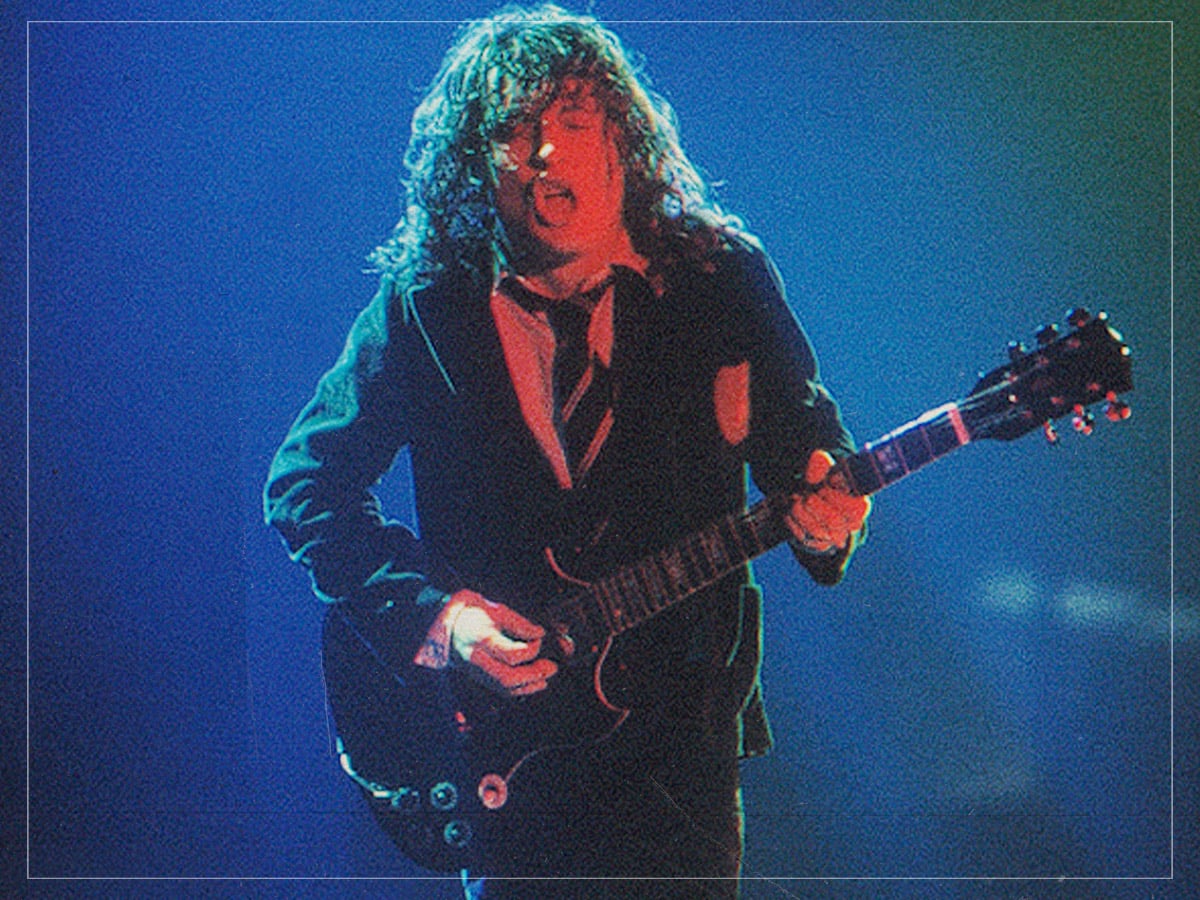
(Credits: Far Out / Joan Sorolla)
Mon 26 January 2026 17:45, UK
There’s only a certain amount of bullshit that Angus Young had a tolerance for when working with AC/DC.
For him, old school rock and roll was all that anyone needed to listen to, and while you would hear a little bit of blues in his delivery here and there, it was always about cutting through the window dressing and beating the audience over the head with one kickass riff after the next. But even with the library of fantastic licks that Angus could play, he knew that not every one of those golden-age legends were all they were cracked up to be when he was cutting his teeth.
Because as much as early rock and roll might have a golden sheen around it, it’s not like every one of those legends had the same staying power by any stretch. Buddy Holly and Chuck Berry might have got the ball rolling in the late 1950s, but are we going to forget that in that space of dead air between the Day the Music Died and the start of Beatlemania gave us everyone from Frankie Avalon and Pat Boone in the meantime?
Rock and roll could be the perfect teenage music, but it wasn’t safe from being impossibly lame more than a few times, and Angus made it his personal mission to never fall into that category. The parts that he played weren’t exactly the most complicated thing in the world, but if you look at the greatest rock and roll icons to walk the Earth, he deserves a spot next to the Little Richards and Jimi Hendrixes of the world for playing every single note like it was the last thing he would ever play.
But not every rockstar was interested in the by-the-numbers approach. The name of the game towards the end of the 1960s was trying to out-blues the person next to you, and while Angus did have a healthy respect for the likes of Muddy Waters and Robert Johnson, hearing Eric Clapton strap on his guitar was always going to be a little bit his and miss depending on the band he was in.
It’s frankly insane to see someone have such a strong lineup of classics, but even Clapton has said that he isn’t too much of a fan of everything he’s put out. He will be the first one to tell you that there are some peaks and valleys when it comes to his 1970s material, and while he may have been impassioned in the moment, making a song like ‘This Has Gotta Stop’ was more than a bit ill-advised when it first came out.
Then again, Angus remembered not being all that thrilled with what Clapton brought to the table outside of his work with John Mayall, saying, “Everyone always used to rave about Clapton when I was growing up, saying he was a guitar genius and stuff like that. Well even on a bad night Chuck Berry is a lot better than Clapton will ever be. Clapton just sticks licks together that he has taken from other people – like B.B. King and the other old blues players—and puts them together in some mish-mashed fashion. I never saw what the big fuss was about Clapton to begin with.”
In all fairness, you could say the same thing about the way that Angus puts together a lot of his solos, but you can tell that he means it every single time he plays. There are more than a few times where Clapton was guilty of going on autopilot and just muscling through every single lick in his library, but when listening to everything from the early Bon Scott material to Back in Black, every single line that Angus came up with was planned for maximum impact.
Where most people were playing from the heart, Angus was more than happy to work out what he was doing rather than fall into the same holding patterns that he saw in Clapton. Not everything that he played was perfect, but if it happened to have the right vibe for the song, that was all that mattered.
Related Topics