
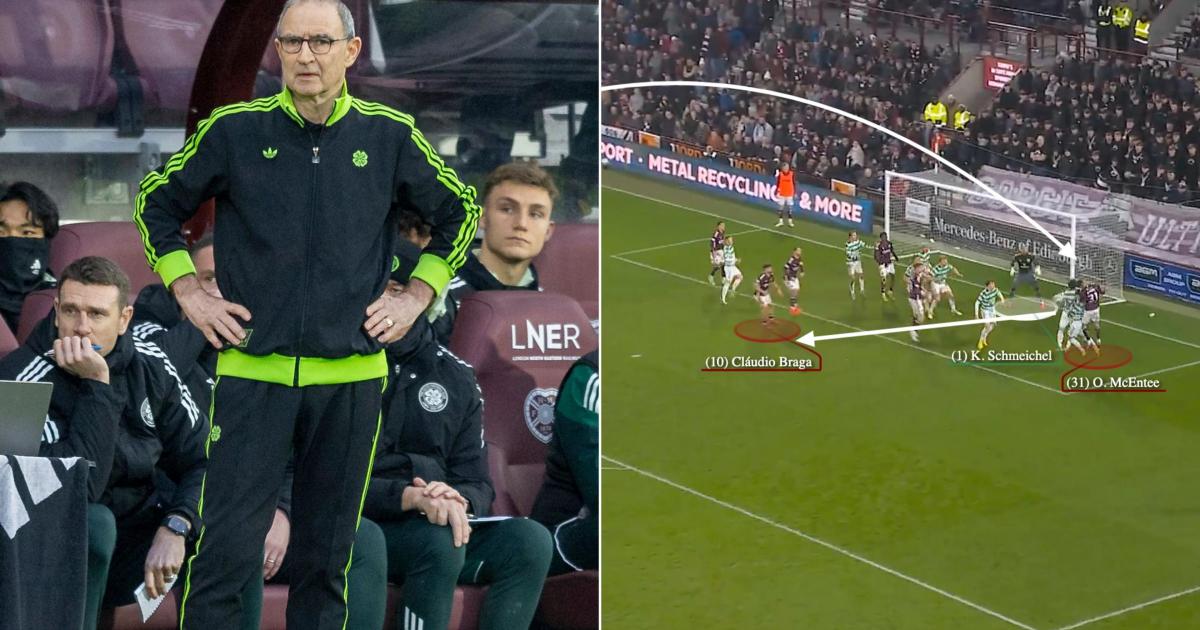
Reduced to ten men for a second successive game, Martin O’Neill’s side dug in to just about keep pace at the summit of the Scottish Premiership.
An outstanding Benjamin Nygren free-kick handed Celtic the perfect early platform before Stuart Findlay’s header brought Hearts level shortly after the interval. Yang Hyun-jun restored the Hoops’ lead from close range, only for the momentum to swing again when Auston Trusty was dismissed for a challenge on Landry Kabore.
As they had done in Bologna on Thursday night, Celtic were unable to see the game out with a numerical disadvantage. Claudio Braga’s late equaliser ensured the points were shared – leaving the champions six points adrift of their hosts and now two behind second-place Rangers.
Celtic’s set-piece woes
Hearts’ ability to exploit set-pieces has been a hallmark of their impressive season. Their 14 goals from dead-ball situations are unmatched in the Scottish Premiership and more than double the league average (StatsBomb).
Celtic’s set-piece problems this season have been more pronounced at the attacking end – a discussion for another day – but defensively, there remain concerns too. They have now conceded seven goals from set-plays, more than their expected goals conceded from such situations (5.02), and Hearts once again demonstrated their dead-ball threat with both goals on Sunday.
Celtic’s defensive set-piece set-up vs Hearts. (Image: WyScout)
For Stuart Findlay’s equaliser just after the interval, as shown above, Celtic set up zonally across the six-yard box. Tomas Cvancara screened the front zone, with Auston Trusty and Liam Scales positioned centrally and Kieran Tierney covering the back post. Benjamin Nygren and Arne Engels were tasked with man-marking Hearts’ primary aerial threats, Craig Halkett and Findlay.
The setup itself was reasonable. The problem emerged at the point of delivery, when Engels was drawn towards the ball, allowing Findlay to free himself and make an unopposed run into Tierney’s zone at the back post.
Hearts exploited Celtic’s weakness for Stuart Findlay’s goal. (Image: WyScout)
Although Engels recovers some ground as the ball drops, Findlay already has momentum and a clear height advantage over Tierney, enabling him to direct a low header towards goal.
Findlay headed home above both Kieran Tierney and Arne Engels. (Image: WyScout)
Kasper Schmeichel, who otherwise produced a strong shot-stopping display – notably denying Alexandros Kyziridis and Claudio Braga – will feel he could have done better. More concerning, however, was his continued tendency to remain rooted to his line. While the delivery was not straightforward to claim, it dropped well inside the six-yard box, and earlier intervention – even a punch – may have prevented Findlay from getting a clear header on goal.
A similar issue arose for Hearts’ late equaliser. Oisin McEntee exploited an even greater mismatch at the back post against substitute Sebastian Tounekti and a backtracking Anthony Ralston, nodding the ball down for Claudio Braga to finish from close range. Again, the delivery travelled a significant distance and landed inside Schmeichel’s six-yard box.
Another poor defensive set-piece moment for Celtic against Hearts. (Image: WyScout)
As Alan Morrison has recently highlighted, Celtic face a genuine decision regarding the 39-year-old goalkeeper. On the evidence of Sunday, despite those fine saves, that is a debate that will continue.
Ultimately, Sunday once again underlined the scale of the advantage set-pieces offer Hearts – an edge that could yet prove decisive in the run-in.
Celtic’s midfield misfired vs Hearts
Another glaring issue in Edinburgh at the weekend was Celtic’s inability to retain possession, particularly in what was a somewhat dysfunctional midfield.
According to Wyscout data, Celtic recorded just 44.22 per cent possession on Sunday — comfortably their lowest figure of the league season to date. The next lowest came in the 2-0 defeat to Motherwell at Fir Park under Wilfried Nancy, where they still managed 52.93 per cent.
Celtic also looked to bypass the midfield more frequently than usual, playing long 50 times as they attempted to bring new centre-forward Tomas Cvancara into the game. That figure is well above their league average of 37.22 long passes per 90 and, while not extreme in isolation, it contributed to an overall pass completion rate of 74.81 per cent — again their lowest of the campaign and a significant drop from their season average of 87.4 per cent.
More concerning, however, was what happened when Celtic did manage to establish possession in that midfield area. The individual passing data from the weekend makes for alarming reading.
That was most evident in the performance of Callum McGregor, who completed just 20 of his 32 attempted passes. His total attempts were barely half his league average of 65, while a completion rate of 63 per cent was a stark outlier – well below his previous season low of 89 per cent, recorded at Kilmarnock in September.
Incredibly, it was also McGregor’s lowest pass completion percentage in any match he has started for Celtic in Wyscout’s records, which stretch back to the 2015/16 season.
Arne Engels fared little better alongside his captain, completing 23 of 30 passes for a 77 per cent success rate. Nygren, tasked with operating closest to Cvancara, recorded the highest completion rate of the midfield trio at 81 per cent – though that came from just 16 attempted passes.
Passing networks in the 2-2 draw between Hearts and Celtic. (Image: Statsbomb)
The lack of cohesion is clearly illustrated in StatsBomb’s passing network from the match, shown above. Hearts debutant Marc Leonard is positioned noticeably higher than any Celtic midfielder and is far more connected to his teammates, underlining his influence on the game. Leonard attempted more passes than any midfielder on the pitch (45) and completed them at a 76 per cent success rate.
By contrast, Celtic’s midfield three are deeper, less connected and far more fragmented.
The problems extended off the ball. Despite Hearts missing their first-choice midfield pairing of Cammy Devlin and Beni Baningime, stand-ins Leonard and Tomas Magnusson still had the edge in duels. Wyscout data shows Leonard led the way with 13 duels won from 19 contested (68 per cent), with Magnusson winning 11 of his 19 (58 per cent).
By comparison, Engels struggled to meet the physical demands of the match, winning just seven from 19. McGregor’s lack of impact on the game was again evident, with the Celtic captain contesting just eight duels – although he did win five of them.
Given the attritional nature of the game – and the context of a Europa League trip just three days earlier, much of it played with ten men – there are mitigating factors. Even so, this was a deeply concerning display from the midfield unit.
With Paulo Bernardo struggling to take his chances and Reo Hatate remaining an unknown quantity on any given matchday, particularly this season, injecting freshness into the midfield in the final days of the transfer window could prove vital. How high that ranks among Celtic’s priorities remains to be seen, and O’Neill may ultimately be forced to search for solutions from within to get his engine room firing.
Lack of creativity on wings shows again
Celtic’s return to a 4-3-3 under O’Neill brought an end to the wing-back system used under Wilfried Nancy and is clearly a better fit for the current squad.
However, that shift back places greater responsibility on the wide players to provide creativity and goal threat from the flanks – an area that again proved lacking on Sunday and represents another cause for concern.
With Tomas Cvancara making his debut at centre-forward, Daizen Maeda was moved back to the left wing, with Yang Hyun-jun retaining his place on the right.
Tomas Cvancara showed some potential with his assist for Yang’s goal. (Image: WyScout)
While Yang did well to attack the box and convert Cvancara’s low cross, it proved to be his only attempt on goal. Maeda, meanwhile, registered just one speculative effort in the first half. More worryingly, neither winger managed a key pass nor created a single chance between them.
Both players worked enough hard off the ball. Maeda, unsurprisingly, led Celtic’s pressing numbers with 19 actions, followed by Yang with 14, but that industry failed to translate into meaningful attacking output.
Tounekti also struggled to make an impact on his arrival into the game from the bench, but, in his defence, much of his time on the pitch came with Celtic reduced to ten men. He clearly possesses ability and has looked improved under O’Neill, but inconsistency has defined his season so far.
Beyond that, the options are thin. Veteran James Forrest remains available, Luke McCowan – more comfortable centrally – has been used on the right at times, while Michel-Ange Balikwisha now appears to be viewed primarily as a number ten and did not even make the bench on Sunday.
As with midfield, the wide area is in desperate need of reinforcement over the coming days.
Martin O’Neill and his coaching staff deserve credit for restoring a measure of stability after Wilfried Nancy’s brief and ill-fated spell in charge. Celtic remain very much in the title race, and their resilience – particularly in difficult circumstances – should not be overlooked.
But Tynecastle was a reminder that resilience alone will not be enough. Issues around set-piece defending, midfield control and attacking output from wide areas continue to undermine performances, and each was exposed again on Sunday.
Whether Celtic can address some of these flaws may depend as much on decisions made off the pitch as on it. All eyes are therefore on the board in the final days of the transfer window to see if they can strengthen O’Neill’s hand for the run-in, even somewhat.