
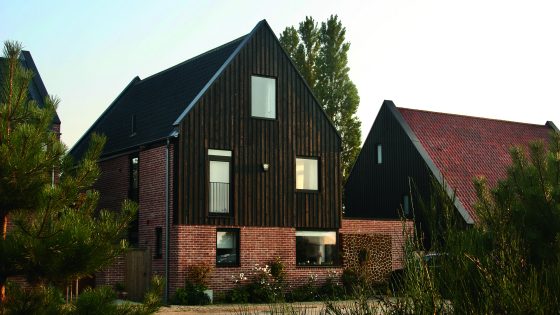
When the AJ last spoke to Charlie de Bono in late 2019, the South West-based architect and director of self-build enabler LivedIn Custom Build had just helped architect Project Orange secure planning approval for a community of a dozen self-build homes in Ingoldisthorpe, Norfolk – a relative rarity in the UK.
Currently, only around 8 per cent of the nation’s homes are self-build or custom-build. In countries including Germany, Italy, Belgium, Poland and Australia almost half of new homes are delivered this way.
The definition of what self-build means is broad. It can include buying the land to build your own home, designing and obtaining planning permission for this home, and even building it yourself – though it is more likely you will hire a builder to do this. The process can either be carried out as an individual or as part of a group or community.
The now-completed bespoke coastal community at Ingoldisthorpe is a mould-breaking scheme of 12 custom homes, two of which are designated ‘affordable’. LivedIn took it to planning while Project Orange drew up the design code and later worked with each future homeowner to craft a personal design.
De Bono believes the model – smaller scale, more custom, and designed with the community alongside – could be redeployed elsewhere as an antidote to volume housebuilders and as an alternative way of tackling the country’s housing emergency.
Earlier this month, the AJ headed west to Stroud in Gloucestershire, home of LivedIn’s sister company, Gloucestershire-based Millar + Howard Workshop Architects, for the launch of LivedIn’s Cohort One.
This grouping brings together architects, landowners/sites and prospective homeowners to roll out a nationwide wave of custom, self-built and community-backed homes.
Could this be, as one participant quipped, ‘self-build on steroids’?
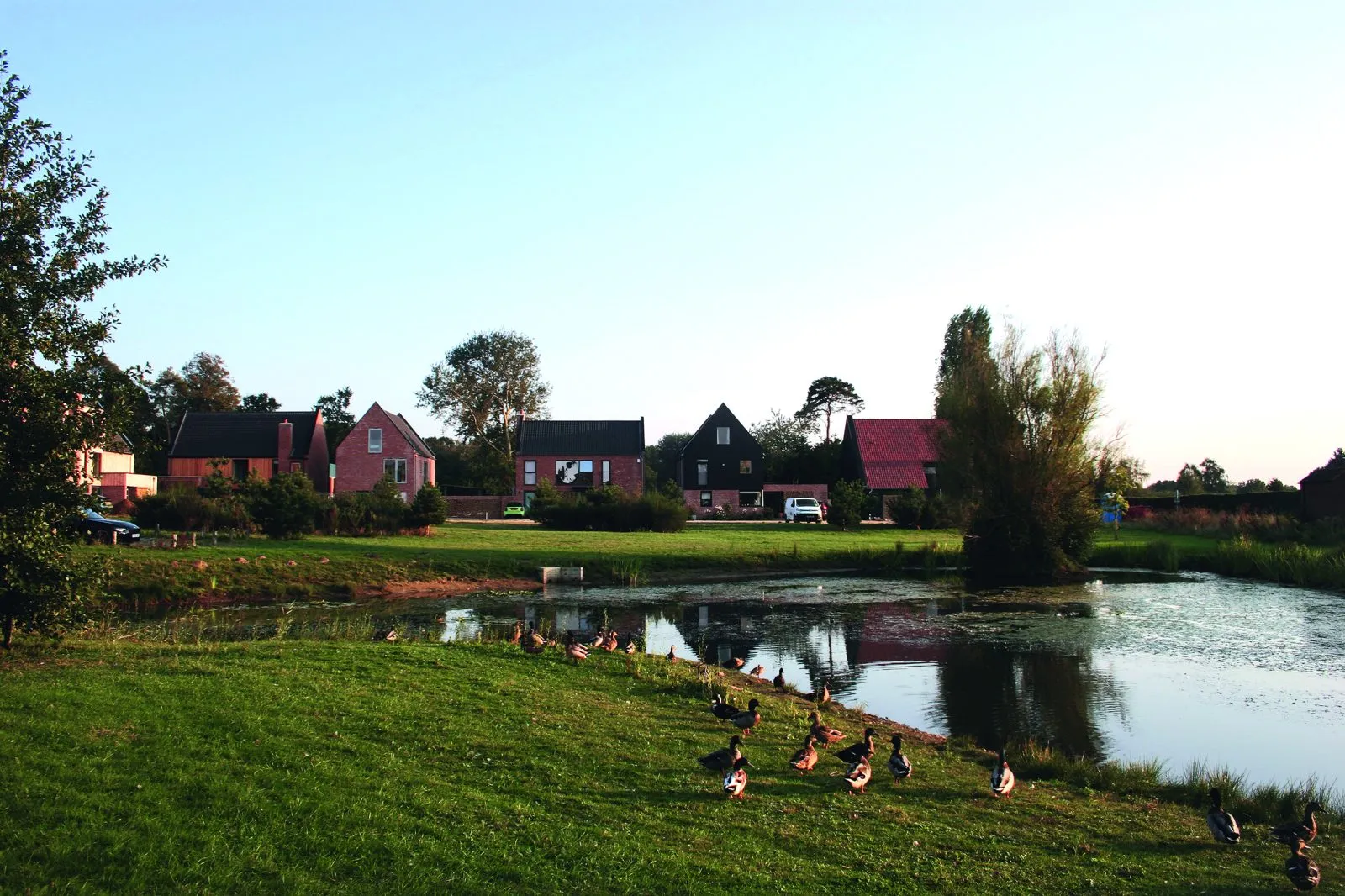
Completed self-build homes at Ingoldisthorpe, Norfolk. Photo: Charlie de Bono
From pilot to proposition
Ingoldisthorpe completed in 2023, four years after de Bono’s interview with the AJ. At the time, he described how Millar + Howard Architects was experimenting with a more intentional, less overbearing, site-specific way of delivering housing.
LivedIn handled feasibility, planning, infrastructure, dealings with the site’s landowner, and sales for the community-focused initiative, while Project Orange worked on a design framework that allowed planners and prospective homeowners to envisage what their new homes could look like.
Homeowners could choose from a range of predetermined colours and materials before initiating their self-build.
‘In hindsight, this idea of “controlled difference” is one of the most transferable aspects of the project,’ says de Bono. ‘Architects can add enormous value by designing frameworks rather than finished outcomes, especially on small, sensitive sites.’
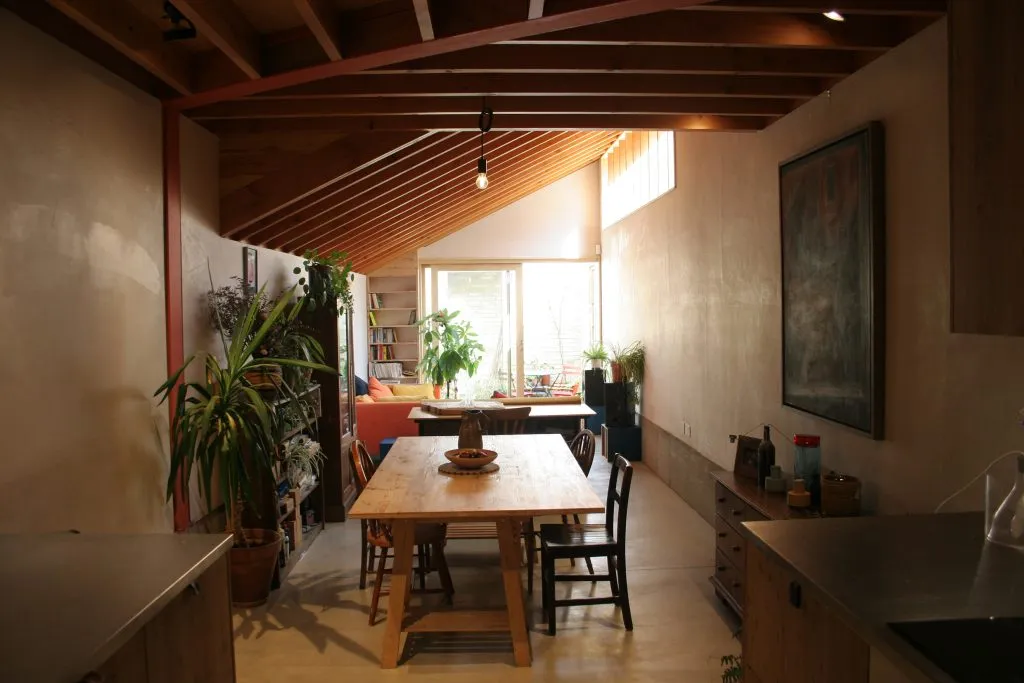
Kenworthy Road, Alexander Hills Architects. Photo: Alexander Hills Architects
Alex Hills, founder of London-based studio Alexander Hills Architects, which is part of Cohort One, tells the AJ that he sees the Ingoldisthorpe model not as a ‘grand strategy’ but as an ongoing experiment.
‘The lack of pressure for it to be the next big thing actually gives it room to become one,’ says Hills. ‘It focuses the vision on action’.
Why this works
LivedIn’s co-founder, architect Tom Howard, tells the AJ that practices on board Cohort One will benefit from his team’s experience in getting self-build and custom homes through planning and then built. Indeed, Ingoldisthorpe is the outfit’s fourth such project.
LivedIn says it will take responsibility for weighing up the viability of more than 100 sites put forward by the 24 practices involved in Cohort One, using an in-house AI tool or ‘appraisal platform’.
LivedIn will then work with the architects to secure permission in principle – at which point the landowner will pay LivedIn a ‘success fee’. It will then work with the landowner and future occupiers to deliver the homes.
Self-build can mean many things, but Howard imagines development happening in three main ways: a landowner-pay-as-you-go approach with an architect drawing up an overall design code and then individual plots being sold off to be developed, as with the Norfolk project; an architect-as-developer route; or a landowner, such as a community land trust, which contracts with a self-build group which, in turn, collaborates with the architect – not dissimilar to Barefoot Architects’ work on Hazelmead in Dorset, which the AJ’s Fran Williams described as ‘a DIY utopia’.
Why architects are paying attention
Barefoot’s Sam Goss, who was at Cohort One’s launch, told the room full of architects that what resonated with people who’d seen Hazelmead was its ingredients and flavour.
‘Hazelmead is the sourdough that everybody wants,’ he said. ‘They are fed up with a sliced bread. It tastes like shit. When people go to Hazelmead, they think: “yum, yum, yum. I want all of this”. Really, it’s inspired me so much. It’s inspired other people.
‘This is an incredibly potent opportunity to deliver more of these projects faster, more smoothly, better, without some of the pain that’s gone through, because this is like a self-build on steroids.’
It’s for these kind of reasons that Archio founding director Kyle Buchanan is interested in pushing community-backed, custom and self-build housing. His practice, co-founded with Mellis Haward, is another one of the 24 architects interested in LivedIn’s offer.
He tells the AJ: ‘If you put an architect-designed scheme next to a housebuilder-led one, the difference is huge. One feels like it could be anywhere. The other feels like a place.
‘It’s also about architects bringing their skills to the housing market in a more intelligent way, and delivering public benefit at the same time.’
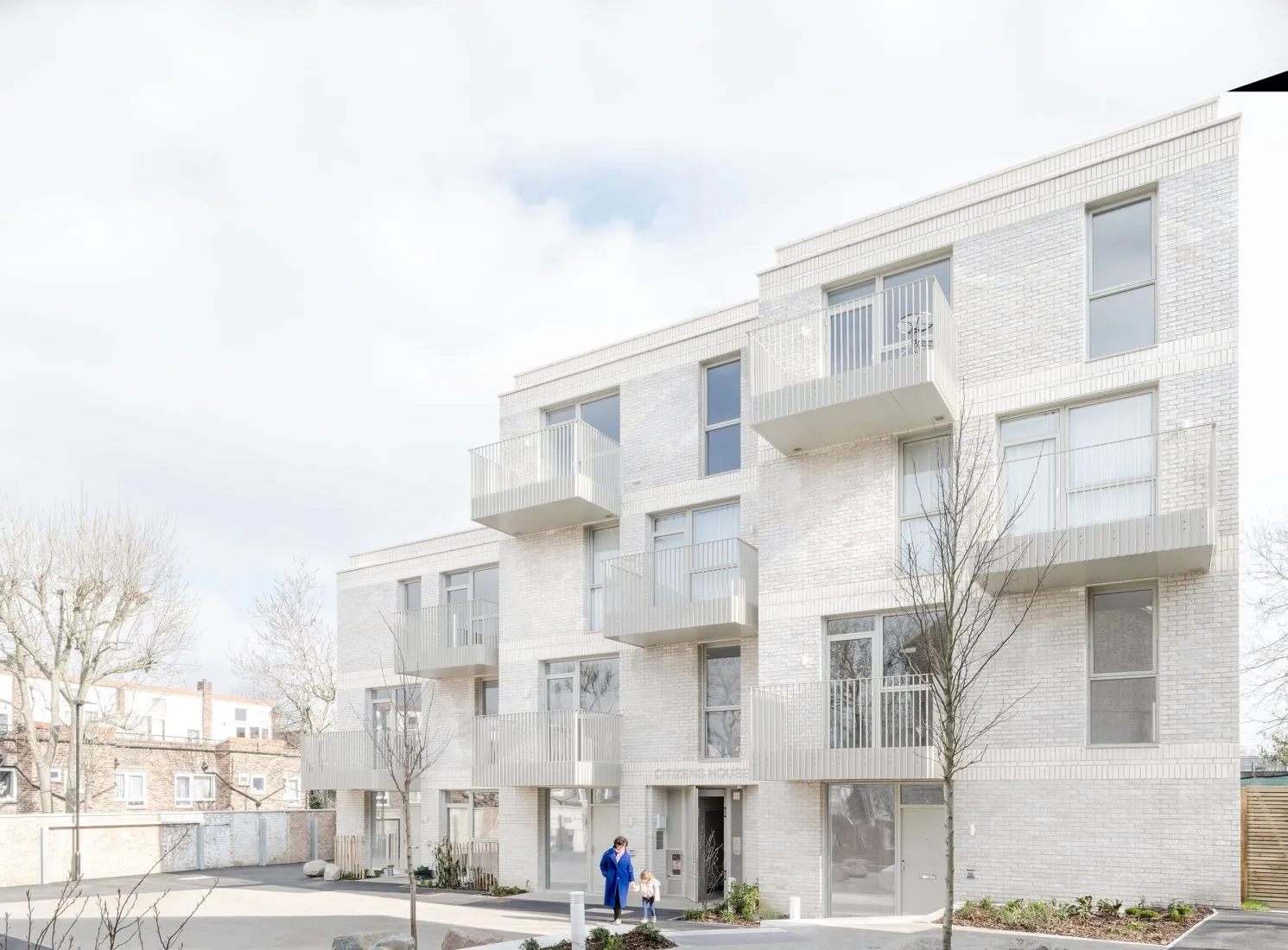
Archio’s Citizens House in south-east London
Buchanan should know. Archio’s 11-home Citizens House in south-east London, a London RIBA Award winner, was another victory for the community land trust (CLT) model of housebuilding (and that is perhaps why LivedIn originally approached the practice).
Members of London CLT, the client in this case, voted the practice in to co-design the project, which they, as owner and developer, have a meaningful stake in.
Risk and reward
Al Scott, co-founder of architecture practice IF_DO, agrees that custom and self-build is an opportunity for both architects and communities to work together to counter the lookalike mediocrity of housebuilder homes and create positive change – even though, he says, ‘it’s about as hard as it’s ever been’ to be an architect and particularly an architect-developer.
‘Normally the focus is on how we’re not building enough homes, but do we really want more of the rubbish we are seeing?’ he asks.
‘So to focus on new homes as the vehicles for creating stronger communities is inspiring – this is where the focus should be.’
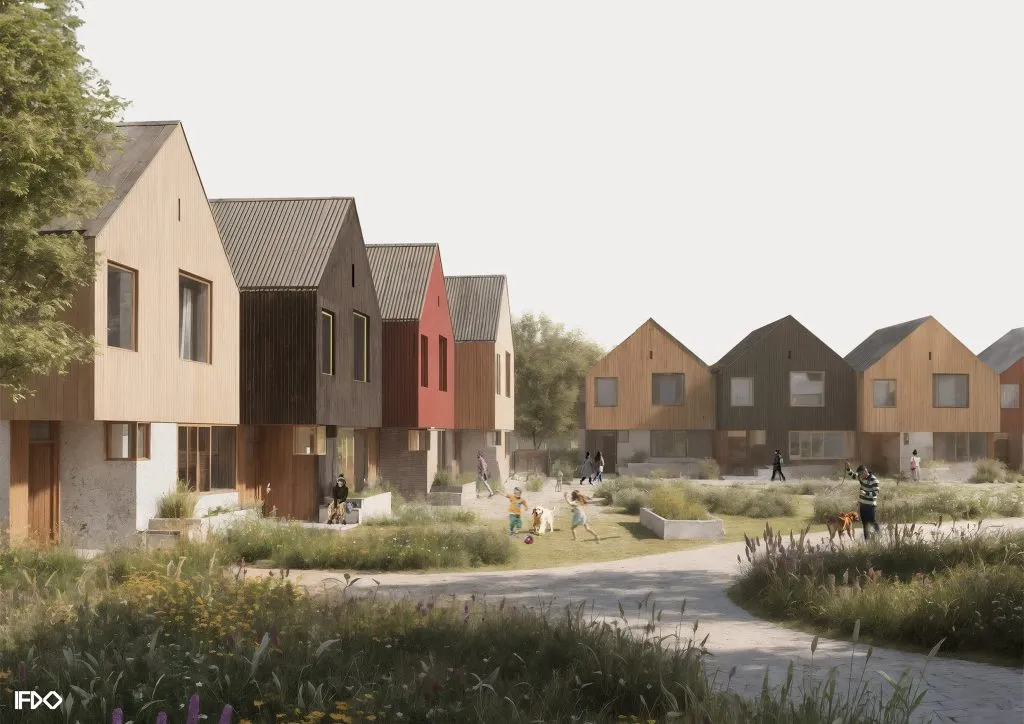
Visualisation of prototype housing by IF_DO. Credit: IF_DO
Participation in Cohort One will involve some unpaid work at an early stage, and a proportional success fee will be due following planning. But Scott says the main risk to his practice concerns time.
‘The commercial risk of being an architect-developer in the first instance is mainly time. This is finding sites and speaking to landowners — but with procurement as it is, we risk time anyway to win work, so why not do this?’
He adds: ‘Once planning is secured in principle, the site is massively de-risked, and the architect is in a much stronger position to persuade the landowner and create a viable project.’
Conclusion
So, what did the AJ learn in Stroud? If nothing else, that the state of mass volume house-building – and the lack of housing – means there is an opportunity for architects to work on smaller, more community-led housing schemes.
The signposts and ingredients already exist thanks to completed project such as Ingoldisthorpe, Citizens House and Hazelmead.
They show that self-build and custom homes offer a route back to relevance at a moment when both housing delivery and professional morale are under strain.
The words ‘optimism’ and ‘optimistic’ were aired several times during the day at the Cohort One launch, and the platform is just one organised effort at addressing a clear need for good homes.
Archio’s Buchanan summed things up with this reaction to the prospect of more well-designed housing: ‘It’s the first time I’ve heard somebody talk positively about the future potential of what we do as architects for a very long time. That’s very inspiring.’
Image, top: Completed self-build homes at Ingoldisthorpe, Norfolk. Photo: Charlie de Bono