
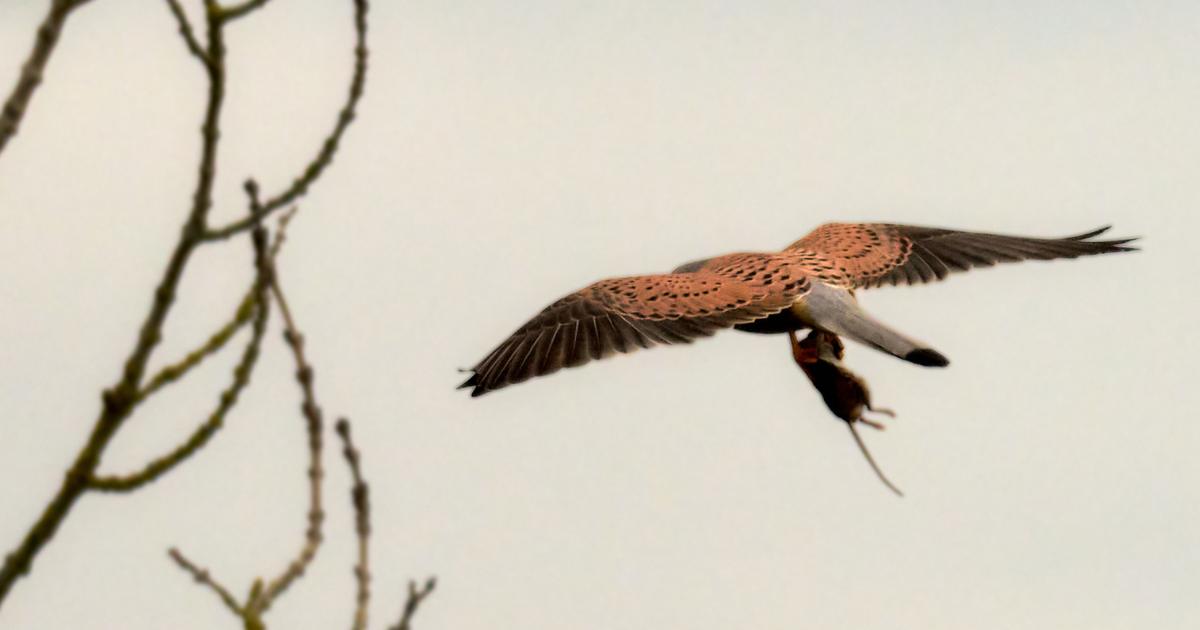
Alistair Magill photographed the kestrel at Pevensey Marshes, near Chilley Farm, during a recent outing.
The bird was carrying a lifeless rodent in its talons.
Mr Magill said: “I’d parked at Chilley Farm and had only taken a few paces into the first field when the kestrel flew right in front of me, prey in hand, and settled on a nearby branch.
“It took a few pecks at the rodent before flying off again.”
Alistair spotted the kestrel flying with a rodent it had caught (Image: Alistair Magill)
Originally from London, Mr Magill moved to Saltdean three years ago to study for a master’s degree in psychology at Sussex.
He said: “I fell in love with the scenery and wildlife on my doorstep and treated myself to a good camera and lenses when I graduated.
“I’ve only been photographing since September 2024, but I’m becoming increasingly serious about it. I’m having my first exhibition in Rottingdean this summer.”
Kestrels are a fairly common bird of prey in the UK (Image: Alistair Magill)
Mr Magill said kestrels are not unusual in the area, but it was the first time he had seen one with prey.
He said: “Kestrels aren’t super rare around here, but it’s always a treat to see one and I’d never seen one carrying prey before.
“On that visit I there were also song thrushes, redwings, bullfinches, blackcaps, robins, goldfinches.
“So I’ll be returning to the Pevensey Levels very soon!”
Alistair says he will be returning to Pevensey Levels soon (Image: Alistair Magill)
According to the Wildlife Trust, the kestrel can be found in all kinds of habitats, from open countryside to towns and villages.
“Kestrels are typically seen hovering, their pointed wings held out”, the trust said.
“The familiar behaviour of the kestrel gives it one of its old country names: the ‘windhover’.
“The kestrel has the ability to keep its head still while it hovers, even in strong winds, helping it to pinpoint its prey by sight.”