
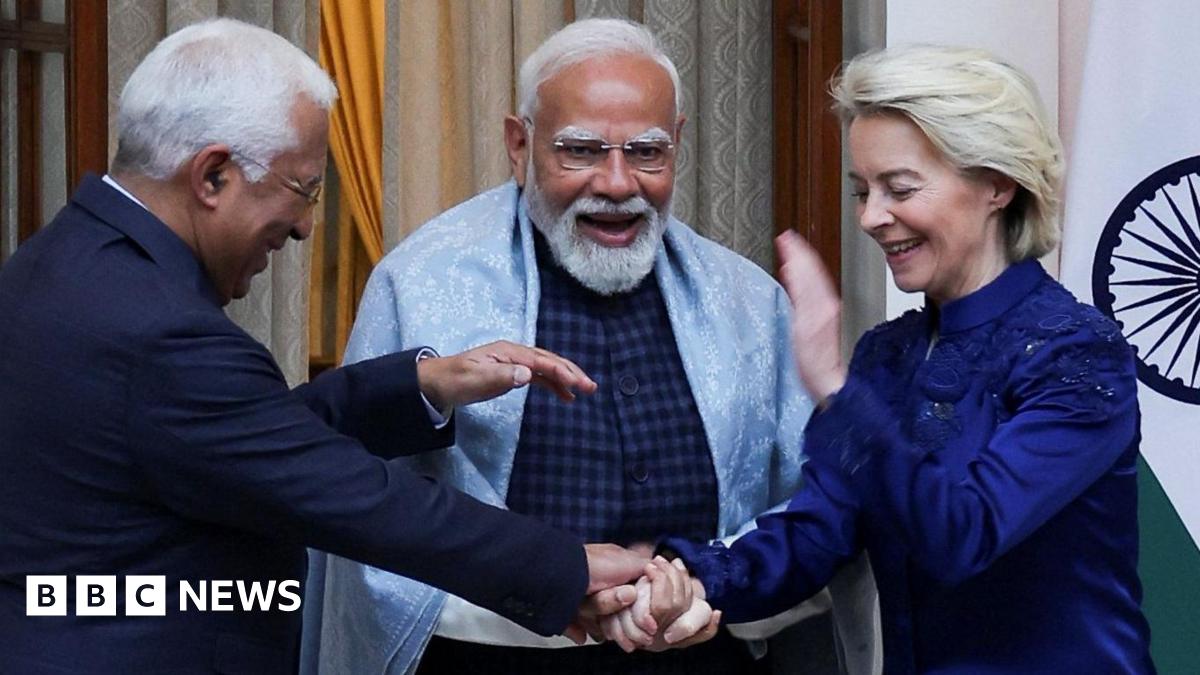
Indian Prime Minister Narendra Modi and President of the European Commission Ursula von der Leyen both called Tuesday’s agreement “the mother of all deals”.
“This is the tale of two giants – the world’s second and fourth largest economies – two giants who choose partnership in a true win-win fashion, a strong message that co-operation is the best answer to global challenges,” said von der Leyen, standing beside Modi after they exchanged agreements.
“By combining these strengths, we reduce strategic dependencies at a time when trade is increasingly weaponised… We are not only making our economies stronger – we are also delivering security for our people in an increasingly insecure world.”
Modi said the global order is in “great turmoil” and the trade deal would strengthen supply chains globally.
“This means it is not just a trade agreement. This is a new blueprint for shared prosperity,” he said.
The two leaders’ may or may not have intended the deal to annoy the Trump administration, but they appear to have done exactly that.
US Treasury Secretary Scott Bessent told ABC News on Sunday that the EU was “financing the war against themselves” by signing a trade deal with Delhi.
He was referring to India’s purchase of Russian crude, which US officials have often said was indirectly financing Moscow’s war in Ukraine. India has always denied this, saying the purchase of Russian oil secures energy needs of millions of its people.
The time-tested Delhi-Moscow relations are also the reason why India has been reluctant to abruptly cut business ties with Russia. It has long relied on Moscow for military hardware but today’s deal will help it build on already strong defence ties with France as it looks to diversify its defence imports portfolio with other European nations too.
The India deal also gives the EU access to another huge market and may help it reduce its reliance on China in the future.
“India will also look at this partnership as a way to counter China’s dominance in global trade, which it envisaged doing with the US. But it’s a different state of play right now. The EU likewise sees India as a useful country to partner within its own efforts to counter China,” Kugelman added.
But it’s worth remembering that behind the chest-thumping headlines, there is still plenty of work to do for both India and the EU. While negotiations around the deal have concluded, the formal signing of the agreement will take a long time.