
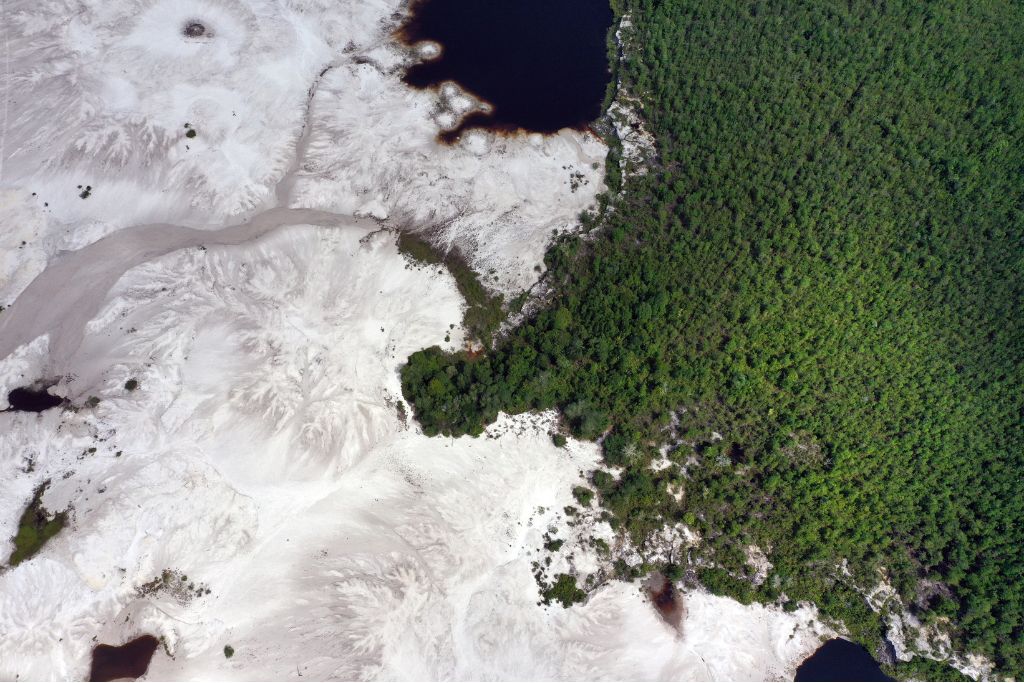
“Ecosystem collapse threatens not only nature, but the foundations of security, prosperity, and human rights. The proportionate response is ecocide law,” writes Jojo Mehta, CEO and co-founder of Stop Ecocide International.
—
By Jojo Mehta
Last week, the UK government published a national security assessment that should fundamentally shift how policymakers understand environmental destruction. Produced by the country’s intelligence community, it identifies ecosystem collapse as a direct threat to UK security and prosperity, with cascading risks including geopolitical instability, conflict, mass migration, and economic insecurity.
Ecological collapse does not respect borders. The assessment is unambiguous and the risks it identifies are universal: critical ecosystems including the Amazon rainforest, Congo Basin, boreal forests, the Himalayas, and Southeast Asia’s coral reefs and mangroves are on pathways to collapse. Some could begin collapsing within the next five years.
This is not environmental advocacy from the UK’s foreign intelligence agency, commonly known as MI6. It is threat assessment conducted by analysts trained to identify risks to national interests. Voluntary commitments and aspirational targets are nowhere near adequate in the face of this. The appropriate response is binding legal accountability.
Ecocide law, which criminalizes the most severe, widespread, or long-term destruction of ecosystems, provides exactly that mechanism. It establishes a clear moral and legal threshold: the worst harms are intolerable, and those responsible should face criminal consequences. Criminal law codifies what a society refuses to accept. People do not refrain from murder mainly because they fear jail, but because murder is understood as fundamentally wrong. Law both reflects and reinforces that moral boundary. Like murder, ecocide is defined by the outcome, not the method. It focuses on the scale and severity of environmental destruction, not on prohibiting particular industries or activities.
The threats identified are not hypothetical. A UN report published earlier this month described the world as having entered an era of “global water bankruptcy”, with critical systems already past the point at which they can be restored. The report found that 75% of people live in water-insecure countries, major rivers no longer reach the sea, and cities are sinking as aquifers collapse. The report’s lead author, Professor Kaveh Madani, warned that “no one knows exactly when the whole system would collapse.”
What makes ecocide law effective is that it operates where political commitments and regulatory frameworks fall short. Criminal liability forces decision-makers, whether in boardrooms or government offices, to ask fundamental questions before approving projects: could this cause severe harm, and could I be held personally accountable? What will that do to me? How will it affect my company’s reputation, value, freedom to operate? My party’s credibility? Those calculations shift behaviour in ways that industry self-regulation and environmental impact assessments cannot and never will.
International developments are already moving in this direction. The Kunming-Montreal Global Biodiversity Framework represents an important collective commitment to halt and reverse nature loss, and advisory opinions from the International Court of Justice and the Inter-American Court of Human Rights have clarified that states have legal obligations to prevent serious environmental harm. But political commitments alone, without binding consequences, cannot prevent the most severe damage.
Criminal law is what is required, and some of the world’s most ecologically vulnerable states are leading the way. In 2024, Vanuatu, Fiji and Samoa, now backed by the Democratic Republic of the Congo, formally proposed recognizing ecocide as a standalone crime at the International Criminal Court, alongside genocide and crimes against humanity. This shift is being echoed from within the court’s own structure: late last year, the International Criminal Court’s Office of the Prosecutor issued landmark policy guidance placing environmental destruction at the centre of international criminal law.
Regional frameworks are moving in parallel. Both the European Union and the Council of Europe have adopted frameworks that prosecute ecocide-level crimes. At the 2025 African Ministerial Conference on the Environment, ministers agreed to make ecocide law a continental priority.
Belgium criminalized ecocide in 2024, and similar laws are progressing in Scotland, Ghana, Argentina, Italy, Netherlands, Mexico, Peru and India. Multilateral progress is driving this explosion of domestic legislation, and new national-level laws strengthen multilateral frameworks in turn. Once enough jurisdictions act, routes that circumvent accountability begin to close. Insurers reprice risk. Banks reconsider financing. Boards start saying no. This is how law constrains power.
Intelligence chiefs have said what many of us already know: that ecosystem collapse threatens not only nature, but the foundations of security, prosperity, and human rights. The proportionate response is ecocide law: clear, enforceable, and designed to prevent harm before it occurs.
—
About the author: Jojo Mehta is co-founder (with the late Polly Higgins) and CEO of Stop Ecocide International, a global organisation working with multiple governments and across civil society to support and progress recognition of ecocide as a serious crime at national, regional and international levels.
This story is funded by readers like you
Our non-profit newsroom provides climate coverage free of charge and advertising. Your one-off or monthly donations play a crucial role in supporting our operations, expanding our reach, and maintaining our editorial independence.
About EO | Mission Statement | Impact & Reach | Write for us