
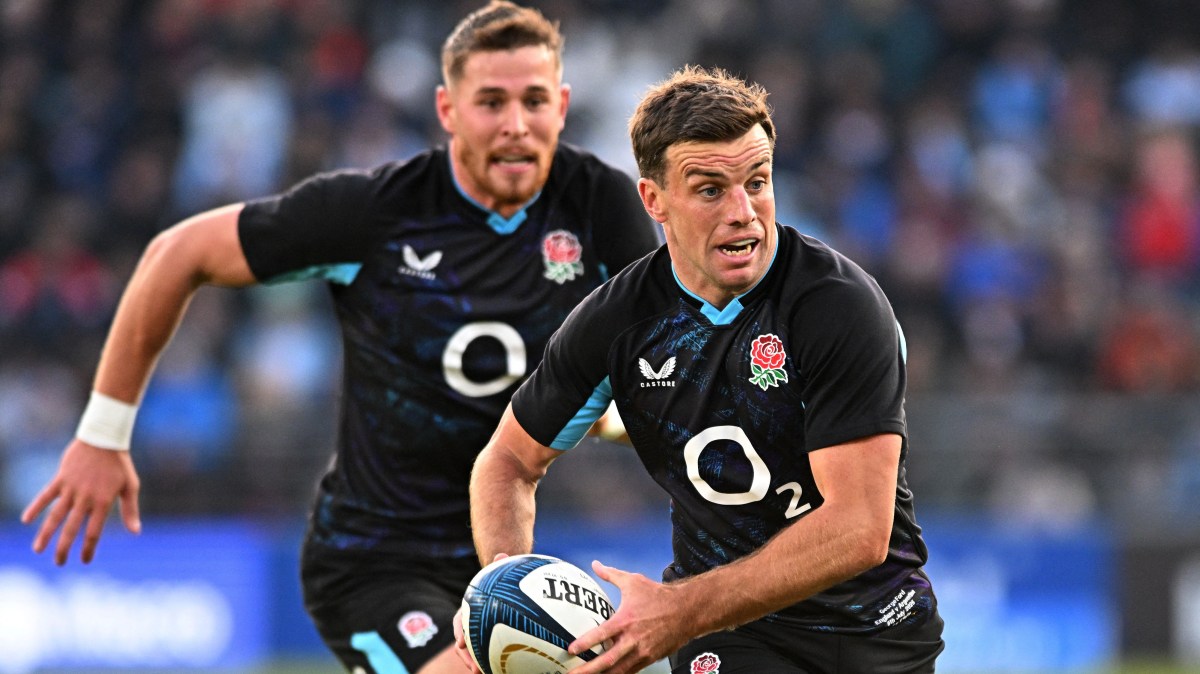
Was it a wind-up? At the fabulous farewell for Stephen Jones last week, three esteemed colleagues from various publications quizzed me on the subject of who would start as England’s fly half in the forthcoming Six Nations.
What sort of question was that? The answer was — and is — George Ford. And yet respected writers were opposing the Sale Sharks fly half with Northampton Saints’ Fin Smith.
In their defence, Smith’s fit in an England back line potentially dominated by Saints at Nos9, 12 and 13 is some sort of case. Yet those averse to Ford’s automatic selection tend not to play the Northampton card. Rather they belittle his defence.
Here is a man who can manipulate a field, who can pass a player into a hole which few can even see, whose capacity to come up with a 50:22 is unparalleled in England. In Argentina last year, Steve Borthwick gave him control of the team. How he has revelled in the role since. Yet his critics claim he cannot tackle. That he offers opposing teams an opportunity to break the gain line.
Well, it is true that he’s no Jonny Wilkinson but Ford’s defensive frailties are as nothing compared to his attacking positives. The 32-year-old makes tries, he delivers hundreds of metres’ worth of territory with his kicks, his spiral bomb is the best in the business, yet listen to the flak when he misses a tackle. He is as brave as they come but he isn’t as improved as, say, Finn Russell. In the perfect world, the tackles he makes would be more “dominant” than the stats tell us.
He has delivered so much for England since the Argentina tour that a guaranteed missed tackle a game shouldn’t affect his selection in the slightest. In short, the creative positives outweigh the negatives to such an overwhelming extent that Ford merits being one of the first names on the teamsheet.
It would be different if Ford were a flanker. An open-side who misses tackles is a liability. But a fly half has other priorities. His job is to map out the match. To be composed, to create; in short, he is something of an artist.
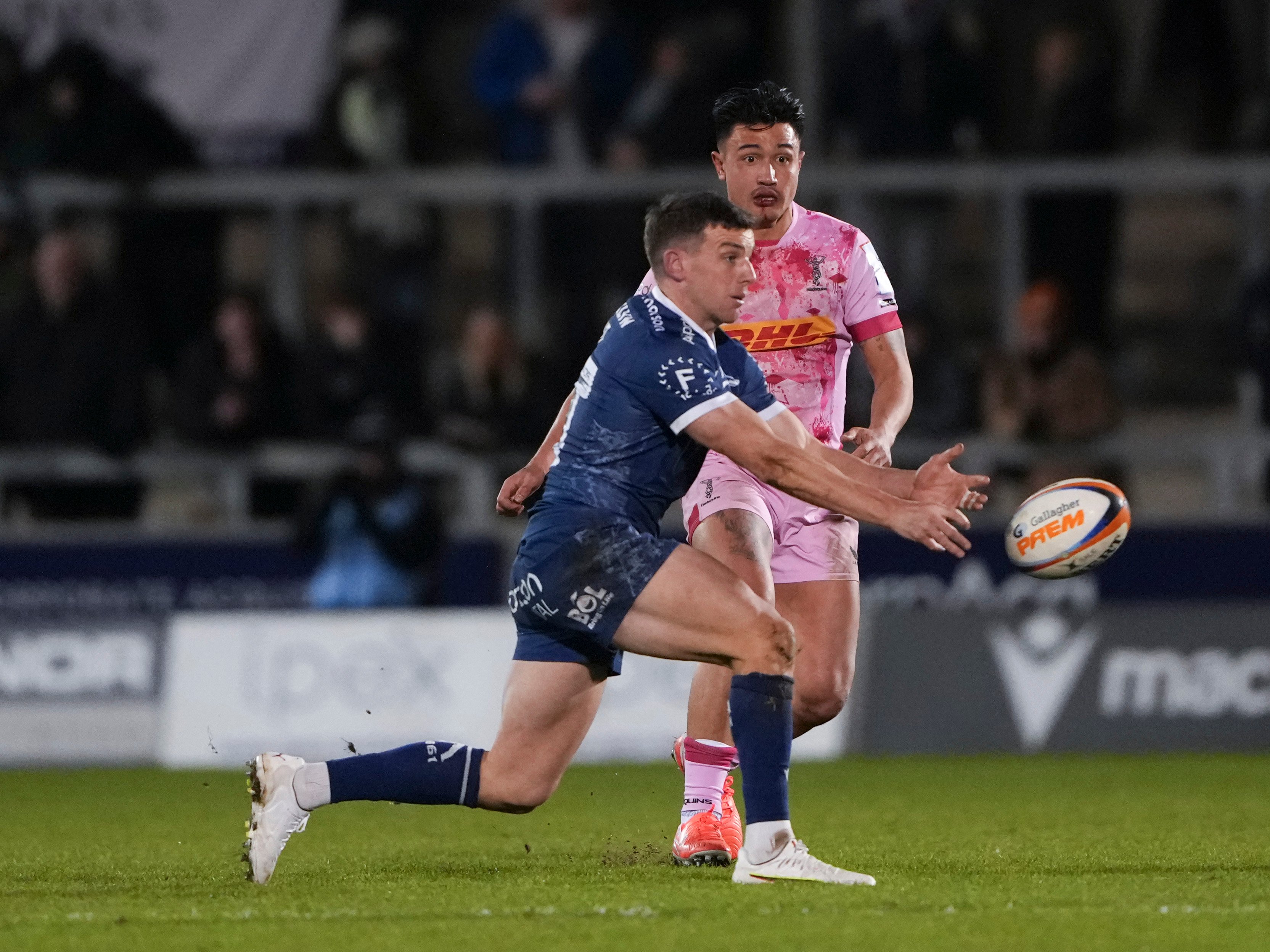
Marcus Smith gets a close look at his rival for the England No10 shirt as Ford’s Sale take on Harlequins
JED LEICESTER
Dan Carter created space for New Zealand as well as tackling tenaciously, technically near-perfect. The Kiwi — on his day — was the ultimate mix of the traditional No10 and the new age, Wilkinson-inspired, brick wall. He is the complete ten of the 21st century. But Jonny’s savage shoulder hits ended the era of the genteel artiste at No10.
As a child growing up in South Wales, the legendary Barry John was my inspiration. I can close my eyes and still see him ghosting through the 1971 All Blacks on some grainy television clip. He was a poet. I say that even though I never saw him in the flesh. John is relegated by distant rugby history to the realms of mythology. In its place has been born a puritanical world of management speak where everyone grafts to roughly the same degree.
Fly halves have to make their share of tackles and hit their rucks. But Wilkinson’s mighty shoulders should not be the rule. They remain an exception. There were negatives to go with his thundering defence. Too often, he was too trapped in breakdowns and collisions to see where next for his team in the eventuality of a turnover.
Forget about Ford’s tackling and think about his vision. A blind, battering ram of a fly half isn’t as effective as a visionary. But the puritans want everyone to be equally adept. If Ford’s goal-kicking falls to pieces, if he passes as sloppily as he did against Scotland in 2024, these are reasons to omit him. But not for missing one glaring tackle.
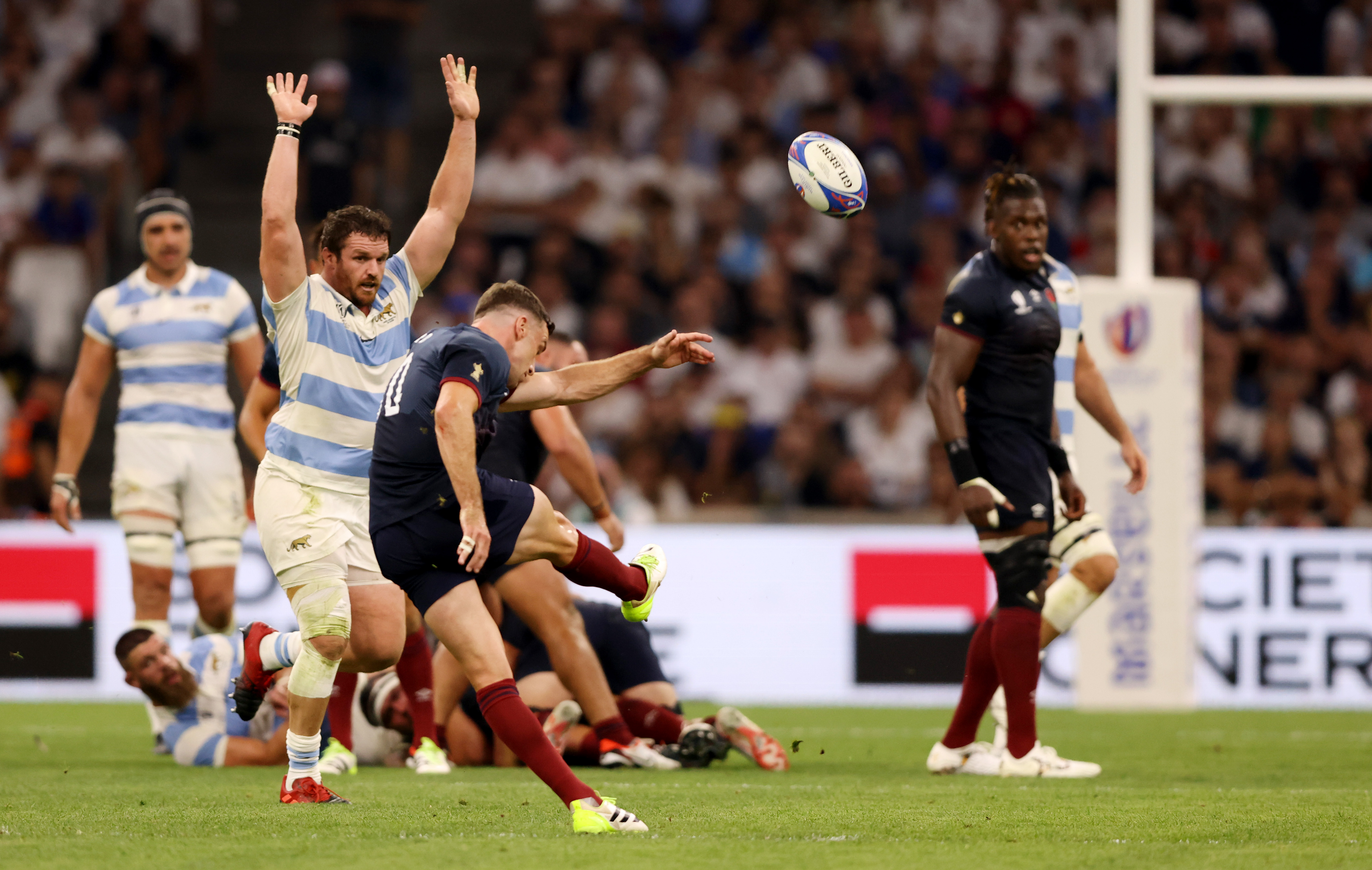
Ford’s capacity to manage a game was exemplified by his performance in the 2023 World Cup, kicking three drop goals and six penalties as England beat Argentina despite a third-minute red card for Tom Curry
PAUL HARDING/GETTY IMAGES
In France, Mathieu Jalibert has been billed as a cavalier, capable of tremendous feats, but another one with a reputation as a part-time tackler. Rumours and whispers somehow become hard facts, even though his cover tackling for Bordeaux is quite brilliant. Such is his pace that few get in a position to miss tackles that he can pull off. I won’t deny a few opponents have bounced him in midfield; slowing attackers down ends up in the “tackles missed” statistics and no one wants to be in that category.
Even if he is the form fly half in Europe, even if Romain Ntamack is injured, Jalibert’s supporters will not relax until he is named No10 for France’s looming clash with Ireland. The head coach Fabien Galthié has some great players at his disposal. “Great” in the proper, grandest sense, yet he has omitted a true great in Damian Penaud from the Six Nations squad.
France’s Test team has frequently sought to emulate the Anglo-Saxon way since the early English successes of this century. Their coach does not trust men billed as mavericks. When you read about a “maverick”, it usually means a player of skill and conviction. Ireland’s Sam Prendergast is such a talent. He has the most delicate, delicious of wrists when delaying a pass. He can ease onto the gainline and get the latest of passes away. Here’s another fly half not trusted in his own land.
But Prendergast is different. He is not in the category of a “one missed tackle” fly half. He is a chasm through which the opposition pour. There are few more enjoyable fly halves to watch, but here is someone whose capacity for indifference in defence can cost his team — think back to his half-hearted attempt to tackle Henry Pollock in last season’s Champions Cup semi-final — more points than those magical hands of his can conjure.
There is a clear case both for and against the gifted Irishman. He needs to stop being selected on trust with fingers crossed. When it comes to the English veteran Ford, forget the faith and think about the facts. It should take a few shocking performances before the brains, the boot and the balance provided by Ford makes way for a Smith.