
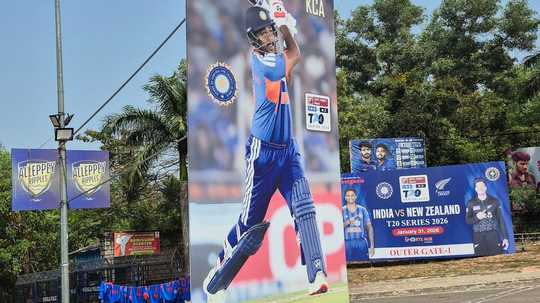
The first sign that this wasn’t just another cricket match arrived before the stadium did.
Take a left from the University of Kerala’s Karyavattom campus and almost immediately Sanju Samson is there. A giant cut-out planted on the divider ahead, bat following through straight down the ground for one of his typical sixes. The road takes you forward, narrowing into one of the entrances to the Greenfield International Stadium, but the image stays with you. It feels deliberate, as if the city wants you to register what this match means.
In the south, big posters remain a language people understand. Cinema hasn’t shrunk into phone screens here the way it has elsewhere. Arrivals are announced loudly. Moments are marked.
As the car edges closer to the gate, my cab driver, Majeesh, asks what time Sanju will reach the ground. “Five,” I tell him. He nods, already doing the arithmetic in his head. This is his only chance to see him; he doesn’t have a match ticket. “Too expensive,” he says, before smiling and adding that the organisers must be over the moon it’s a sell-out this time. “They should thank Sanju for it,” he says.
The comment carries more weight than it seems.
Thiruvananthapuram has never been a city that defaults to cricket. Attention here has always been shared. Football has its loyal following. Athletics has its space. Other pursuits have long coexisted without one demanding primacy. Cricket, in that sense, has always had to negotiate its place rather than assume it. That reality has often shown itself in the stands, where internationals have been played out in front of conspicuous pockets of empty seats.
That sensibility follows you around the stadium complex. Greenfield sits inside a multi-activity campus, its walls painted with silhouettes of footballers and volleyball players frozen mid-action. Before you see a stand named after a former player or a mural celebrating a past victory, you walk past a Moviemax cinema hall, its entrance lined with portraits of South Indian movie stars, with only the bottom row reserved for posters of sports films like Lagaan, 83 and the MS Dhoni biopic.
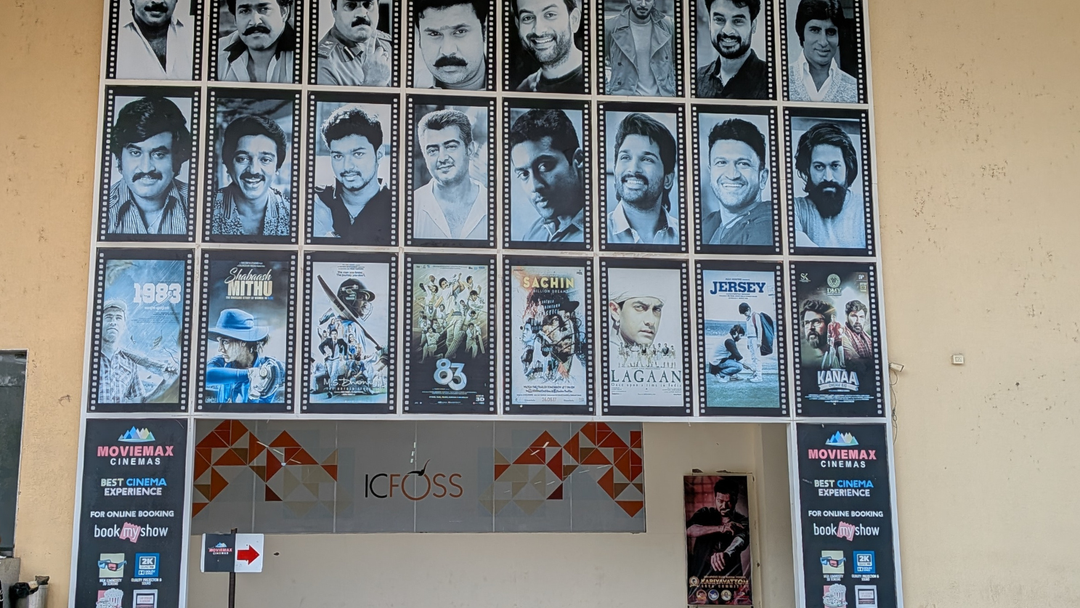
The Greenfield International Stadium comes with its own movie theatre
Cricket and cinema share the same foyer here, without explanation or hierarchy. It feels natural, it feels appropriate. At least this week, when the mood resembles that of a long-awaited release. Tickets flew off the shelves within hours after prices were lowered following intervention from the state government. The ground, for once, will be full, even if there are still millions like Majeesh who won’t be able to make it.
When the Indian team landed on Thursday, Suryakumar Yadav turned the arrival into an announcement, setting the tone for something big the city was gearing up for. The Indian captain playfully cleared a path at the airport, telling photographers to move aside and not disturb “Chetta”. Sanju laughed, slightly embarrassed, trying unsuccessfully to stay in the background. Asked how it felt, he admitted it was special. Extra special.
By the time India reached the stadium for their optional practice session, anticipation had thickened. The press conference itself struggled to stay contained, pausing repeatedly as different news portals stepped forward to place their microphones, each logo needing to be seen on an evening like this.
Once it ended, attention shifted immediately outside. Just beyond the press conference room, a narrow balcony overlooks the nets. At least twenty photographers filled it, elbows jostling for space, lenses fixed on the dressing-room entrance. One of them hit me on the side of the head. There was no apology.
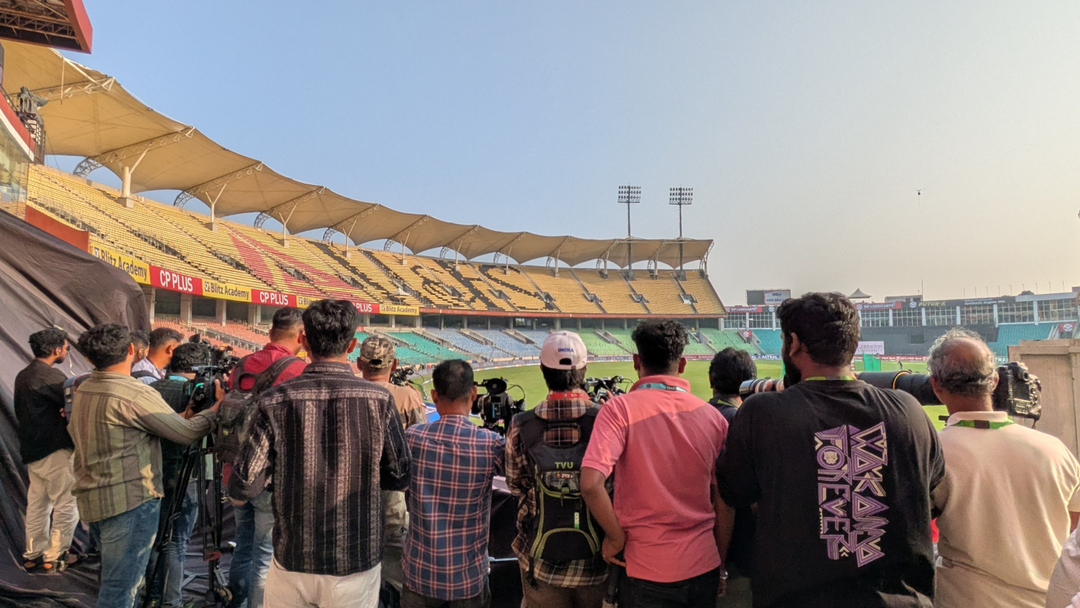
Photographers line the balcony hoping to get the perfect shot ©Cricbuzz
When Sanju finally came into frame, it wasn’t in full kit. Vest on, relaxed, smiling, shaking hands with almost everyone he passed. Then he disappeared, changed, and returned to work. The shutters came alive again.
His training session was long and deliberate. Throwdowns first. Then spin, with Varun Chakaravarthy, Ravi Bishnoi and Axar Patel all taking turns. Later, Sanju returned to the original net to face a bowler mimicking Mitchell Santner, the man who had bowled him in Vizag just as he appeared to be finding rhythm again. Between stints, he sat on an ice box, greeting those around him, waiting out his turn.
When Sanju batted, the attention around him was unmistakable. Behind his net, half a dozen bowlers from KCA clubs stood in full gear, still and attentive. Not everyone got to bowl to him, but they could all watch. At where the point fielder would stand, a BCCI photographer crouched low, contorting himself in search of the right angle. At mid-off, Suryakumar and batting coach Sitanshu Kotak stood nearby, watching, talking quietly.
It felt like a spotlight had settled on Sanju. There was attention here, and that is where the irony lay.
Since the start of last year, Sanju’s T20I returns have been modest. As opener, a role taken away and then given back, he has scored 128 runs in 10 innings, averaging 12.8. The numbers reflect a career that has kept looping back to reassessment.
By 7.38 pm, nets on one side of the square were coming down. On the other, Sanju kept batting. At 7.40, he finally walked off, bumped fists with the slingers and dropped to his haunches near where Suryakumar and Kotak stood. Kotak walked over and hugged him, acknowledging a long and intense session. Nothing was said. Nothing needed to be said.
Sanju threw his gloves on the ground, lay back on the grass and looked skywards. He stayed there for a while. Eight floodlights burned above him. Sweat glistened on his skin. It felt less like rest than absorption, as if he were taking in the weight of where he was and what it had taken to get here. It was hard not to read meaning into it.
Moments like that have already been claimed by the city. The posters are up. The tickets are gone. The attention has gathered. What remains now is simpler and harder. For Sanju Samson to do what he has been circling for most of his international career. To turn promise into performance, to audition once again in India colours under lights. Only this time, it will be in front of people who knew him long before any of this felt inevitable.
There is no better time. And there is no better place.