
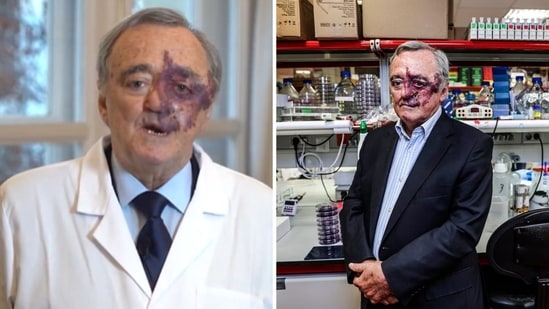
Mariano Barbacid, head of the Experimental Oncology Group at Spain’s National Cancer Research Centre (CNIO), has designed a therapy with his team that successfully and completely eliminated pancreatic tumours in mice, with no significant side effects. While the scientific community and the general public hailed the news as a potential turning point in the fight against the disease, a segment of social media users chose to ignore the monumental moment. They turned their attention to Barbacid’s facial mark, launching a series of distasteful and shallow remarks.
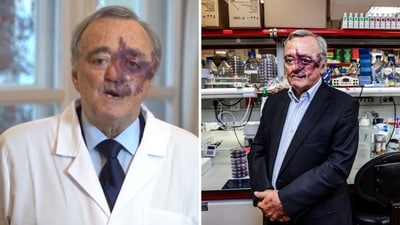 Mariano Barbacid is the head of the Experimental Oncology Group at the National Cancer Research Centre, Spain. (Screengrab)The ugly side of social media
Instead of discussing the content of Barbacid’s study, published in the journal PNAS (Proceedings of the National Academy of Sciences), some people shared comments and memes that shifted the narrative from groundbreaking science to schoolyard bullying.
Public support:
Fortunately, there were people who rallied around Barbacid, prioritising the discovery over the noise. They further slammed social media users who body-shamed the scientist.
An individual wrote, “This 76-year-old man could have retired long ago to enjoy a hedonistic life, but he keeps working to give hope to thousands of people and maybe save millions of lives in the future. And yet, some mongrels mock the birthmark on his face. We don’t deserve him.” Another said, “What’s wrong with today’s world? This man has made a breakthrough in cancer treatments, and the world wants to mock him for a birth defect. F**k everyone in these comments, seriously.”
A third expressed, “Bro discovered a cure for cancer, and all the comments are about his appearance, omg some of you are just truly awful awful people, and there’s nothing cute about it.” A fourth wrote, “This guy found a cure for cancer with one of the lowest survival rates, and still people make fun of his face. We deserve nothing.”
Who is Mariano Barbacid?
Mariano Barbacid got his PhD in Madrid’s Universidad Complutense (1974) and trained as a postdoctoral fellow at the US National Cancer Institute (1974-78).
His work, in 1982, led to the isolation of the first human oncogene, a gene that has the potential to cause cancer. He is also credited with the isolation of the TRK oncogene from a colon carcinoma.
The recent breakthrough study is titled “A targeted combination therapy achieves effective pancreatic cancer regression and prevents tumor resistance,” with Carmen Guerra as co-lead author and Vasiliki Liaki and Sara Barrambana as first authors.