
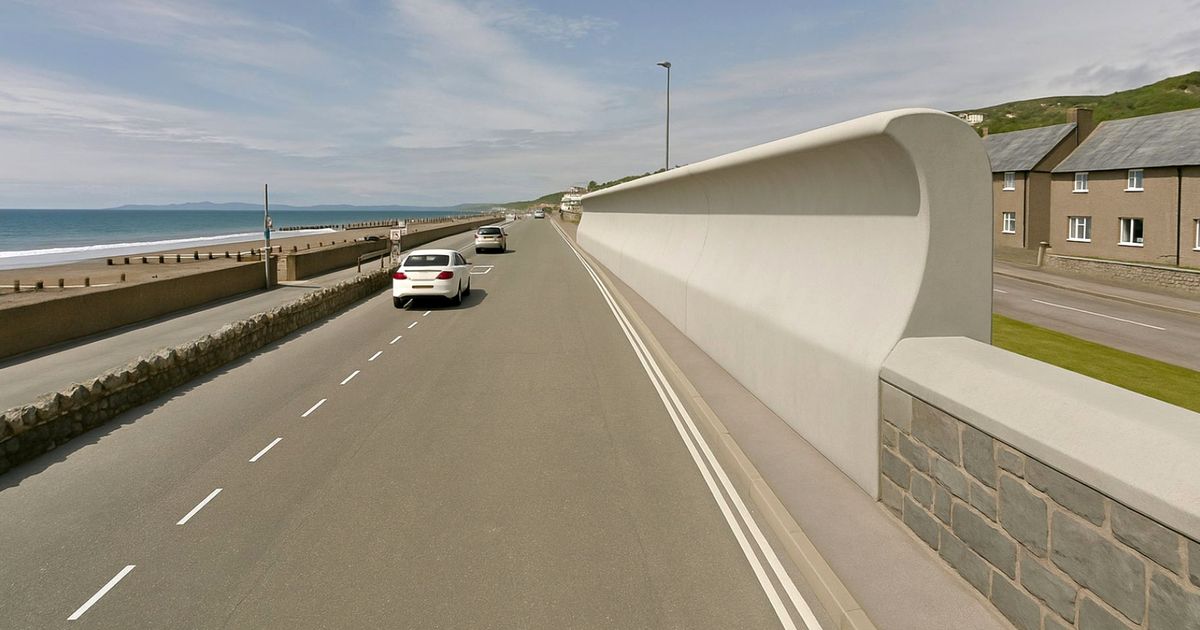
Work on a two-year flood alleviation scheme is due to start this summer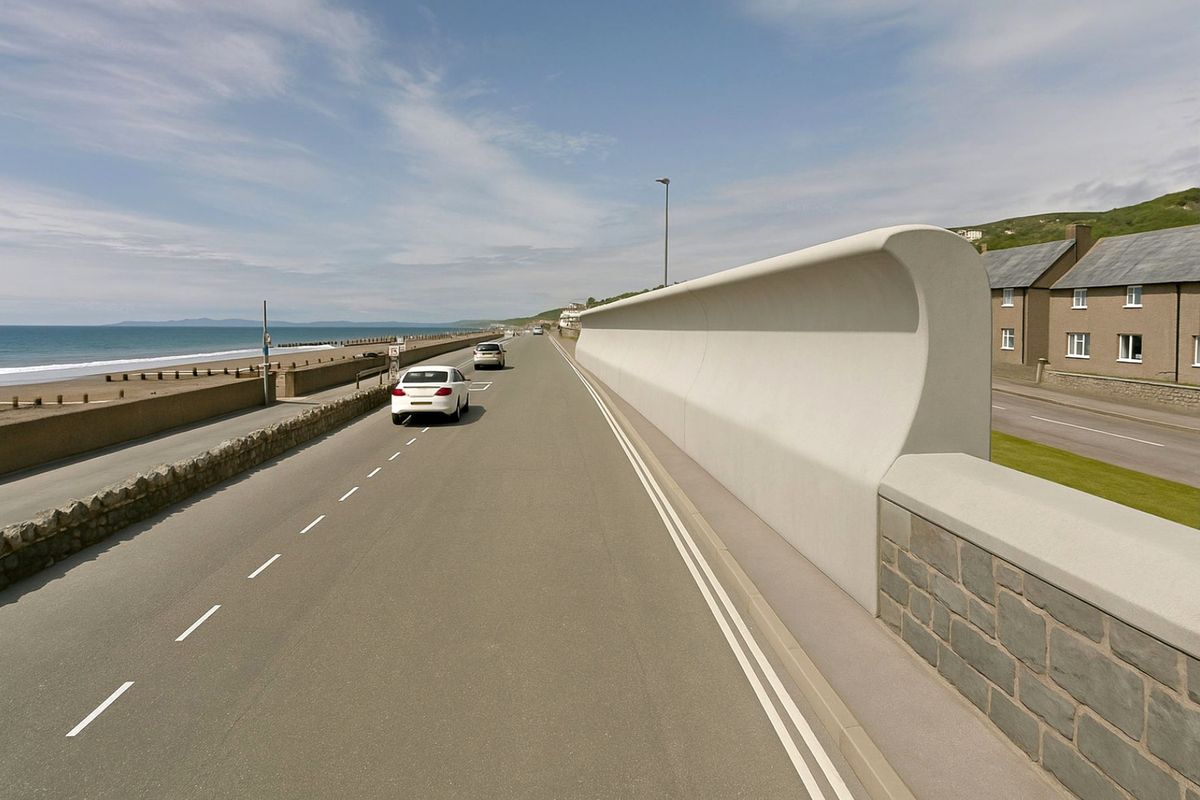
AI-generated approximation by Kye Smith of the impact of north Barmouth’s planned secondary wall in front of properties(Image: Kye Smith)
The full scale of planned flood defence works at a Gwynedd seaside resort is dawning on worried residents. Concerns have been raised in Barmouth over the height of a planned new flood defence wall and the potential visual blight of new rock armour.
Safety fears have also been flagged over aspects of the two-year project due to start this summer. Residents have called for changes to a scheme that will allow the resort’s promenade to flood in stormy weather, storing water like a reservoir.
New coastal defences along Barmouth’s north promenade are in the final stages of design by Cyngor Gwynedd. Partial prom collapses in 2020-21 highlighted the urgent need for improvements to avoid potentially catastrophic flooding.
Council consultants YGC ruled out raising the height of the primary wall and revetment along the seafront as this would have a “significant visual impact” on a town that relies heavily on tourism. Instead the goal is to increase the height of a 1.2km-long secondary wall. This wall is set back from the seafront and sits in front of housing estates.
The new concrete recurve wall will vary in height between 1.55 and 1.7 metres (5.1ft-5.6ft). Estate resident Kye Smith was shocked when he discovered this was the plan. “Residents will feel like they are in a maximum security prison,” he fumed.
“The extreme height of this concrete wall will obstruct light and views. It will also invite anti-social behaviour such as graffiti and poor driving as it’s so high no one can be seen behind it.” Join the North Wales Live Whatsapp community now
To prove his point the 38-year-old construction worker propped up 1.7-metre planks alongside the existing stone wall. Taking photos, he then overlaid coloured blocks on the images to produce an “accurate” representation of the wall’s visual impact.
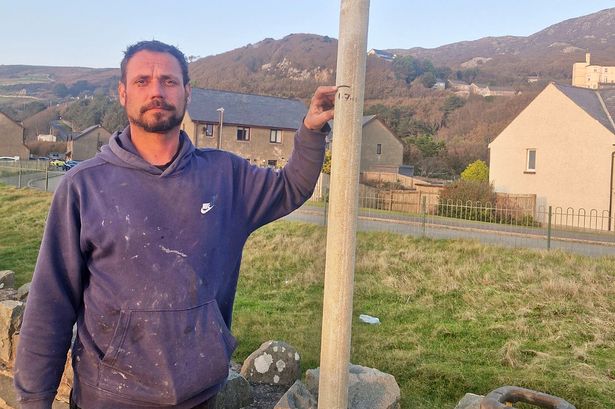
Kye puts a 1700mm mark on a post to give an idea of the height of the planned secondary defence wall(Image: Kye Smith)
It was at this point he realised the wall would be even more domineering when viewed from the promenade. As this lies 550mm lower down a slope, he calculated a net height of 2.25 metres when viewed from the seafront.
Kye said the planned secondary wall was “unnecessary and impractical” – especially as consultants say the beach’s new rock armour will “significantly reduce wave overtopping at the primary wave wall”.
He added: “It may be appropriate to consider improving the secondary wall with a more structural design supported by piles. However there is no clear justification for the proposed 1700mm height – or for introducing a wave-return curve that would detract from the character and visual appeal of the existing stone wall and the Wales Coast Path.”
Not everyone is on board: some residents point out graffiti is not currently an issue in Barmouth and a higher flood defence wall will screen passing traffic.
Under the original proposals, a 10-metre wide rock revetment was planned along the promenade north of Heol Idris, a little over its entire length. Additional rock armour north of the prom was also considered but later rejected as unnecessary. Other planned work includes:
Groynes to be removed where possible, subject to environmental surveys.Primary wall to remain at the same height but with some localised modifications and repairsCentral stone-faced wall (to delineate the prom from the seafront road) to be replaced with a similar height 0.4-metre concrete wall.Flood gates to replace stop logs across key openings, with goal to reduce the number of temporary defences.Introducing rock pods to enhance marine biodiversity.Improving public spaces with new seating, raised planters and better lighting.New art installations and cycling amenities.Traffic calming features with parking improvements and better access to the beach. These could include a new parking layout on Marine Parade and refurbishment of the northern car park.Designated locations for commercial activities such as food and drink trucks.
Leaving the primary wall at the same height, to safeguard views of the seafront, will inevitably mean more overtopping as sea levels rise. YGC said this is part of the plan.
“The promenade including the road (Marine Parade) will still flood and is part of the defence solution,” said YGC’s experts. “This area will be closed during a flood event.
“Allowing the promenade to flood balances the need for flood protection with maintaining the character of the town.”
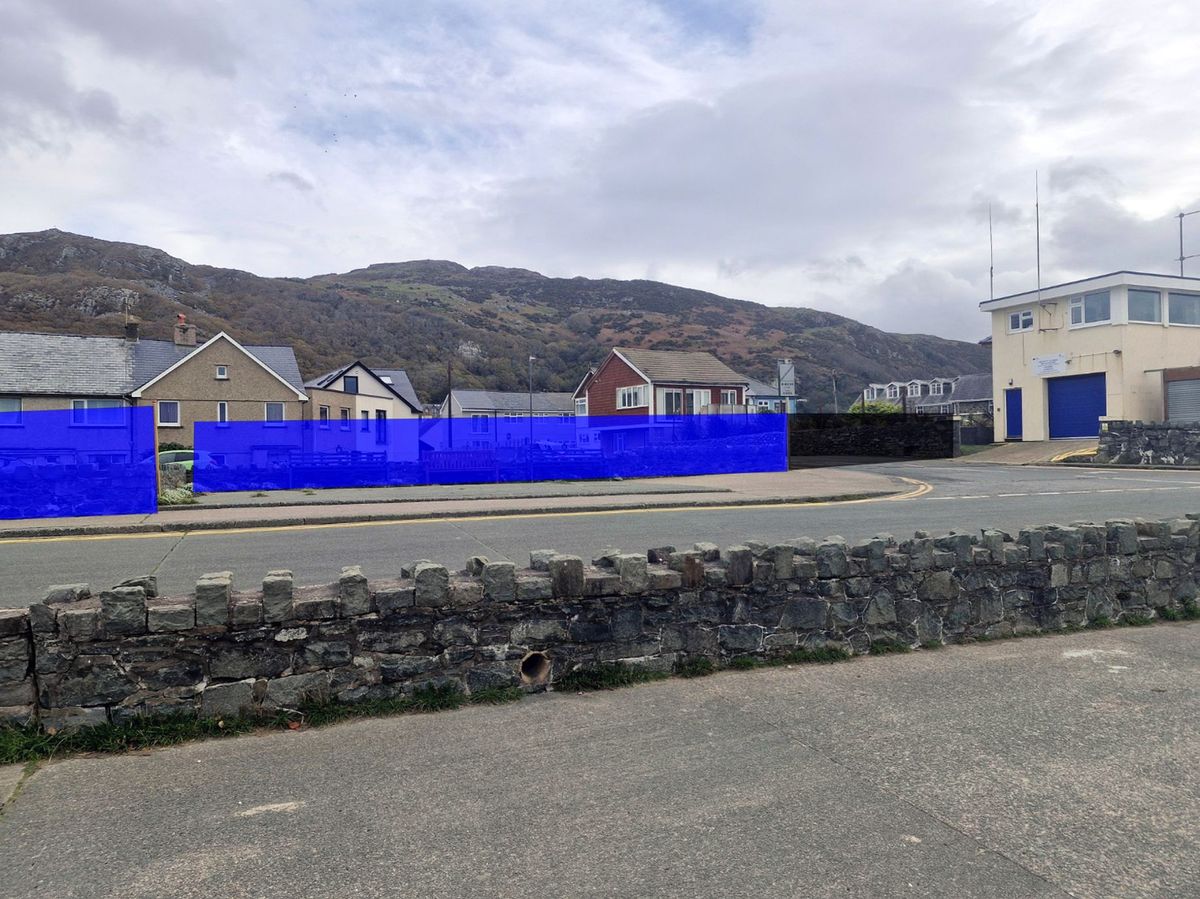
Using wooden planks, Kye produced a ‘very close-to-accurate’ visual of the impact of the planned 1700mm (5.5ft) secondary wall (blue) viewed from the promenade. Also shown is a 1700mm (5.5ft) flood gate (black) planned at Barmouth’s Coastguard look-out(Image: Kye Smith)
Rock armour fears
The new rock armour should reduce the degree and frequency of flooding on the promenade. However Kye is not impressed, believing there is a better solution – one less intrusive and “less dangerous”.
To make people aware of the scheme’s implications, and to offer alternative ideas, he set up Facebook page Barmouth Flood Defence Scheme to reflect local concerns. Already this has attracted almost 600 members in a town with 2,500 people that swells five-fold with summer visitors.
Rock armour is unsightly but it works – it’s now used in the majority of coastal defence schemes in North Wales. However Kye worries it has drawbacks.
“You are essentially putting an obstacle course akin to a climbing frame on the beach,” he said. “Barmouth is one of the busiest tourist towns in Gwynedd with many visitors coming from cities in England – one reason why they call this place Little Birmingham.
“After a long journey of two to three hours, the driver often drops off the rest of the family at the seafront before looking for somewhere to park. The kids are excited, they want to get on the sand and it’s inevitable some will start clambering over the rock armour.”
As well as slips and trips, people have been known to become wedged in rock armour. Kye cites several examples from around Britain – but most keenly recalls one closer to home.
In April 2024, a young girl became trapped while playing on rock armour on Tywyn beach. With the tide coming in, a multi-agency rescue was launched involving Coastguards, fire teams, paradmedics and an air ambulance. Heavy-lifting machinery was brought in and the girl was rescued after around three hours.
“People will do anything to get to the beach,” said Kye. “I can see similar issues happening in Barmouth that happened in Tywyn that day.” Get all the latest Gwynedd news by signing up to our newsletter – sent every Tuesday
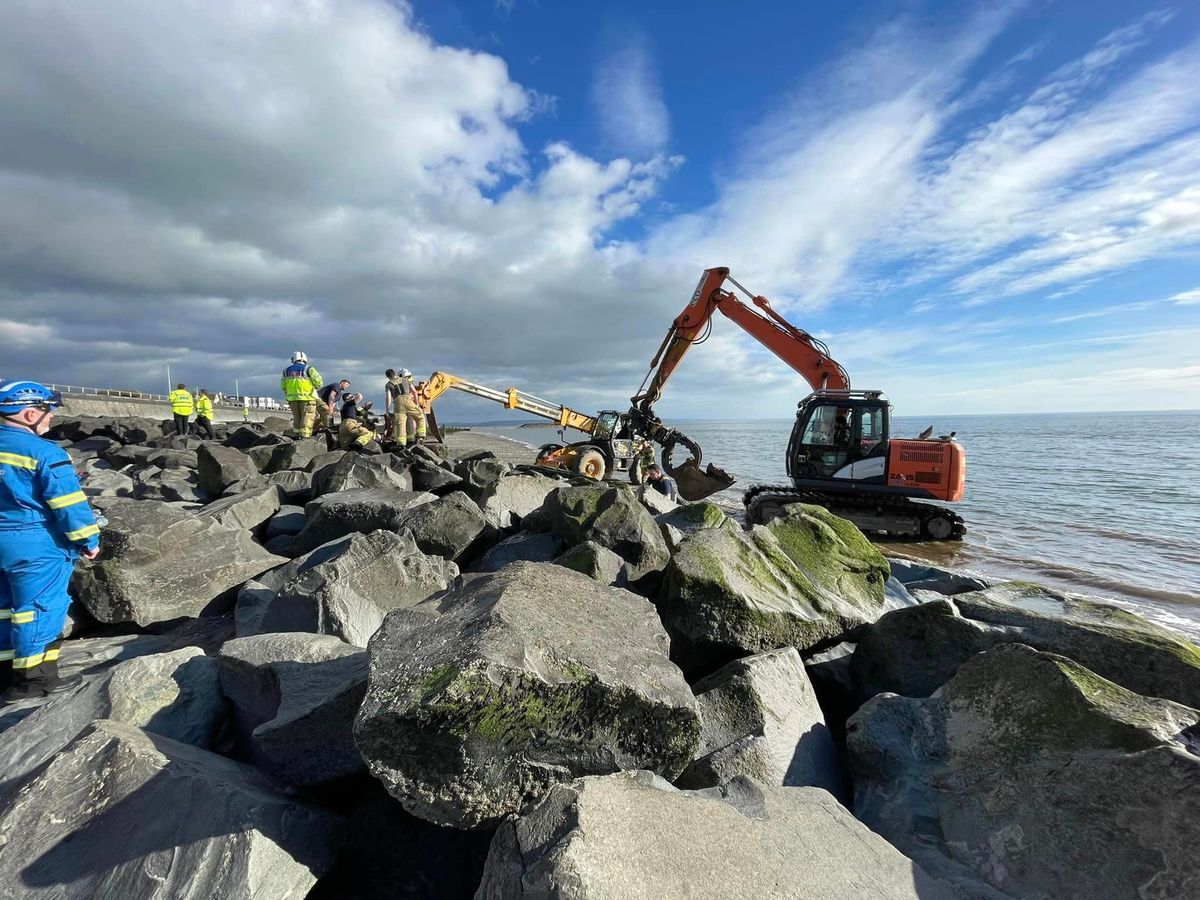
An incoming tide was perilously close to rock armour in Tywyn when a trapped girl was freed after a three-hour rescue operation(Image: Mid and North Wales Coastguard)
Artificial reef
Around 86,000 tonnes of rock will be needed for the revetment. Trucking this in through the town’s narrow streets would be a major logistical headache, requiring around 20 round trips per day over 10 months, equivalent to 4,400 HGV journeys.
The project team is weighing up different transport routes. Fetching in the rocks by sea is another option being considered. It has a lot going for it: just four trips by a barge carrying up to 25,000-tonne loads would be needed.
If the latter option is preferred, Kye would like to see the rocks dumped at sea. He favours on an off-shore reef at a 15 to 20-metre depth line. It’s something being considered as a long-term future option for Barmouth’s coastal defences, when parts of the resort may have to be sacrificed to the sea.
At present, a man-made reef is not on the table: instead, the goal is to beef up defences as much as possible to delay the future “managed realignment” of north Barmouth.
In place of of the current hold-the-line approach, Kye claimed an artificial reef would offer greater protection by “advancing the line”.
“It would not only support marine life, it would also act as a natural wave barrier at a safe distance,” he said. “By the time the waves reach the shore, their energy will have been dispersed, greatly reducing their impact on the beach and sea defences.”
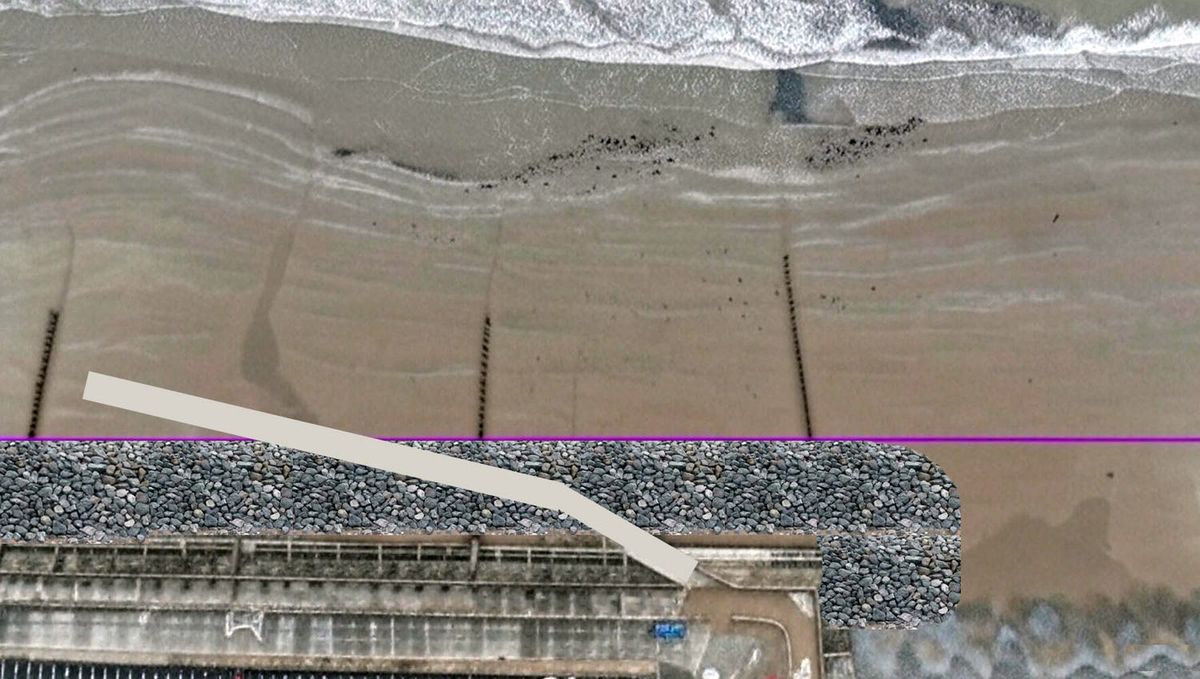
Kye’s estimation of the amount of beach space lost to planned rock armour at low tide(Image: Kye Smith)
Loss of sand
An off-shore reef would provide another benefit, Kye believes. Sand loss from north Barmouth is an ongoing issue, leading to the kind of voiding that undermined the promenade so badly in 2020. Much of it drifts south: each autumn, council diggers and truck fetch it back from the south beach.
Locals blame the deterioration of beach groynes allied to the construction of a causeway to Ynys y Brawd in the mouth of the Mawddach estuary. It was built in response to the many drownings that occurred in the fast-flowing channel between the beach and the island. This made Ynys y Brawd accessible to walkers but it blocked the channel which many blame for silting up the harbour
Kye believes it also prevented the northward drift of sediment, resulting in a sand-starved north beach and, ultimately, today’s proposed flood defence upgrades. Retaining and restoring the groynes would offer a partial solution, he said.
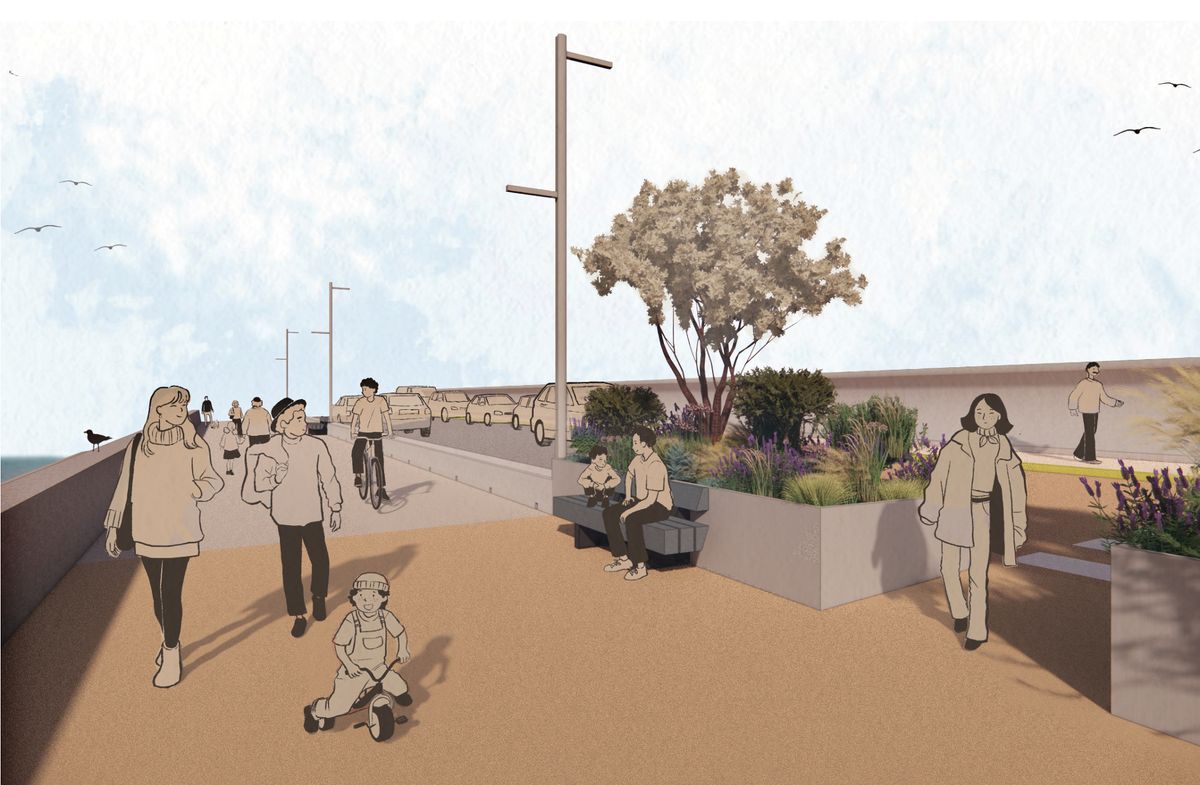
Proposed public realm improvements along the promenade in north Barmouth. The much higher secondary wall is depicted on the other side of Marine Parade road(Image: Cyngor Gwynedd)
He understands the planned rock revetment has been expanded to a width of 18 metres, swallowing up more of what’s left of the beach. “It will claim around 21,600 square meters of usable soft sand beach space,” he said.
“Removal of the groynes would then allow what’d left to move freely down south like it historically has done since the creation of the causeway to Ynys y Brawd.
“In an ideal world, and for the benefit of Barmouth, its residents, businesses and visitors, it would be more effective to create an artificial reef, reinstate the groynes and properly renourish the North Beach – something that has not been done for many years.”
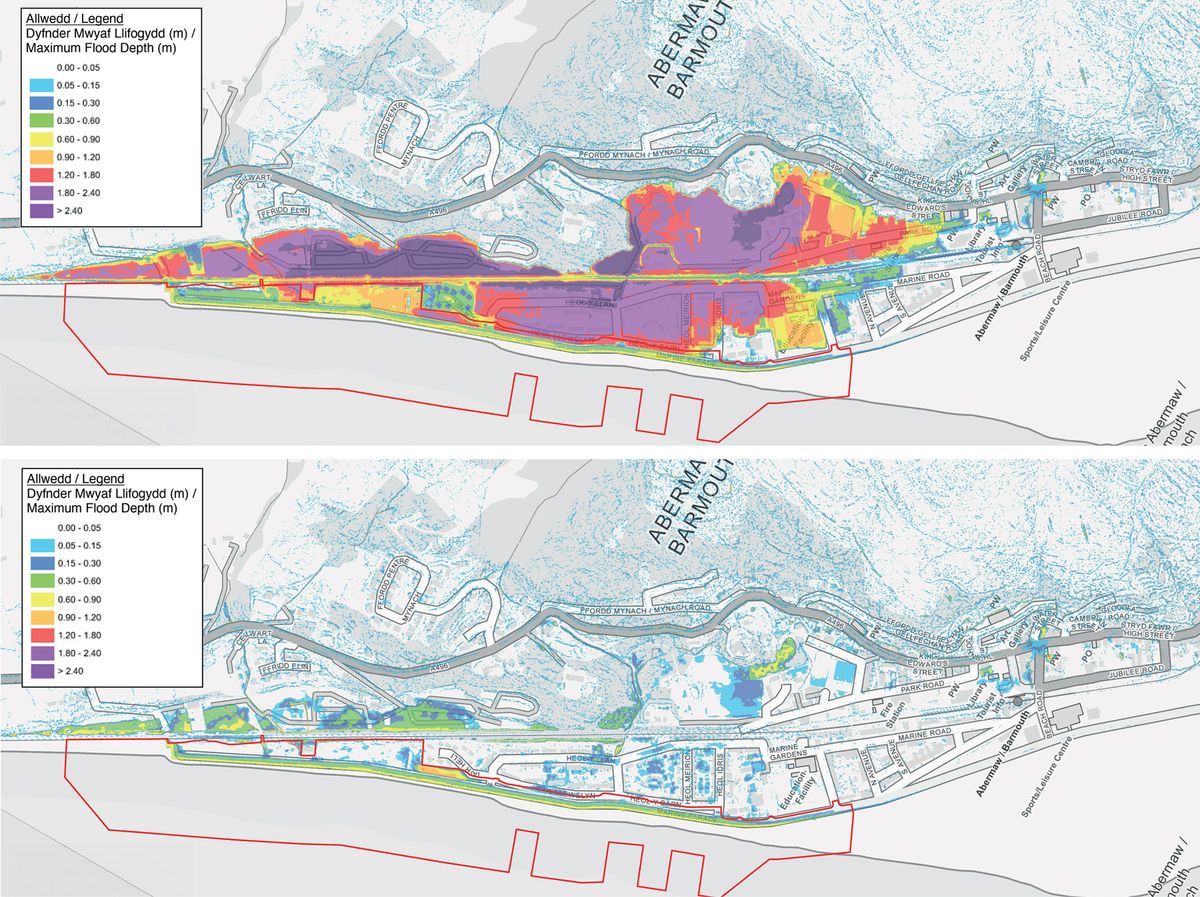
Projected flood risk to Barmouth in the event of a one-in-200 year storm. If current defences are not improved, it would result in devastating flooding (top). Once planned upgrades are completed by summer 2028, the threat should be significantly reduced (bottom)(Image: Cyngor Gwynedd)
‘Eight million litres of water’
YGC has no plans to nourish – or extend – the beach. However there is little doubt that upgraded flood defences are needed. Current analysis shows much of the resort being flooded – in places more than two metres deep – in the event of a one in 200-year storm.
As well as the risk to an estimated 757 properties, vital transport links such as the Cambrian railway could be inundated. YGC has said its key priority in designing the planned scheme is the protection of property, businesses and infrastructure.
Kye accept the needs for defence upgrades but differs and how they should be done. Another example is drainage along the primary wall. Currently, drain holes are spaced every five metres but these only have a 110mm diameter, which he says is “insufficient”.
Moreover, none have non-return valves and so allow water to come back in. “It’s difficult to see how more than eight million litres of water could drain efficiently through such limited outlets,” he said. “What’s needed are larger drain-offs equipped with non-return valves.”
Also on his wish-list is a fire emergency plan: access to north Barmouth through congested streets can be tricky. He also wants certainty over the planned floodgates between properties and roads. “We don’t know how long they remain closed before and after a storm,” he said.
The scheme is scheduled to start this summer and finish in summer 2028. Design tweaks may be announced in the interim. To reduce impacts on tourism – and locals – the 7am-7pm working days will be suspended during the school summer holidays. Sign up for the North Wales Live newsletter sent twice daily to your inbox
Find family activities near you