
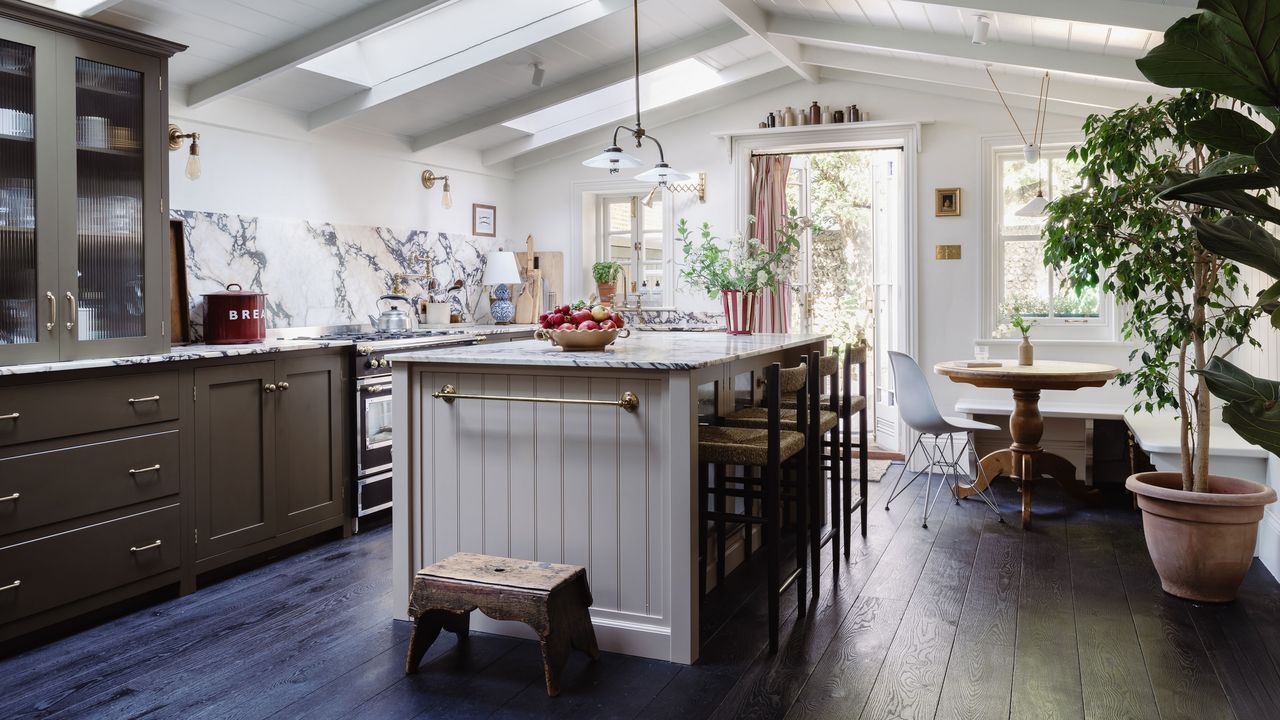
Readers who use Instagram for interior inspiration may already be familiar with The Flint House, which commands more than forty thousand followers. For those that don’t, it is a visual record of the renovation of a pretty flint-fronted house on the south coast belonging to Samantha Palmer and her husband Adam Weir. Sam is a maven for sourcing second-hand pieces from Facebook Marketplace, eBay and, of course, Instagram. Most famously, the Devon & Devon bath, which she boldly procured from eBay before they even completed on the house. Tenacity is the key, apparently. She waited two years for the glazed bookcase that functions as a kitchen dresser, which came from an antique dealer in Rye via Instagram. It has been shortened to fit the space, given knobs from deVOL so it matches the kitchen cabinets, and looks absolutely perfect.
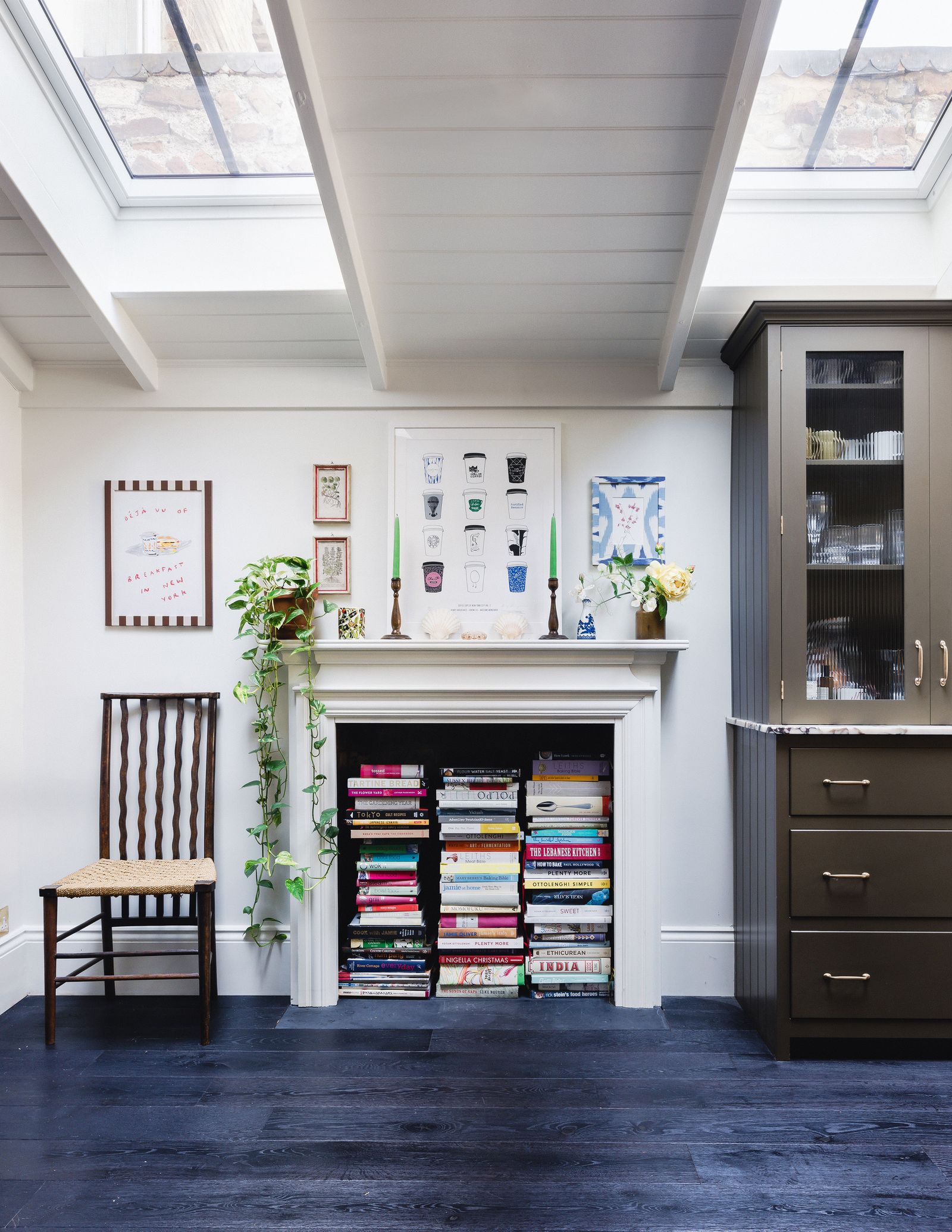
In the kitchen the glazed dresser (right) took two years to source. A disused fireplace is used as storage for cookbooks.
Owen Gale
Tenacity also played a part in the purchase of the house. After ten years plus living in New York and before a stint in Boston, the couple spent a year in the UK. During this time Sam would walk her son to forest school along a road with a collection of striking, mid-nineteenth century, flint-fronted buildings. ‘The flint work is particular to the town and the British seaside. The houses have this whimsical quaintness, with the white masonry, like a Christmas cake. I was just so completely in love with them but never thought we would ever have the opportunity to live in one.’ But they waited, and thanks to a great stroke of luck, one came up for sale some months after their return from Boston and they snapped it up.
The house had belonged to an elderly gentleman who had grown up there and was downsizing. It was in good condition – clean, loved and well-maintained – but nothing had been updated since the Fifties. Aside from the lively decoration, which included teal leopard-print lino and red swirly carpets. There was no central heating, dodgy wiring and the bathroom was downstairs. In many ways however this was a benefit, as so many of the period features were preserved, including doors, coving, architraves and fireplaces. ‘The shell of the house was so beautiful with so much history, I wanted that to be at the forefront of the renovation.’