
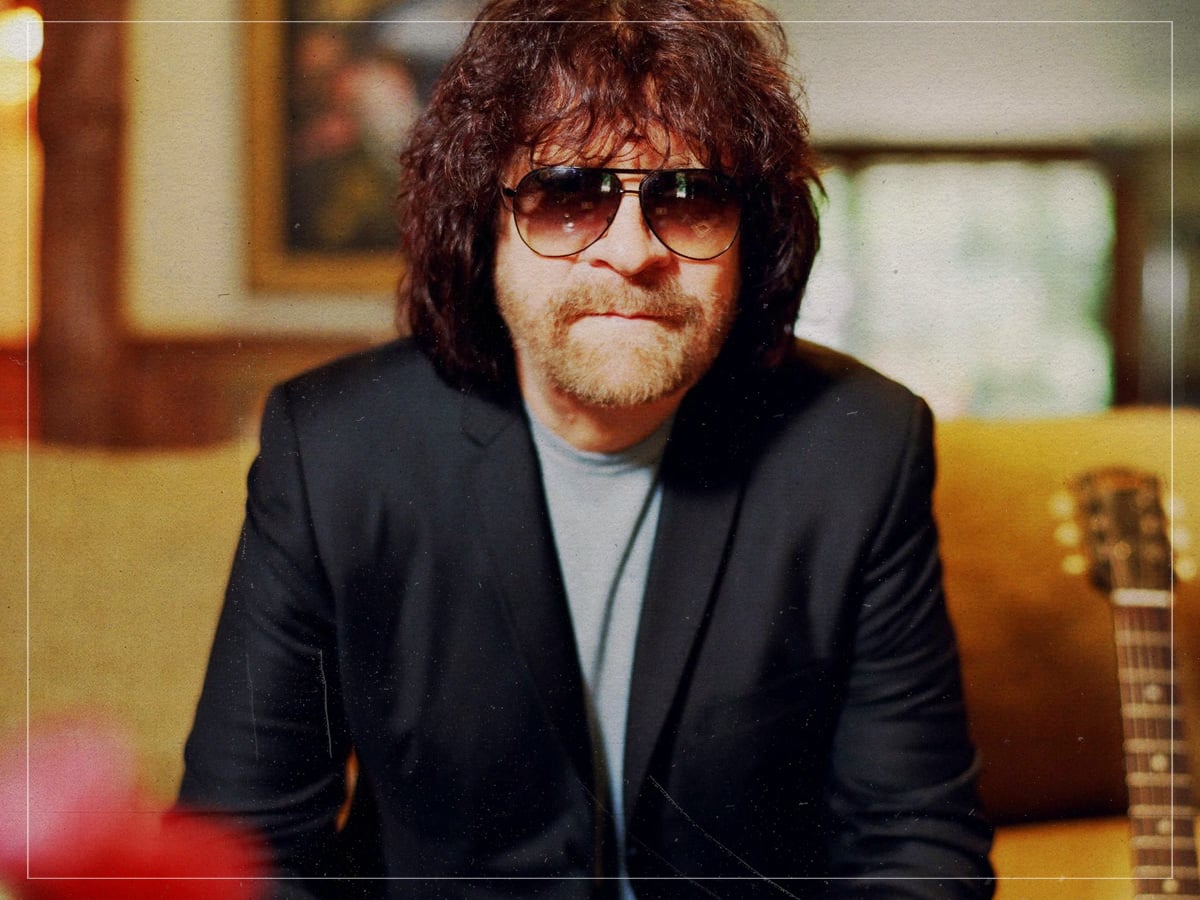
(Credits: Far Out / Jeff Lynne)
Thu 5 February 2026 20:10, UK
The first thing that comes to mind when discussing Jeff Lynne is the indomitable positivity of ELO’s ‘Mr Blue Sky’. Of course, the song and the album it’s from, Out of the Blue, remain staples of the era’s extra-punk sounds. However, before that moment and after it, Lynne had achieved much on both sides of the studio’s window.
Born in Birmingham in 1947, Lynne was captivated by the explosion of sounds that the 1960s brought. In particular, though, the unfamiliar music of The Beatles galvanised him, which was fast taking hold of his generation’s hearts and minds. He received his first guitar from his father, which he had purchased for just £2. This would be enough for Lynne to commit himself to developing his craft in tandem with the influence of the great cultural happenings unfolding in front of him. Little did he know then that he would soon ascend and become friends with one of The Beatles, George Harrison, and a creative collaborator.
Just as the vanguard of The British Invasion was preparing to disembark on North America with The Beatles’ debut performance on The Ed Sullivan Show in February 1964, Lynne was making his first steps as a musician. He formed The Andicaps the previous year and eventually moved on to The Chads at the end of 1964.
The middle of the decade was also significant for him, as not only would he be developing his work as a musician, but he would also add another vital string to his bow and begin his foray into production. In circa 1965, he purchased his first recording equipment, a Bang & Olufsen ‘Beocord 2000 De Luxe’ reel-to-reel tape recorder, which he would later assert taught him how to produce.
The rest of the decade passed with a flash for Lynne. He founded The Idle Race in 1966 and then, in 1970, accepted the invitation to join rock staples The Move and wrote extensively for their final two albums. Yet, his time with them was short, and later that year, he and the band’s co-founder Roy Wood disbanded them and formed ELO, which was born out of their increasingly expansive creative proclivities and the broader desire to craft modern rock that merged pop and classical. Wood’s presence was fleeting, though, and after he left ELO two years later, Lynne became their leader and wrote, arranged and produced most of their future releases.
 (Credits: Far Out / Alamy)
Lynne’s creative arc over the 1970s is compelling. He worked prolifically to expand ELO’s scope, drawing on various instrumentation, including the mellotron, harmonium, and the most cutting-edge device, the Moog synthesiser. This fusion of classic textures with modern ones helped the group stand out, making Lynne a highly respected and sought-after producer. This newfound status meant that when his friend George Harrison – who was deeply ensconced in his solo career – needed help bringing 1987’s Cloud Nine to life, he enlisted the Birmingham native as co-producer. This title aptly describes its sonic character and that of Lynne’s broader oeuvre.
The late 1980s was a fruitful period for Lynne. Tthe highlight of this era for most fans was forming The Traveling Wilbury’s in 1988 with Harrison, Bob Dylan, Roy Orbison and Tom Petty. However, celebrated efforts on Cloud Nine, which produced hits such as the cover of ‘Got My Mind Set On You’ and ‘This Is Love’ also opened up a path to work with one of the creative titans of his youth, Brian Wilson.
However, the Wilson he found was not the one that had crafted some of the 1960s’ most influential sonics and was mired in a personal morass. Having frittered in and out of The Beach Boys several times, Wilson was under the strict 24-hour surveillance of his psychiatrist, Eugene Landy. A strange programme, this schedule worked as a means of Landy profiting off the Wilson brand, which he did on the 1988 self-titled solo album that Lynne featured on.
When Warner Bros asked Lynne to produce Wilson’s album, he was confused, as he couldn’t possibly have assisted the finest mixing desk wizard out there. He recalled to Rolling Stone that he told them: “You can’t produce Brian Wilson. He’s the best producer in the world.” Although it might appear like an overstatement, this point makes sense given Wilson’s own pioneering of popular music and classical in 1966’s innovative Pet Sounds. This opened up the gates for musicians such as Lynne.
Alas, Lynne accepted and co-wrote ‘Let It Shine’ with Wilson at his home in Malibu. The ELO leader called it “horrible” to see such a pleasant human being so mistreated but noted that The Beach Boys vocalist continued to trudge on despite Landy’s ominous presence. The music itself was a triumph, too. An exemplary collaboration, the uplifting track remains one of the finest moments in both’s later careers, fusing their respective styles. To have witnessed the pair in the studio would have been quite something.
What that collaboration ultimately highlights is Lynne’s quiet confidence as a facilitator of other people’s brilliance. He never approached Wilson as someone to be reshaped or corrected, but as an artist whose instincts deserved space and protection, even under difficult circumstances. Lynne’s production style has always been about clarity and warmth, about removing obstacles rather than imposing direction, and Let It Shine benefits from that restraint. The song feels less like a revival and more like a meeting point between two generations of pop craftsmanship.
Looking back, Lynne’s career reads as a continuous conversation with the music that inspired him. From The Beatles to ELO, from George Harrison to Brian Wilson, his path has been defined by reverence without imitation. He absorbed ideas, refined them, and then passed them on through collaboration. That generosity, more than any single hit or project, may be Jeff Lynne’s most enduring contribution to popular music.
Listen to Brian Wilson’s ‘Let It Shine’ below.
Related Topics