
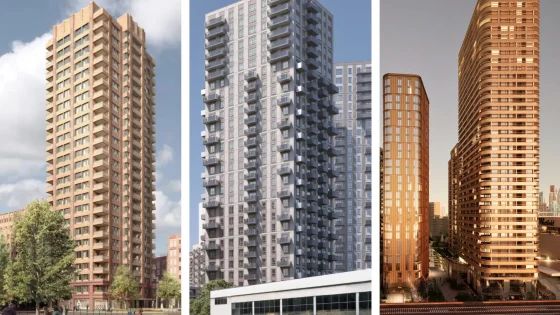
One of the key regulatory changes that have been introduced alongside the Building Safety Act was the requirement for second staircases in new residential buildings taller than 18m.
This and other new fire safety measures have prompted a flood of redesigns in major residential schemes, many of which ask councils to allow extra storeys to maintain viability.
Recent schemes that have pushed for an upward extension include Makowers now 29-storey mixed-use development in Hendon; HTA’s 28-storey co-living tower in Old Oak Common; Maccreanor Lavington’s Aylesbury Estate project in Southwark; and Scott Brownrigg’s Westfield London Block C in Southwark, which now reaches 38 storeys.
According to residential building experts, the new fire safety regulations are compounding already fragile market conditions and forcing developers and architects to redesign and renegotiate to keep projects on track, ultimately leading, in many cases, to big buildings getting even bigger.
Speaking to the AJ, partner at Ridge and building services engineer, Austin Wikner, said the regulations required by the Building Safety Regulator put an ‘awful lot of pressure on the internal space of a building’. If a building was drawn up pre-Covid, he said, developers were likely having to redesign elements of their schemes.
This may be to allow for a second staircase, which ‘effectively wipes out an entire column of apartments’, additional ventilation systems, or fire lobbies, which are required throughout the building.
Earlier this month, the developer of Makower’s Silkstream scheme in Hendon went back to Ealing Council, asking to add 220 more homes and up to 16 extra storeys across the final phases of a project that was originally approved in 2024.
A planning statement submitted on 6 January states that the project is ‘not deliverable as currently approved’ and therefore must be amended. The document points to the need for a second staircase following changes to fire regulations, as well as ‘significant economic challenges’ affecting the viability of the development.
Meanwhile, HTA has submitted designs for a 28-storey residential tower on a site in Old Oak Common, significantly larger than a previously consented 20-storey scheme by Stiff + Trevillion, which was deemed undeliverable after the new fire regulations took effect.
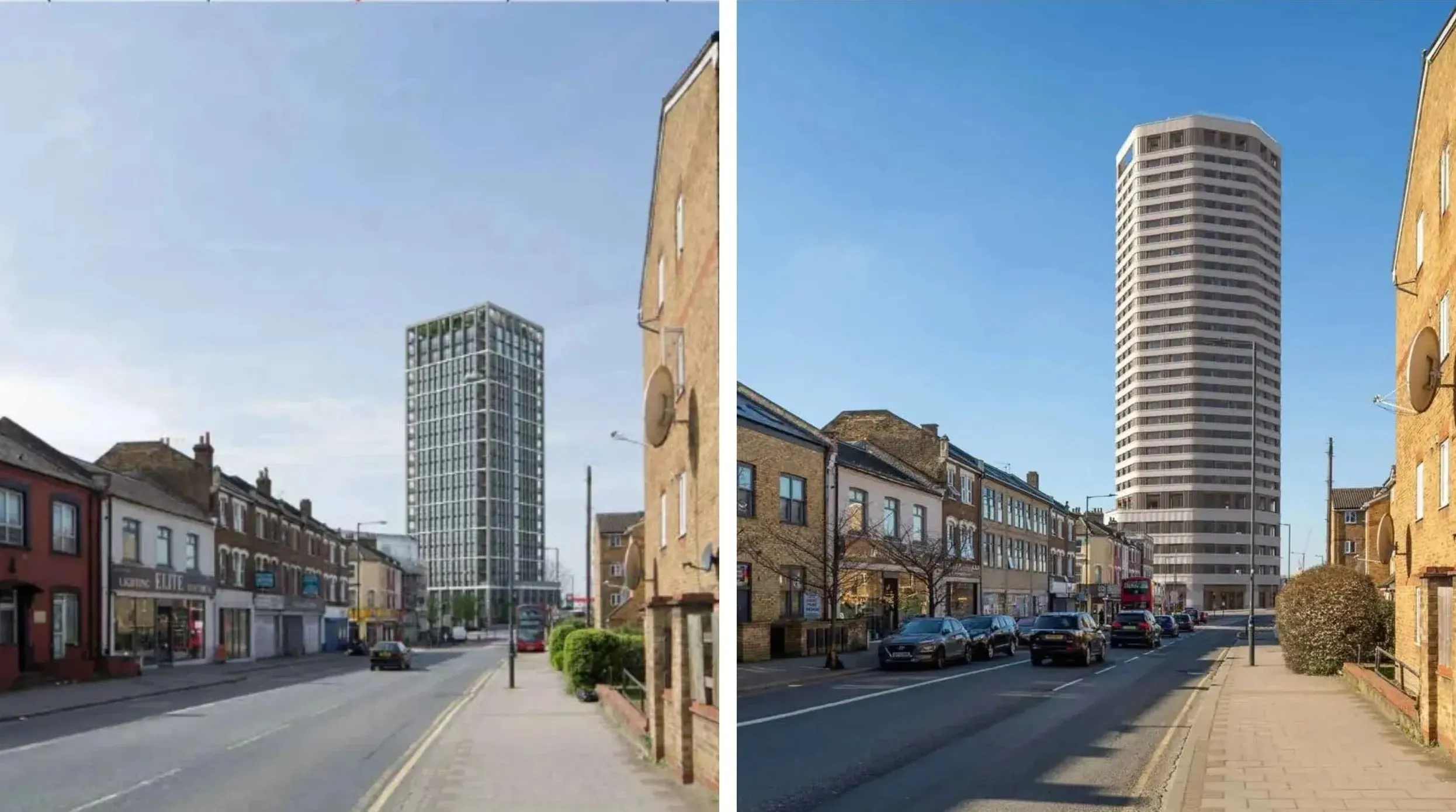
Stiff + Trevillion’s consented scheme (left) for a site on Old Oak Common, and HTA’s eight-storey taller proposal (right). Credit: Stiff + Trevillion, HTA
Scott Brownrigg’s 165,000m2 nine-building mixed-use project, north of Westfield Shopping Centre, which won consent in 2024, could also be extended. New proposals increase the height of residential blocks by an average of three storeys, pushing the maximum height from 34 to 38 storeys.
These changes, along with a reduction in affordable housing provision from 20 to 17 per cent, have been at least partly put down to a redistribution of massing resulting from compliance with the latest regulations.
Scott Brownrigg chief operating officer Richard McCarthy said: ‘The changes have been driven by a multitude of reasons. We removed two buildings and significant areas of servicing, to make a more open and accessible masterplan with improved public realm and amenity spaces, and better ability to manage staged delivery.
‘Additionally, the design has been amended to reflect BSA changes and futureproofing of residents’ safety.’
The application for the second phase of Maccreanor Lavington’s Aylesbury Estate project in Southwark has been amended to add an extra storey to four mid-rise buildings, after revising plans to include second staircases.
Wikner said that the impact of these new regulations has prompted a lot of ‘head scratching’ among developers and building engineers, but that the viability of residential projects ‘has to work for housebuilders in the long term’.
He told the AJ: ‘Ultimately, we will all find a way that this works. Otherwise, there is no development.
‘The residential market has been greatly impacted by the building safety regulator, and the challenges of processing gateway applications, but I am starting to see some green shoots emerge and sensible conversations happening with developers and authorities.’
Wikner also pointed to a Ridge scheme being drawn up for a site in Canary Wharf, where the design team is considering ensuring viability by adding an extra building rather than more storeys.