
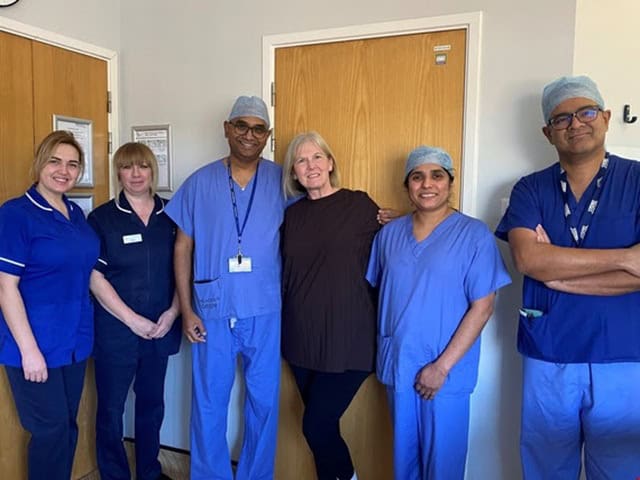
 First patient Mandy Lee with the surgical team at QEQM
By Liz Baker
A multi-million-pound surgical robot has been installed at the Queen Elizabeth The Queen Mother Hospital in Margate.
Mum and grandmother Mandy Lee was the first patient to have a robotic procedure using the system, named Hugo, and said she was hugely grateful to medical teams for their care. She was diagnosed with bowel cancer after a routine screening.
Mandy, 58, from Whitstable, said: “I just can’t thank the teams enough.
“I feel very lucky – the bowel screening kit came through the post the day before I moved, so one day later it could have been a very different story.
“I cannot stress how important it is for you to do the bowel screening test as soon as you receive this. It is delivered by post, it’s easy and only takes a minute to do and you return it by post, simple.”
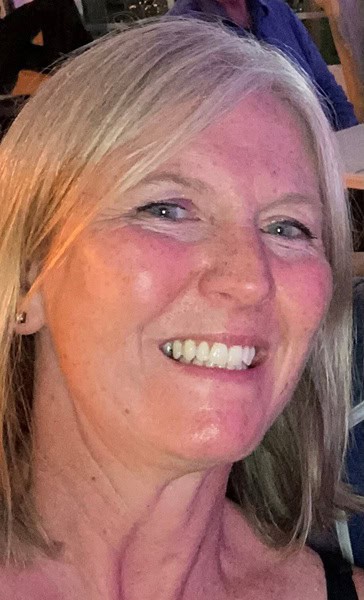
Mandy had experienced some symptoms but had dismissed them as stress. But when the screening detected blood, she had a colonoscopy which discovered a small growth known as a polyp, later confirmed to be cancerous.
She said: “The consultant, Mr Mangam, said I needed surgery to remove part of my bowel and that they would like to use the new robot.
“He reassured me it was used elsewhere in Europe with really good results, and was less invasive, and said they would be flying in an expert to oversee the surgery.
“It was a bit of a scary thought, I hadn’t even considered the possibility of robotic surgery, but I just wanted the cancer gone and I wasn’t put off.
“They were so thorough and really happy to discuss everything with me to explain it, and I could change my mind even on the day, so I felt really reassured.”
The Hugo robot was first used by the NHS at Guys and St Thomas’s Hospital in 2023. Although East Kent Hospitals teams have used da Vinci robots at Kent and Canterbury Hospital for 15 years, this is the first time colorectal robotic surgery has been possible at the Trust.
The robot has four arms that are operated remotely by the surgeon, who has a 3D view inside the patient’s body thanks to a camera on one of the arms. The others are used for surgical tools, and patients are left with keyhole scars.
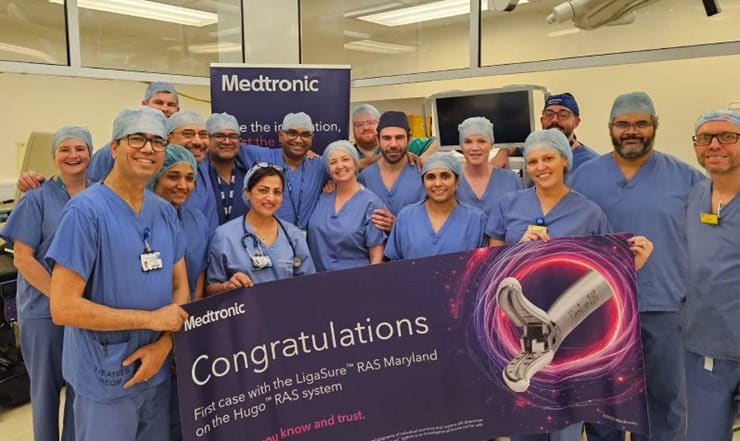 The team at QEQM
Consultant colorectal and general surgeon Mr Sudhaker Mangam, who led the procedures with consultant general surgeon Mr Joseph Sebastian, said it was a significant milestone for the team.
He said: “This marks a major advancement in surgical capability for East Kent patients, enabling greater precision, improved outcomes, and faster recovery times.
“I am very grateful to Sister Kelly Morgan and the wider theatre and perioperative teams for their outstanding support in ensuring this was a positive experience for our patients.
“The introduction of robotics means we can offer people minimally invasive procedures, which mean less pain, shorter hospital stays, and a faster return to their normal activities.
“These first procedures are the result of months of preparation, training, and collaboration across clinical, nursing, theatre, anaesthetics, estates, and management teams. It also demonstrates the Trust’s continued ambition to invest in innovation, workforce development, and high-quality care for our communities.”
The NHS National Cancer Plan, published today, pledges to increase the amount of robotic surgery for cancer patients, up from 70,000 a year to half a million by 2035.