

Cricket matches between India and Pakistan rarely need extra spice but Sunday’s encounter in Colombo is poised for plenty of added zest should Pakistan name in their XI their new mystery spinner Usman Tariq. To say India’s commentariat and supporters have got themselves in a lather over the manner in which he bowls, and whether it is legal, is an understatement.
At the start of last week, after Pakistan lifted their threatened boycott of this T20 World Cup group A fixture in protest at Bangladesh’s exclusion from the tournament, Tariq was making a match-winning contribution of three for 27 against the United States, having sat out his side’s opener against the Netherlands.
Largely through the actions of the BCCI in minimising contact with Pakistan cricket, India’s leading players have never faced Tariq. Pakistanis are blocked from playing in the Indian Premier League and Indian cricketers barely take part in the competitions in which he happens to have made his name, such as the Caribbean Premier League and the UAE’s ILT20, quite apart from the no-go area for them of the Pakistan Super League.
And it is clear that the best way to fathom what Tariq does is to face him, although even that is not necessarily a guarantee of success.
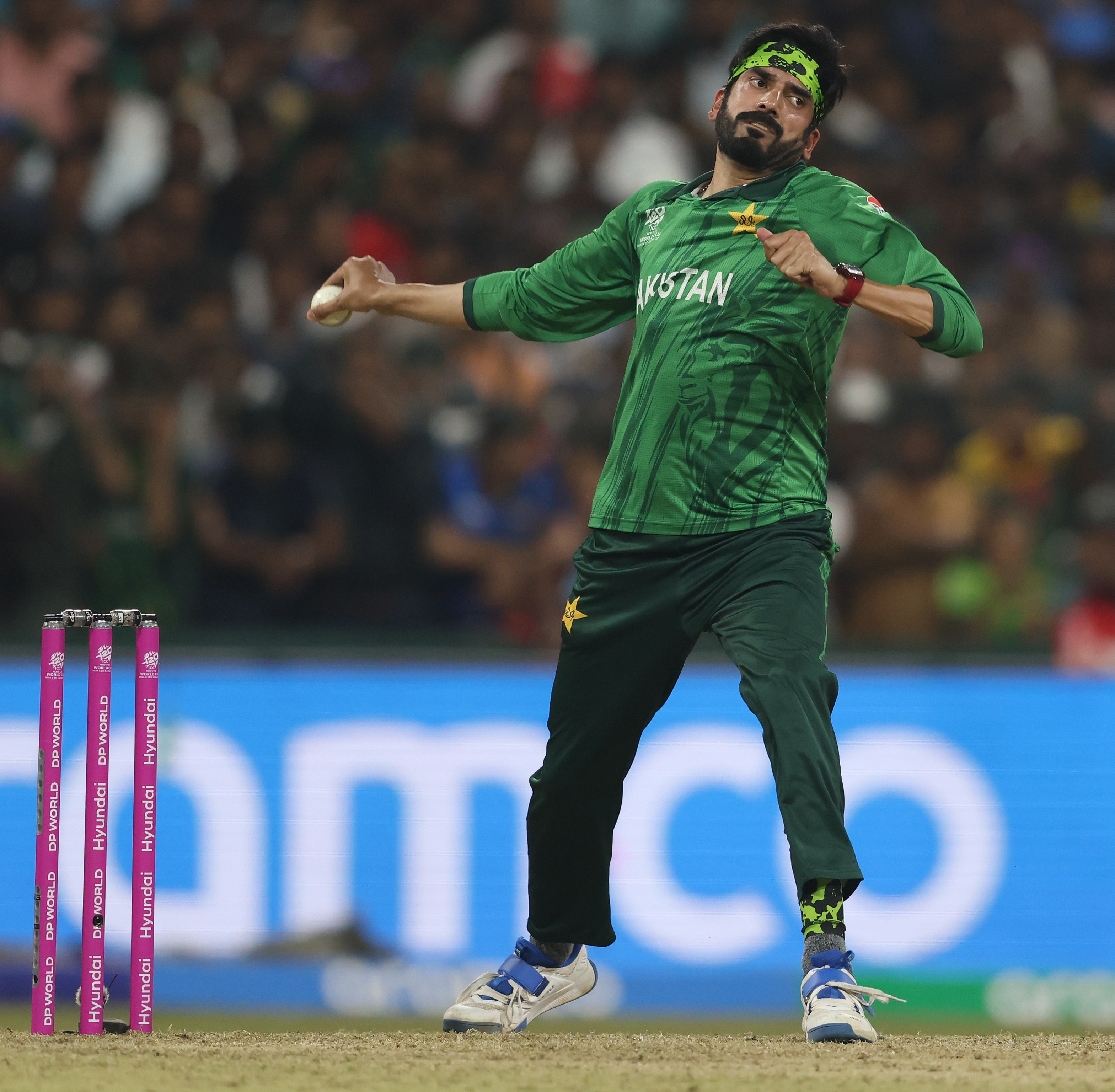
Tariq took three for 27 against the United States in his only game of the World Cup so far
GETTY
Tariq, who stands 6ft 4in and hails from the remote mountainous Khyber Pakhtunkhwa region, is broadly termed an off spinner, but is equipped with an arsenal of tricks which involve constant switches in finger and wrist positions. A large proportion of his four overs against the USA were googlies and carrom balls, a delivery which is flicked out of the front of the hand. He also deploys sharp variations in pace (his average speed is low, if not quite as low as Adil Rashid’s).
The 30-year-old says he developed these weapons after growing up playing on flat surfaces in Peshawar. That is only the start of the story. After a short run-up, he delivers the ball with a low, round-arm action reminiscent of Sri Lanka’s Lasith Malinga (although Malinga operated at very high pace), but only after a pronounced pause just before the moment of release.

Pietersen is among those to have been critical of Tariq’s bowling action
ECB/ECB VIA GETTY IMAGES
This delay must be disruptive to a batsman’s rhythm and some commentators, including the former England batsman Kevin Pietersen, believe Tariq gains an unfair advantage by using the pause to assess what early movement the batsman is making.
“I watched Usman Tariq bowling very closely today,” Pietersen wrote on Instagram after the USA match. “It is clearly visible that he released the ball after looking at the batsman and this is not at all legal . . . ICC should take action against this bowler.”
However, others were less sure, and Ravichandran Ashwin, the great Indian spin bowler, argued that the pause was “entirely legal” because it was part of his regular action. Other spinners have displayed such a “hang” time during delivery — Saeed Ajmal, another Pakistani, provided one of the better known examples — but rarely has there been a delay as marked as this.
Whether a bowler has acted unfairly in this way is essentially down to the discretion of the umpire, as there is no specific time limit on how long a pause might be. Law 41.5 covers “deliberate distraction, deception or obstruction of batter”.
Another area of feverish debate is that Tariq’s bowling arm is not completely straight, raising suspicions that it might breach the 15 degrees of flex permitted by the laws.
Some opposition players have been unable to keep their disquiet to themselves. When Cameron Green was dismissed by Tariq during Australia’s evisceration in a T20 series in Pakistan last month, he mimicked a “throwing” action as he walked off. He later apologised.
Please enable cookies and other technologies to view this content. You can update your cookies preferences any time using privacy manager.
Enable cookiesAllow cookies once
Tom Banton, a member of England’s squad at this tournament, did something similar when he fell to Tariq during the ILT20 in December. It is not known if he apologised, which could be awkward if the two come up against each other during the Super Eight stage. Assuming both sides qualify, England and Pakistan will meet in Kandy on February 24.
In fact, Tariq will have an advocate within the England dressing-room in Sam Curran, who played alongside him with the Desert Vipers. Tariq’s team-mates know that he has a congenital issue in his bowling arm in the same way that Muttiah Muralitharan did, which means he cannot fully straighten it.
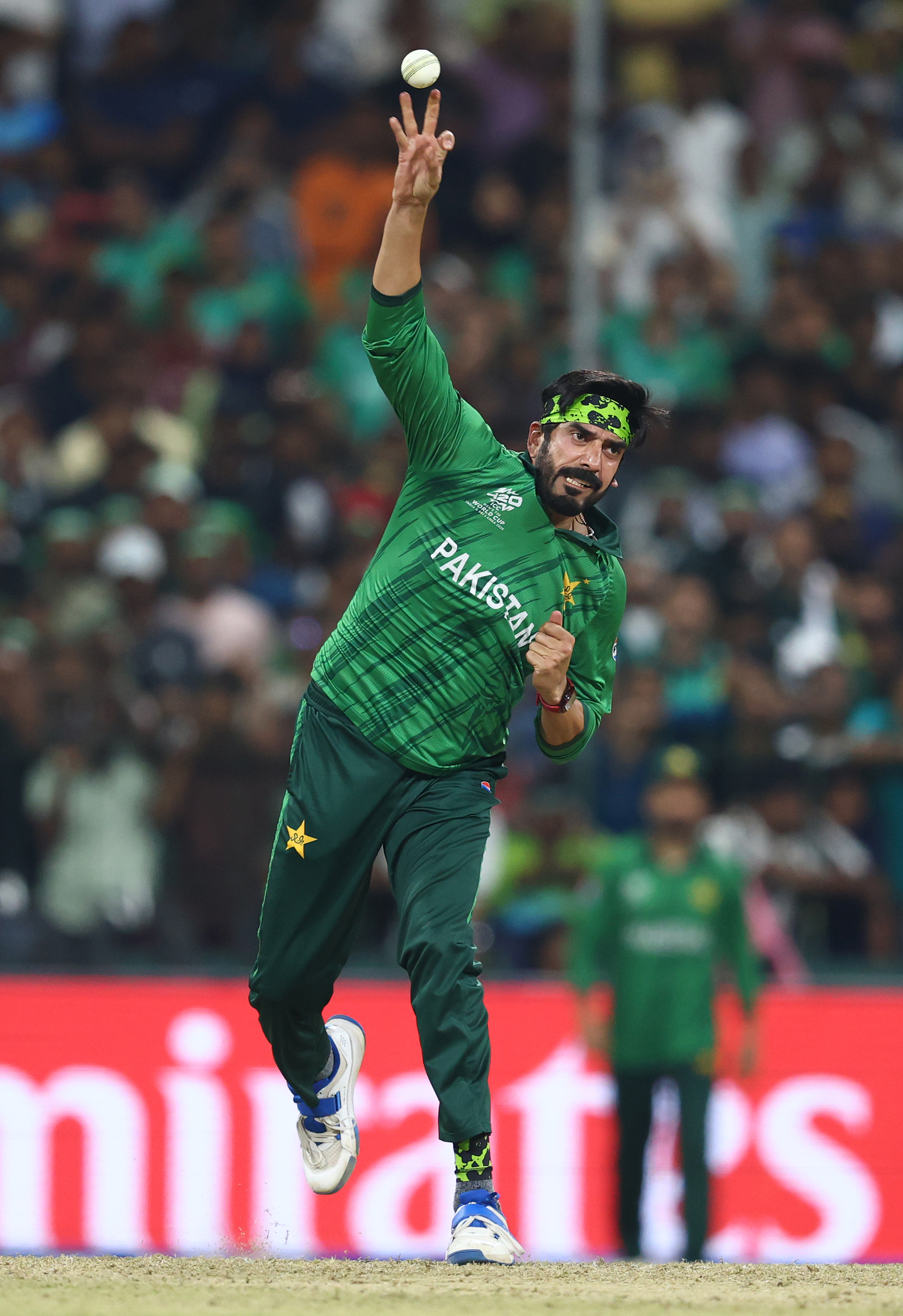
A congenital issue in his bowling arm means Tariq can’t straighten in properly while bowling
GETTY
Umpires in the Pakistan Super League have twice reported Tariq’s action and both times he was cleared through the ICC’s testing procedure.
These details are little known because Tariq is relatively new to the big time, although he has helped teams win the Caribbean Premier League and ILT20 in recent months and boasts an impressive economy rate of 6.79. He only made his Pakistan debut in November and has featured in four international T20s.
In recent days, he has been the target of much hostility from ignorant fans on social media. According to his cousin Haseeb ur Rahman, Tariq has developed a thick skin. “He jokes about it,” Haseeb said. “He says he doesn’t care, that they do not know he has cleared ICC’s test twice. ‘The more hatred they spread, the more famous I become.’ ”
Even so, there are risks attached to a strong performance against India in Colombo, because it can only lead to fresh scrutiny. Perhaps the greatest danger is that questions are raised as to how he manages to impart the speed he does on his faster ball from what is effectively a standing start.
The former India opener Aakash Chopra asked: “If there’s no momentum generated by the run-up, is it possible to increase your pace by 20-25km on certain deliveries without bending the arm?” Other pundits argue persuasively that it is difficult to “throw” with a round-arm action.
The last thing Pakistan want is him banned from the competition’s later stages, which is why there has been speculation that they might keep Tariq under wraps.
Tariq’s origin story is remarkable enough. As a teenager, he briefly worked in a hotel kitchen in Dubai to support his family after his father died before Tariq turned ten. After getting through various jobs over several years in Kabul and Islamabad, he was driven to renew his passion for cricket after watching a biopic of MS Dhoni in 2016. Naturally for someone of his build he started out as a fast bowler, but eventually switched to spin.
Fears of what Tariq might do in Colombo may have been heightened by India’s struggles against Namibia’s Gerhard Erasmus, who took four for 20 against them on Thursday with an almost subterranean round-arm style. Erasmus’s release point was so early that umpire Rod Tucker twice signalled dead ball.
India v Pakistan
T20 World Cup, Colombo
Sunday, 1.30pm
TV Sky Sports Cricket