
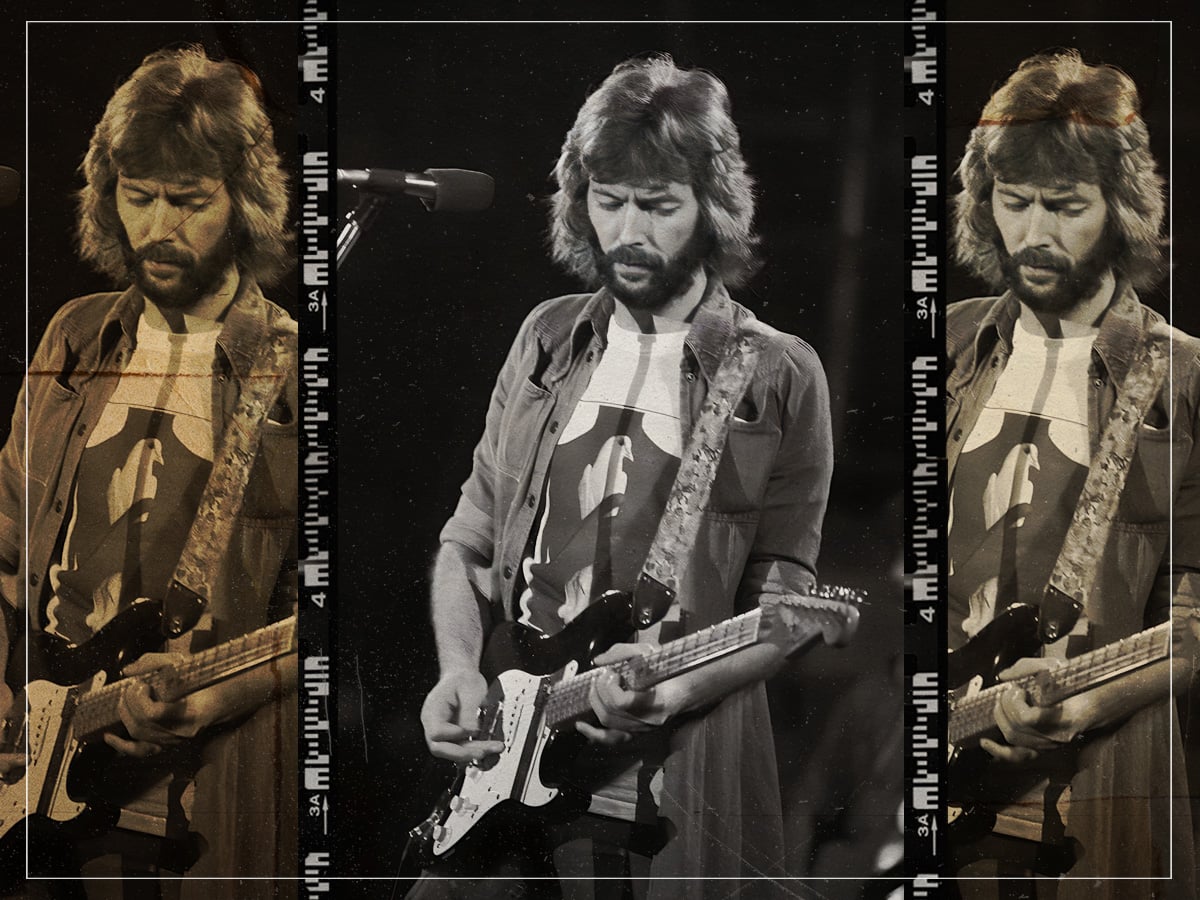
(Credits: Far Out / Matt Gibbons)
Mon 16 February 2026 17:30, UK
‘Layla’ by Eric Clapton is many things: an ode to seventh-century Persian literature, a call to Pattie Boyd, and one of the greatest rock songs of all time.
There are many things you can unpack within those statements. The most pertinent was obviously the fact that Clapton’s friend, George Harrison, had married Boyd in 1966, and as the friendship between the musicians deepened, so too did the Cream guitarist’s love for the woman at the centre of it all.
This story is, of course, one of the most famous in all of rock music history, so it doesn’t need rehashing for the hundredth time, but the point remains that when Clapton was told the old Arab tale of Layla and Majnun, about a girl forced to marry off to the wrong man who subsequently goes insane, it struck more than a bit of a resonant chord.
Yet in many ways, the star-crossed illustriousness of the origins of ‘Layla’ can often threaten to overshadow the real thing that it is at its core: a true example of mastery in a rock song. Between Clapton’s iconic raspy vocals to that blistering riff, it exhibited the absolute power of passion that could be poured into a track, which could never be matched.
In this sense, however, Clapton wasn’t the one you have to thank for creating that integral piece of electrocution: after all, he wanted to write ‘Layla’ as a ballad lusting after Boyd, as schmaltzy as all the rest. Instead, it was Duane Allman, of The Allman Brothers Band fame, who became the hero of the hour for penning the riff and permanently powering ‘Layla’ forever.
Despite this, the guitarist held somewhat of a double standard. “I have regrets, obviously. Countless,” he once reflected, adding, “One of the great regrets was getting involved with George Harrison’s marriage.” Yet there’s no denying that he wouldn’t be without ‘Layla’ for all the stratospheric things it did to his career, so it was a bit of a lose-lose situation.
It meant that, practically in the same breath after saying he regretted coming between Harrison and Boyd, he was hailing that very same wedge that drove them apart. “‘Layla’ was like striking gold. There’s that thing about when you’re looking in the water and the sand, and suddenly you see the sparkle. It’s never, for me anyway, ‘Oh, people will like this’. It’s, ‘This is the mother lode here!’”
And to be fair to the man, he wasn’t far wrong. With the song already being considered as a pillar of rock and roll music only two years after its release in 1970, it didn’t take a rocket scientist to figure that this was a track that would go on to transcend the ages for the rest of time.
We’re only really half a century on from that moment, but in a lot of ways, it feels as though ‘Layla’ has existed forever. Long after Clapton’s love triangle has faded into the scores of history, the song still stands as the most striking remnant of that time: electric, fiery, and simply burning with passion.