
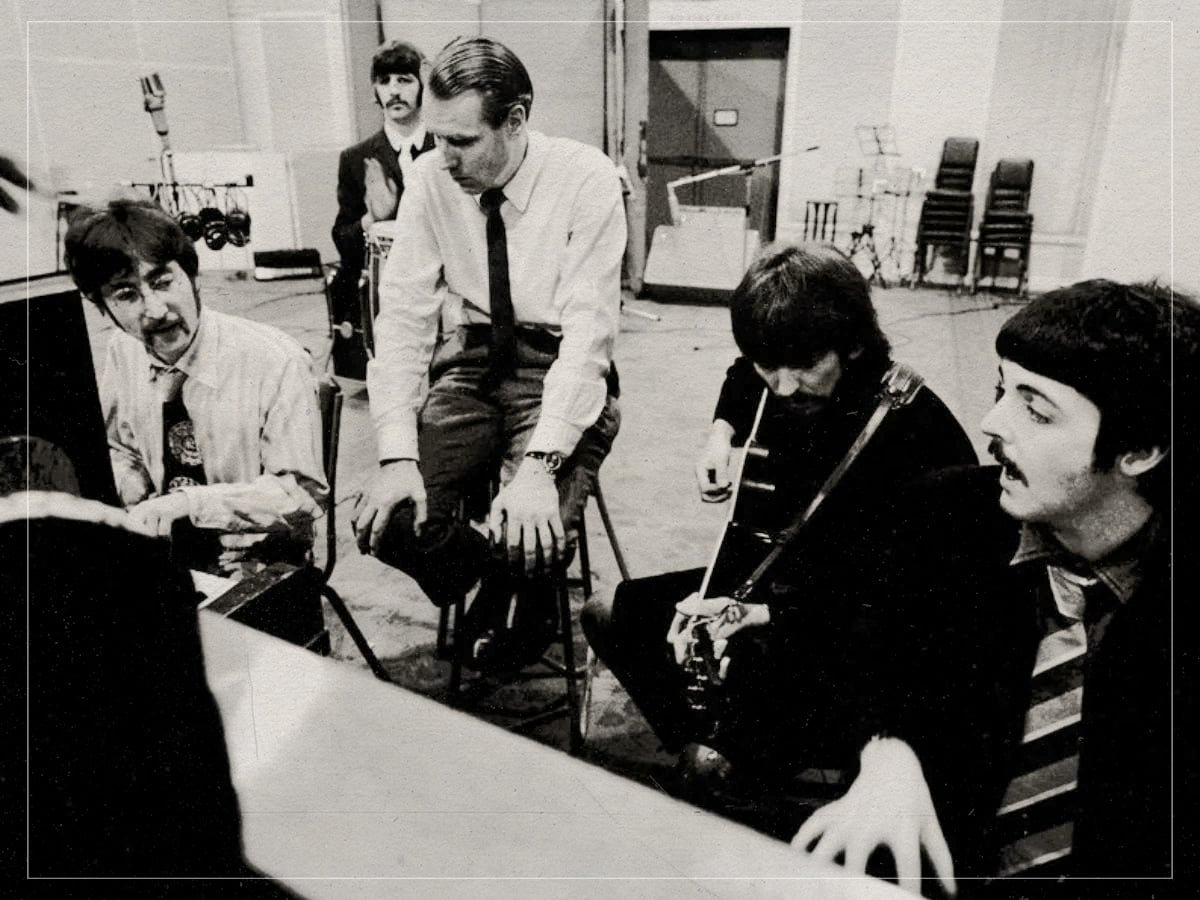
(Credits: Far Out / Alamy)
Fri 20 February 2026 16:35, UK
The entire career trajectory of The Beatles most likely wouldn’t have happened without the assistance of the silver-haired George Martin.
While John Lennon and Paul McCartney may have been making brilliant pieces of music independently, it took Martin’s touch as a producer and musical arranger to help turn their visions into fully realised songs in the group’s early days. In fact, the very first time that he saw them, he wasn’t overly impressed by their skills.
As he later recalled, “I didn’t think the Beatles had any song of any worth – they gave me no evidence whatsoever that they could write hit material”. But vitally, he did go on to add, “It was their tremendous charisma, rather than their music, that won me over.” So, he gave them the time of day, and suddenly their skills began to rapidly improve.
By the time the band had started working on their later material, Martin called one song one of their most fully realised compositions in the same way that he would reflect on the classical music he had helped to make before them.
When the band initially got signed to a recording contract, though, Martin didn’t believe that Lennon and McCartney had what it took to write songs. Persuading them to cut a song called ‘How Do You Do It’ during their first recording session, it didn’t take long for the band to continue with their original material, coming up with the basis of ‘Please Please Me’.
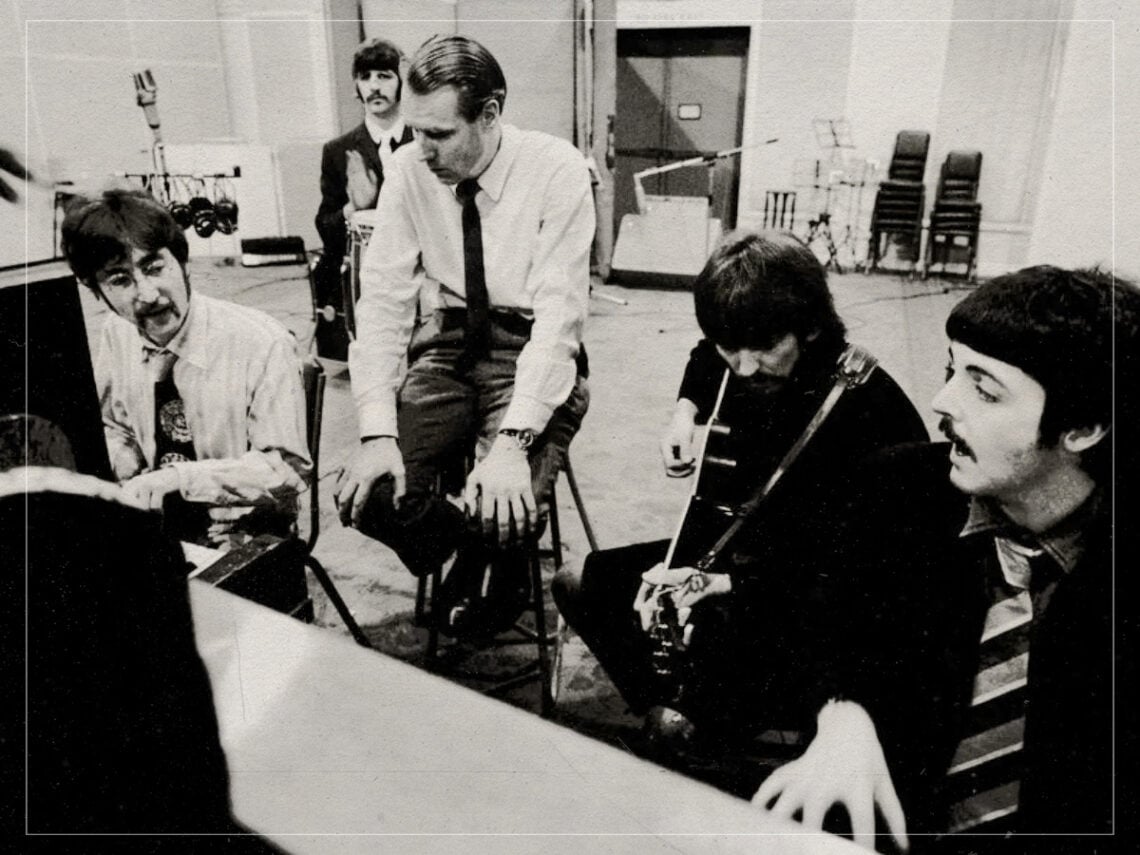
 (Credits: Far Out / Alamy)
Even though the band members ultimately got the writing credit for every song, Martin was responsible for fine-tuning every piece of their material. On the band’s debut, the producer would be the one to suggest speeding up ‘Please Please Me’ as well as help construct the opening chord of ‘A Hard Day’s Night’ one album later.
As the band started to adapt to the studio environment, though, they tended to see Abbey Road Studios as a songwriting workshop rather than a standard recording institution. Usually coming in with fragments of an idea, every musician would work off their bandmates to help flesh out songs, culminating in brilliant works of art on albums like Rubber Soul.
By the time the band had got around to making Revolver, they had started to realise that their material didn’t suit the live format anymore. Not wanting to deal with the influx of screaming and playing subpar versions of their new material, The Beatles eventually played their final show in 1966 in San Francisco before turning the studio into their laboratory on the following album, Sgt Pepper.
Taken from an idea McCartney came up with, the record would be one of the first high-profile concept albums, with every song serving as another sample of what the titular band wanted to play. While the album would feature significant twists and turns like Lennon’s ‘Lucy in the Sky With Diamonds’ and George Harrison’s ‘Within You Without You’, Martin would single out one of McCartney’s ballads as the best work from the album.
Having used orchestral works to soundtrack songs like ‘For No One’ and ‘Eleanor Rigby’ on one album prior, McCartney wrote a devastating song of loss on ‘She’s Leaving Home’, playing the role of the clueless parents who never paid attention to their daughter. While it would be the first song not to include a George Martin arrangement, the producer did claim to be stunned when hearing it for the first time.
Looking back on those sessions, Martin would have high praise for what McCartney did with the tune, saying in All You Need is Ears, “It’s almost like a little opera, and it’s one of the best-constructed songs they ever did. I am amazed that they could do this at their age because they could see the conflict between the young and the old”.
Leonard Bernstein was even in agreement when it came to this complex tune. Speaking about The Beatles, the revered composer said that you could even compare them to Robert Schumann when it comes to ‘She’s Leaving Home’. “This new music is much more primitive in its harmonic language,” Bernstein explained, “It relies more on the simple triad, the basic harmony of folk music.”
Before adding, “Never forget that this music employs a highly limited musical vocabulary; limited harmonically, rhythmically, and melodically. But within that restricted language, all these new adventures are simply extraordinary. Only think of the sheer originality of a Beatles tune.” Now, that’s far from shoddy praise from the man they called ‘the maestro’.
Yet, it was also the poetry they applied to the music that made it such a complete composition, too. As much as the story may have read like a period drama, this wasn’t just about McCartney telling a story. With the Summer of Love fast approaching, ‘She’s Leaving Home’ was a keen observation of what the youth of the world were feeling at the time, looking to break out of their usual lives and leave their parents’ dreams for them behind.
The Far Out Beatles Newsletter
All the latest stories about The Beatles from the independent voice of culture.
Straight to your inbox.