
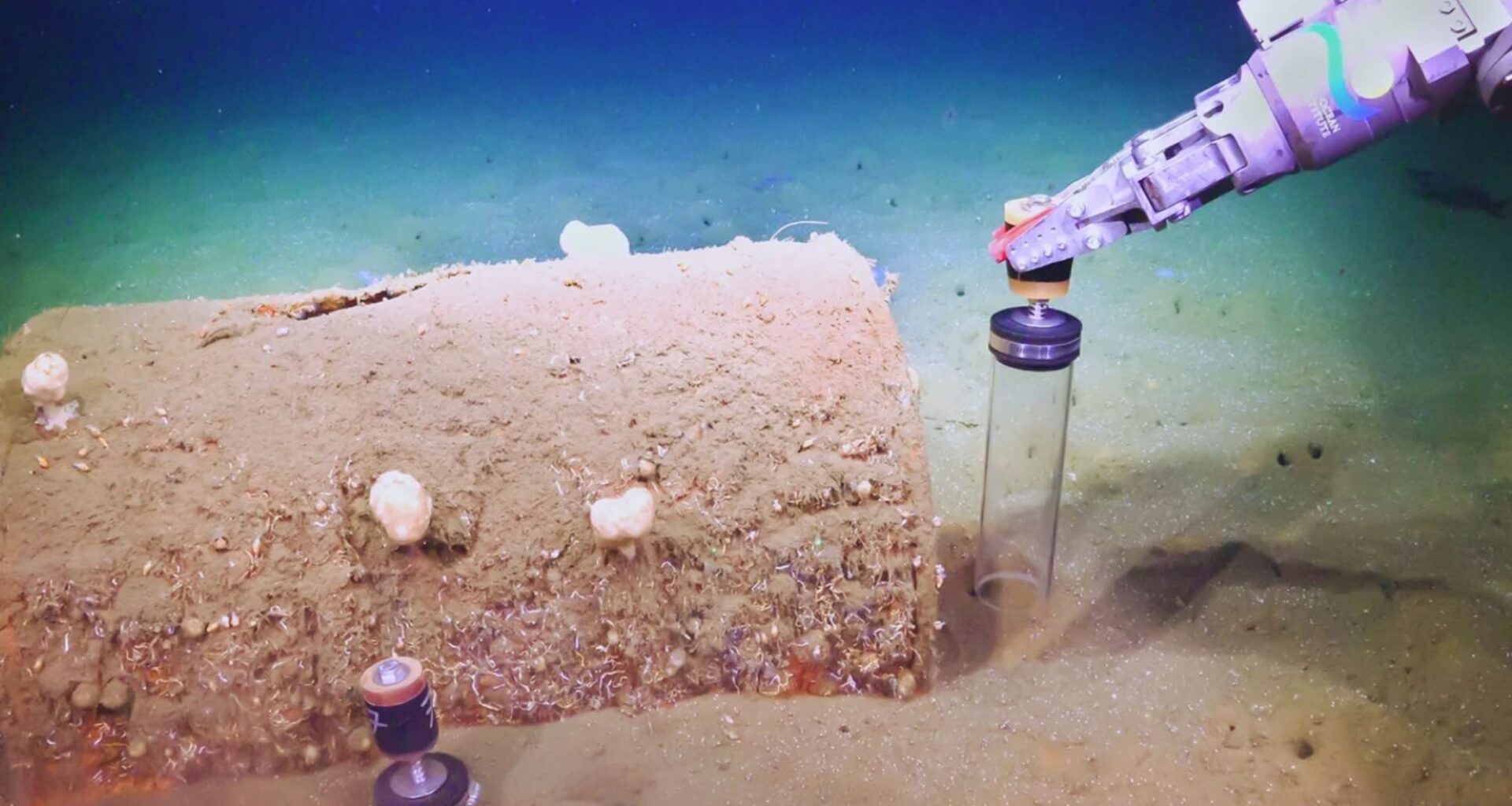
Faded white rings around rusting barrels on the ocean floor have been traced to leaks of highly corrosive chemical waste into the surrounding mud.
The finding shows that material dumped off the U.S. coast decades ago is still reshaping deep habitats more than 50 years later, reacting with the seafloor and changing deep ocean life today.
White halos emerge

In mud cores lifted beside the barrels, white halos appeared as hardened crusts and powdery patches in otherwise dark sediment.
Sampling along those halos, a team at Scripps Institution of Oceanography traced the crust to leaking alkaline waste.
Microbiologist Dr. Johanna Gutleben at Scripps compared halo sediments with nearby controls and found almost no microbial genetic material in the halo cores.
Because the halos stay visible, they let researchers spot likely leakage sites quickly, even before they sample what escaped.
Mapping the graveyard
A deep-sea survey scanned about 58 square miles of the San Pedro Basin. Robot submarines crisscrossed the bottom with sound and cameras, turning rough guesses into a tight map of debris.
Across that patch, analysts logged over 74,000 debris targets, including about 27,000 barrel-shaped objects scattered off Los Angeles.
Such counts make every follow-up dive a triage job, since each sample run reaches only a tiny fraction of sites.
DDT was not
For years, many people tied the rusting barrels to DDT, a pesticide that lingers for decades, already measured in nearby seafloor sediments.
In the new tests, DDT stayed high across the dump site regardless of how close a core sat to a barrel.
That flat pattern meant the barrels did not act as fresh sources, even where white halos sat right beside them.
Long after its 1972 ban, DDT can still bioaccumulate, build up in animals faster than they break down, in ocean food webs.
Chemistry writes rings
Chemical leaks from some barrels turned soft mud into pale rings, and the process depended on simple seawater reactions.
Measurements showed the sediment reached a pH, a scale for acidity and alkalinity, close to 12 while seawater stayed near 8.
Magnesium in the surrounding water reacted with that base, hardening grains into a rim that resisted waves and slow seafloor currents.
Over time, brucite, a magnesium hydroxide mineral that forms in a strong base, helped lock those rings in place for decades.
Microbes meet extremes
Under the halos, the sediment held far fewer microbes than neighboring mud, and the community looked nothing like a typical seafloor mix.
At those high pH levels, alkaliphilic bacteria, microbes that grow best in alkaline conditions, dominated samples that once supported many groups.
Instead of many kinds of microbes living together, a handful of lineages took over, leaving little genetic variety for the rest.
Reducing microbial activity can change how the bottom recycles nitrogen and sulfur, with effects that can reach larger seafloor animals.
A scar that persists
Years pass, yet the halos remain, because the mineral crust keeps buffering the sediment toward strong alkalinity.
Brucite dissolves in seawater at a crawl, releasing basic chemicals that raise local pH even after the original spill stops.
Based on dissolution rates, the team estimated the seafloor effects could last several thousand years in parts of the basin.
That timeline means even careful sampling can disturb a long-lived chemical pocket, so planners must choose targets with care.
How dumping became legal
Between the 1930s and early 1970s, agencies and companies treated deep ocean water as a ready-made disposal system.
Records from the U.S. Environmental Protection Agency (EPA) describe at least 14 deep-water dump locations off Southern California.
From refinery byproducts to low-level radioactive waste, the dumped material included chemicals, oil drilling debris, and even obsolete military explosives.
Thin steel barrels were never designed for decades underwater, so today’s corroded seams make the original contents hard to pin down.
What stays unknown
Even with new maps, scientists still cannot say which barrels remain sealed and which have already emptied into the mud.
About one-third of the barrels carry white halos, a clue that alkaline waste leaked and changed only the surrounding few feet.
Some leaks can free metals trapped in sediment, and no one yet knows whether those metals have moved into fish and shellfish.
Hard choices underwater
Any cleanup plan faces a tradeoff between disturbing fragile sediment and accepting that damaged barrels may keep leaking.
At about 3,000 feet deep, crews rely on robots and cables, and a wrong move could spread caustic material farther.
EPA has already tested new surveys and sampling around the dumpsites, but the agency still lacks a complete inventory of contents.
For now, scientists can use the halos to set priorities, while EPA and lawmakers decide whether old dumping policies deserve a modern response.
Seeing the leftovers
Rusting barrels and white halos show that industrial waste can keep rewriting seafloor chemistry long after the dumping stopped.
Better maps and careful sampling can narrow the unknowns, but every decision must weigh exposure risks against the damage of intervention.
The study is published in PNAS Nexus.
Photo: Schmidt Ocean Institute.
—–
Like what you read? Subscribe to our newsletter for engaging articles, exclusive content, and the latest updates.
Check us out on EarthSnap, a free app brought to you by Eric Ralls and Earth.com.
—–