
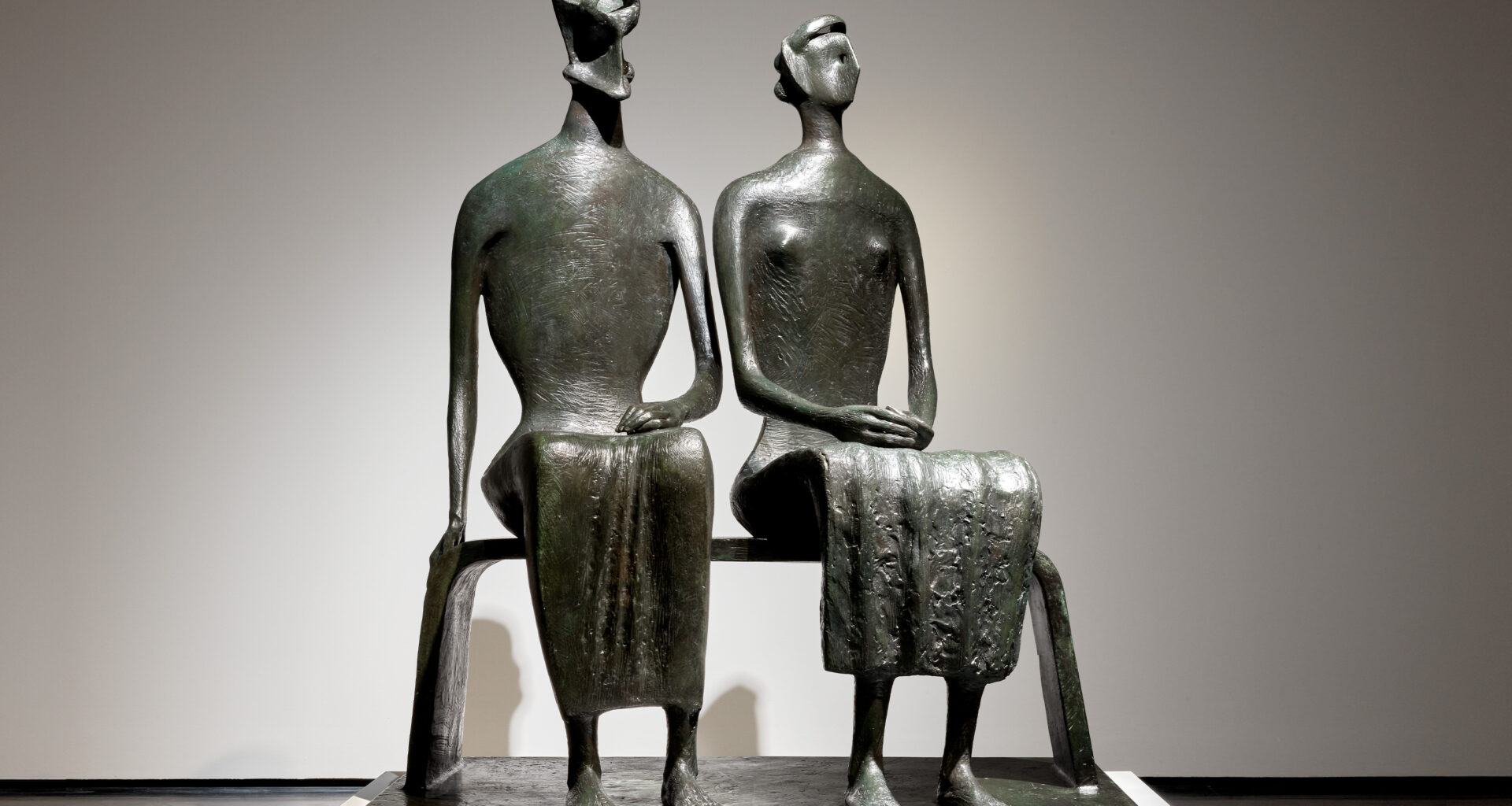
Born in 1898, the youngest of eight children, in the mining town of Castleford, West Yorkshire, Moore showed early artistic promise. Encouraged by his family, he set his sights on art school, but the First World War interrupted these ambitions. He served on the Western Front and was badly injured in a gas attack — an experience that would profoundly shape his later sculpture.
After the war, Moore received a serviceman’s grant to study at Leeds School of Art, and later at the Royal College of Art in London. He travelled to Paris, where he encountered Surrealism and saw works by Picasso and Hans Arp. At the British Museum, he discovered pre-Columbian art. It was the power of this ritualised sculpture — its forbidding, elemental presence — that set Moore on his unique path.
If Moore knew where he was going, others were less certain. His breakthrough came with The Helmet (1939-40). This harbinger of war — with its gleaming, armour-like exterior enclosing a figure that seems to shelter within — pushed his work towards a more psychologically charged abstraction. His experiences on the front line held him in a kind of savage chokehold, and they filtered out in the angularity of his sculpture.
Moore’s enduring subject, however abbreviated or distorted, was the human body. He possessed an uncanny ability to transform wood, stone and bronze into flesh and bone. He attributed this to his belief in ‘truth to materials’, working with rather than against their organic qualities, incorporating flaws, veins and discolourations into the carving, much as prehistoric artists had done in the cave paintings at Lascaux some 20,000 years earlier.