
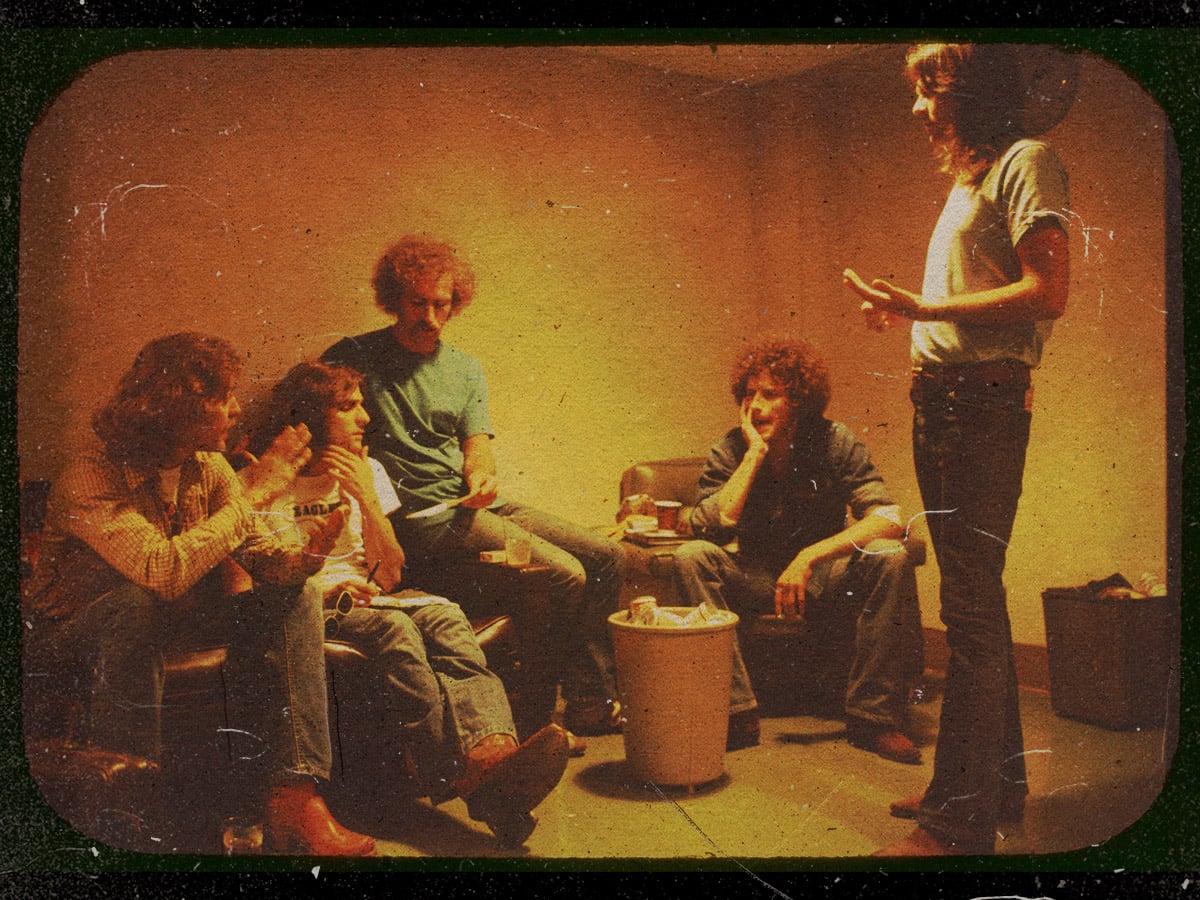
(Credits: Far Out / Showtime / The Eagles)
Sun 22 February 2026 19:43, UK
In the ten best-selling albums of all time list, you’ll find the Eagles pop up twice.
And yet, in the UK, the band struggled their way to a mere five top 40 singles, with the highest charting reaching a disappointing eighth. This marks them out as one of those few rarities that fail to translate from one side of the pond to the other, highlighting the fact that there is simply something quintessentially American about the kings of smooth rock.
Their harmonies feel sun-bleached, their narratives stitched together with motel signs and desert skylines. Even when the sentiment turns inward, there is a widescreen quality to the Eagles’ music that seems inseparable from the geography that birthed it. It is less about spectacle than about space, the suggestion that somewhere beyond the next bend lies reinvention.
For Don Henley, this is typified by one track that signposts a specific element of the American dream. When reflecting on the band’s track ‘Take it Easy’, he told Rolling Stone: “The song’s primary appeal, I think, is that it evokes a sense of motion, both musically and lyrically. The romance of the open road. The lure of adventure and possibility – Route 66, the Blue Ridge Parkway, Pacific Coast Highway.”
“Great American writers from Thomas Wolfe to Jack Kerouac to Wallace Stegner have addressed this theme of the restlessness of the American spirit,” he said, reflecting on seminal works seizing upon the opportunities of the continent’s great open spaces like On the Road. He continued to say that the track was reflective “of our need to keep moving, especially from east to west, in search of freedom, identity, fortune and this illusive thing we call ‘home.’”
The UK doesn’t really have that for one distinct reason: it is simply too wee. When the Eagles sing of getting behind the wheel and burning through lonely miles towards brighter horizons, or Kerouac waxes lyrical about wayfaring hard yards towards a spiritual utopia, you can believe it and pump your fist in recognition. But what’s the UK equivalent? Daring to drive 71mph in a second-hand three-door Corsa for two hours before you get to a service station in Leeds, eat an overpriced burger, and realise you’ve made a huge mistake, with the safety net of home and welfare rendering the whole thing far less dramatic?
But in the US, there was a dreaminess to their message, a sense of history and horizons converging. It was a song that shaped the future of the Eagles just as they were getting going. Glenn Frey described it as “America’s first image of our band with the vistas of the Southwest and the beginnings of what became country-rock” intact from the start.
It is also a driving song, a tenet that fittingly defines a lot of American music. As Thomas Wolfe wrote, outlining the highway of the American dream and the potholes that can render it a nightmare: “Perhaps this is our strange and haunting paradox here in America – that we are fixed and certain only when we are in movement. At any rate, that is how it seemed to young George Webber, who was never so assured of his purpose as when he was going somewhere on a train. And he never had the sense of home so much as when he felt that he was going there. It was only when he got there that his homelessness began.”
This is what the Eagles were hoping to capture with the epic ballad of ‘Take it Easy’.
In doing so, they distilled a feeling that stretches far beyond a single song. ‘Take it Easy’ does not merely describe the open road, it mythologises it, presenting movement as both escape and affirmation. For listeners raised on vast skies and endless highways, that promise resonates instinctively, even if it proves harder to export.