
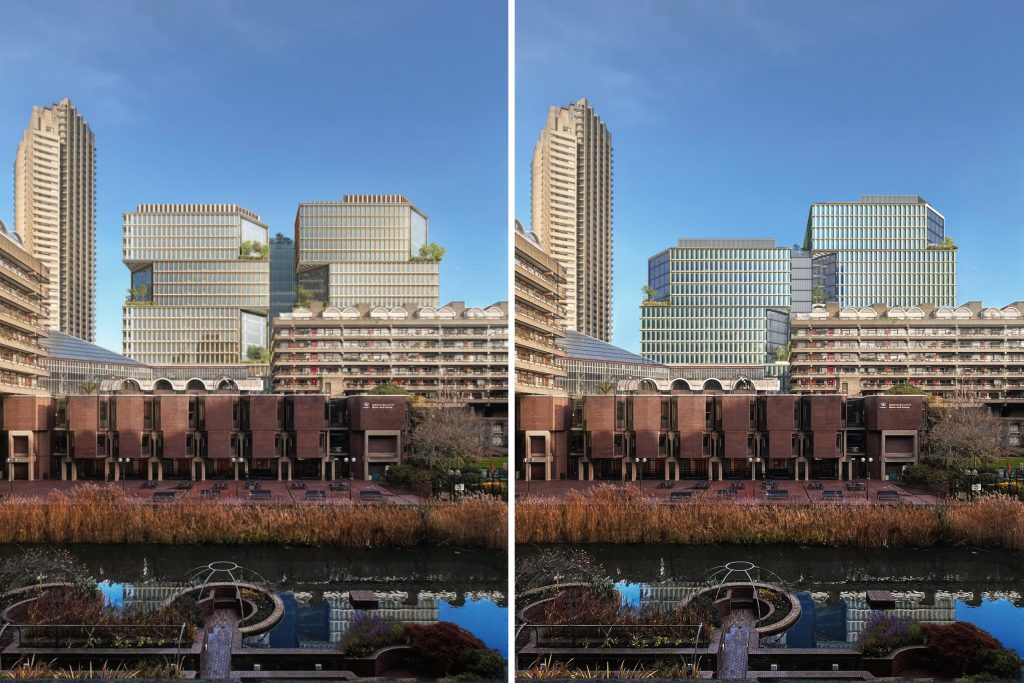
The scheme, for developer Lipton Rodgers and investor La Salle, was originally submitted late last year, with plans for a 20-storey building on a 0.57ha plot at 1 Silk Street, in the City of London opposite the Barbican’s Silk Street entrance.
The proposal prompted a backlash from local residents and it seems the team has responded to the concerns in recently resubmitted plans which have cut three storeys from the proposed office building’s west side. The development is now 17 storeys high, according to planning documents.
Other changes include updates to the appearance and materials on the façade, which has turned green, and the realignment of the western part of the site to create 2,282m2 of enhanced public space in front of the Barbican Centre’s main entrance.
SOM and Lipton Rodgers say the proposals have ‘significantly reduced daylight impacts to neighbouring homes’. Meanwhile, the team is promising more privacy for residents next door following the removal of overlooking terraces.
Subject to planning, the development would rise just three storeys higher than an existing building on the site, which is tipped for demolition, instead of six storeys higher. SOM has previously committed to reusing the existing foundations.
Chicago-based SOM’s designs are 10m shorter on the western part of the building, facing Cromwell Tower, which will ‘significantly reduce the building’s visual impact on the wider Barbican Estate and St Bride’s Church’, the development team says.
The height of the building on the eastern side of the site remains the same as the plans submitted late last year, while the overall scheme has lost around 5 per cent of planned office space due to changes to the proposed massing.
The scheme also still includes a public space opposite the Silk Street entrance to the Barbican Centre, which is due to undergo its own revamp under plans by Allies and Morrison and Asif Khan, unveiled last year.
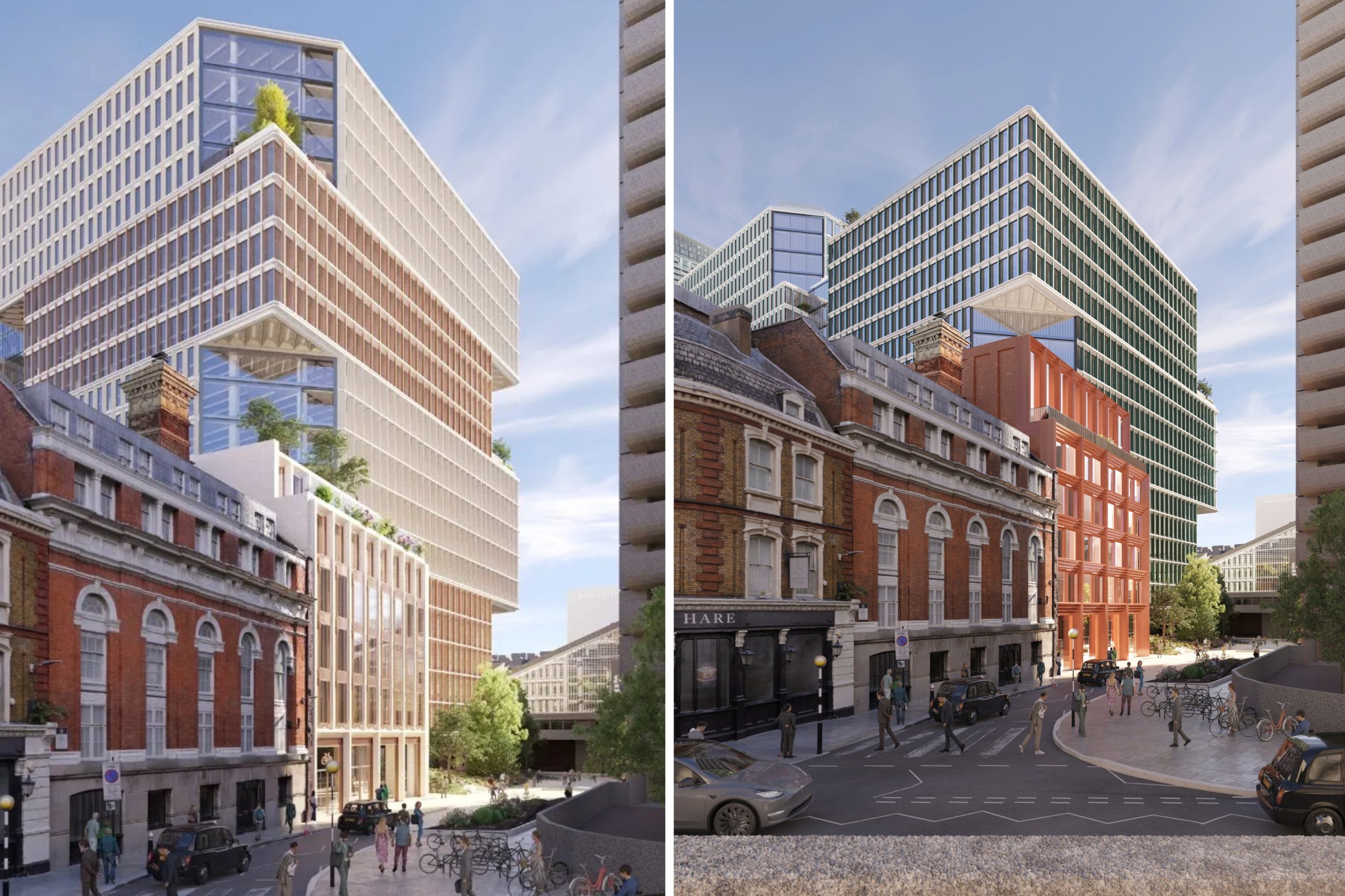
Comparison of submitted and revised schemes for SOM’s 1 Silk Street
When SOM first submitted plans for 1 Silk Street, Barbican Quarter Action, a group which is simultaneously opposing demolition of the Museum of London building, told the AJ last year that the 1 Silk Street development was ‘a devastating blow to the architectural and visual coherence of the iconic Grade II-listed Barbican.’
Following the changes, Lipton Rogers founding partner Stuart Lipton said of SOM’s redesigned scheme: ‘In listening carefully to feedback received, the revised scheme designed by SOM is more modest in scale, while more ambitious in public benefits. It opens itself to the community, enriches the cultural fabric of the Square Mile, and delivers clear improvements for Silk Street and its surroundings.’
Gary Moore, head of international accounts for Europe at LaSalle Investment Management, said: ‘The revised proposals for 1 Silk Street reflect our continued commitment to listening carefully to residents and investing in the City of London’s future
‘While the scheme has evolved in response to feedback, our ambition remains unchanged – to deliver a high-quality, future-focused commercial building that reinforces the City’s position as a globally competitive financial district, whilst strengthening culture and the public experience in the Square Mile.’
The existing 1 Silk Street building consists of two interlinked towers designed by Fitzroy Robinson Partnership – the 17-storey Milton House to the east and 13-storey Shire House to the west – both featuring heavily glazed façades. Sheppard Robson refurbished the buildings between 1994 and 1996.
A scoping opinion by environmental consultant Trium, submitted to the City of London Corporation late last year, described the building as ‘a utilitarian office building that does not represent the best work by either firm of well-known architects associated with its construction and refurbishment’.
The consultant explained: ‘Architecturally, the building is not distinguished, nor does it present an innovative approach to office design; rather, its current condition reflects the office requirements of the time of its refurbishment in the mid-1990s.
‘The existing building is not considered to have any architectural merit, and it detracts from the streetscape as a result of the inactive frontages and lack of permeability.’
SOM says redevelopment of the site will ensure the new 1 Silk Street meets Energy Performance Certificate (EPC) requirements for commercial buildings set to come into force in 2027, which would have made the current structure unlettable. It will be stripped down to its 1982 foundations, which will be retained.
Subject to approval, completion is scheduled for 2032.
Current site view