
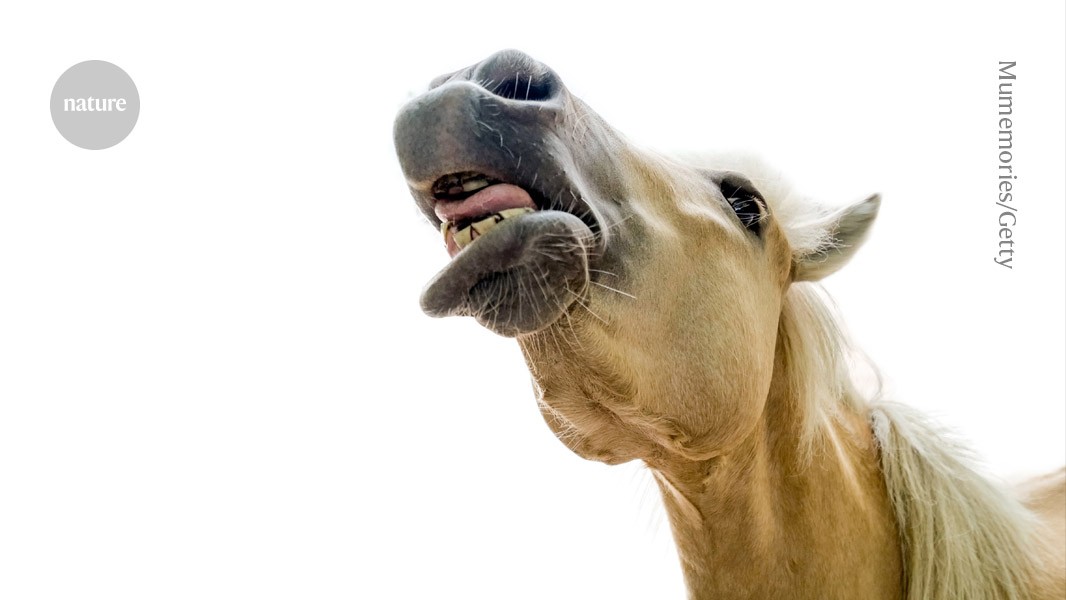
Whinnies seem to play a part in horses’ social interactions. Credit: Mumemories/Getty
The horse whinny, or neigh, has been a familiar sound at least since the animal was domesticated, around 4,200 years ago. But until now, scientists didn’t understand how horses produced this characteristic vocalization.
Fresh research shows that horses (Equus ferus caballus) whinny by making two distinct sounds at once: a low-frequency ‘nickering’ sound made in their vocal folds and a high-pitched whistle produced by forcing air through the cartilage of their larynx. The biomechanics of this dual-frequency sound, or biphonation, were described in a paper published on 23 February in Current Biology1. The authors theorize that this multilayered vocalization enables the animals to convey complex messages to each other.
Horses’ ability to whistle while vocalizing earns them membership into a small club of animals — including several bird species, human beatboxers, throat singers and people who can sing while whistling — that can make biphonic sounds.
Two-toned neighs
Of all the noises horses make — grunts, squeals, snorts and more — the whinny is the most common, and the longest in duration. Being social animals, horses whinny to greet other horses, to keep in contact with each other across long distances, and in fear or stress — in the wild, it can be dangerous for them to get separated from the herd. “Each horse has a different whinny,” says Elodie Briefer, a behavioural ecologist who studies animal communication at the University of Copenhagen.
About ten years ago, Briefer and her colleagues published evidence2 that the horse whinny is made up of two distinct frequencies: a high whistling sound at more than 1,000 hertz and a lower-pitched noise at about 200 hertz. Their work also showed how variations in both frequencies correspond to positive or negative emotions, as well as the intensity of those emotions. But, Briefer says, it took years to work out how horses produce these complex sounds.
Her team started by imaging horses’ larynxes using endoscopy, a camera-technique which veterinarians often use to diagnose breathing problems in the animals. The researchers recorded footage from the throats of ten stallions, including when they were introduced to mares. In these videos, Briefer says, they could see that the animals’ vocal folds vibrated, as would be expected, but also that the cartilage above the stallions’ vocal folds contracted.
Next, they obtained horse larynxes from butchers in France, where the animals are used for food, and mimicked the whinny ex vivo with the help of Tecumseh Fitch , who is a bioacoustics specialist at the University of Vienna.
The experiments showed that the high-frequency component of the call is an acoustic whistle, a noise caused not by vibrating tissue, but by vibrations of air moving through a tube. (High-pitched noises made by some other mammals, including dolphins, are colloquially called whistles, but are technically not true whistles.) The researchers discovered this by using helium. Because the speed of sound varies depending on the type of gas it passes through, changing the composition of air blown through a larynx will change the pitch of a whistle. When the researchers added helium to the air, the frequency of the higher pitch increased, but the low pitch stayed the same. This proves that the high-frequency sound is a whistle, whereas the low one is caused by vibration of the vocal folds, the researchers concluded.
Rare talent