
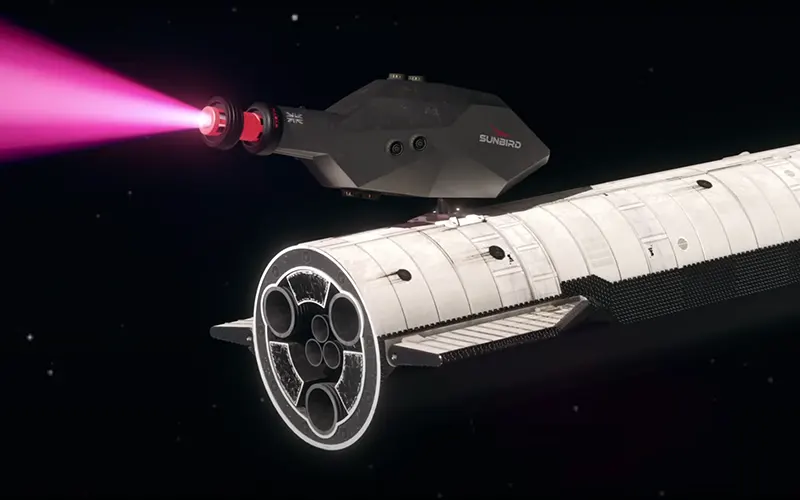
 Credit: Pulsar Fusion
UK-based in-orbit propulsion systems provider Pulsar Fusion has announced that the UK Atomic Energy Authority will assist the company with the development of neutron shielding and activation modelling for its Sunbird Migratory Transfer Vehicle.
In March 2025, Pulsar Fusion unveiled its Sunbird Migratory Transfer Vehicle, which it claimed had been developed “in complete secrecy over the past decade.” The vehicle is intended to serve as a reusable space tug, transporting satellites and probes into deep space in a fraction of the time required by spacecraft using conventional propulsion systems. According to the company, it could cut mission times to Mars by half and enable missions to Pluto in just four years.
Sunbird will be powered by the company’s Dual Direct Fusion Drive (DDFD), which uses nuclear fusion to produce ultra-hot plasma that can be directed to generate thrust. In addition to propulsion, the DDFD also generates electricity to power the spacecraft’s systems.
On 24 February, the Bletchley-headquartered company announced that the UK Atomic Energy Authority (UKAEA) would support the development of its Sunbird programme, aiding in the development of neutron shielding and activation modelling. According to Pulsar Fusion, the work will include “high-level modelling and analysis to inform shielding approaches and materials considerations for future fusion-powered spacecraft architectures.”
“This is an important step forward for Sunbird,” said Pulsar Fusion CEO Richard Dinan. “UKAEA’s support strengthens the technical groundwork behind our fusion propulsion roadmap and reflects the growing momentum behind the UK’s role in building the future fusion economy, not only on Earth, but in space.”
When Pulsar Fusion initially announced its Sunbird vehicle, the company expected to complete a static fire test in 2025 and conduct the first in-orbit demonstration as early as 2027. However, the company has not given any indication that the static fire test was conducted in 2025, making the 2027 deadline for an in-orbit demonstration unlikely.
Keep European Spaceflight Independent
Your donation will help European Spaceflight to continue digging into the stories others miss. Every euro keeps our reporting alive.